
Practice: ticket #9
Answers are checked instantly. The hint — a rules excerpt — is under the question.
-
Question #1 Is it necessary, in accordance with the requirements of the Traffic Rules, to coordinate the placement of advertising media with the State Traffic Inspectorate?
Topic: Individual traffic rules issues requiring coordination with the State Automobile Inspection
Answer help
32.1. The following are agreed with the State Automobile Inspectorate bodies:
a) placement in the right-of-way of highways or red lines of city streets and roads and their artificial structures of kiosks, pavilions, advertising media, mobile -
Question #2 When at tram stops not equipped with boarding platforms, are pedestrians allowed to enter the roadway to board a tram?
Topic: Duties and rights of pedestrians
Answer help
4.12. At tram stops not equipped with boarding platforms, pedestrians are allowed to enter the carriageway only from the side of the doors and only after the tram has stopped.
After getting off the tram, it is necessary to leave the carriageway without delay. -
Question #3 Is it allowed to tow a passenger car on a section of road in front of which this road sign is installed?
Topic: Road signs (Appendix 1)
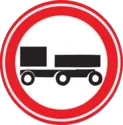
Answer help
3.4. "Junction of a secondary road." Sign 1.23.1 — junction from the right side, 1.23.2 — from the left, 1.23.3 — from the right and left, 1.23.4 — from the left and right side. -
Question #4 Which road sign obliges to give way to vehicles moving on the intersecting road?
Topic: Road signs (Appendix 1)
Answer help
2.1. "Give way." The driver must give way to vehicles approaching an uncontrolled intersection on the main road, and if plate 7.8 is present — to vehicles moving on the main road. -
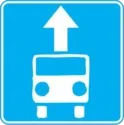
Question #5 Is it allowed for a bus driver to drive along the lane indicated by this road sign if this lane is separated by a solid yellow line of road markings?
Topic: Road markings (Appendix 2)
Answer help
5.11. "Lane for route vehicles." The lane is intended only for vehicles moving on established routes in the same direction as the general flow of vehicles.
The effect of the sign extends to the traffic lane above which it is installed. The effect of the sign installed to the right of the road extends to the right traffic lane.
17.1. and 5.17.2. "Direction of movement along lanes." -
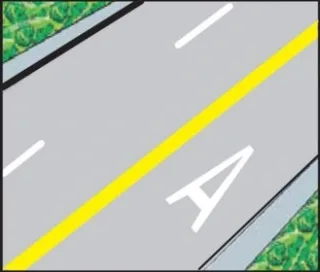
Question #6 Which vehicles are allowed to drive along the lane indicated by road marking 'A'?
Topic: Road markings (Appendix 2)
Answer help
1.23. — marks a lane intended for movement only of route vehicles.
route vehicles (public transport vehicles) — buses, minibuses, trolleybuses, trams and taxis moving on established routes and having certain places on the road for boarding (alighting) passengers; -
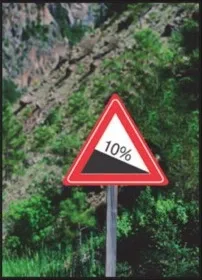
Question #7 A truck driver, whose permissible maximum mass exceeds 3.5 tons, approaches a section of road in front of which this road sign is installed. Must the driver on this descent use special mountain brakes if they are
Topic: Road signs (Appendix 1)
Answer help
1.7. "Steep descent." Signs 1.6 and 1.7 warn of approaching an ascent or descent on which the requirements of section 28 of these Rules apply. -
Question #8 According to the State Standard of Ukraine, round signs on a blue background:
Topic: Road signs (Appendix 1)
Answer help
8.4. Road signs (annex 1) are divided into groups:
d) mandatory signs. Show mandatory directions of movement or permit some categories of participants to move on the carriageway or its individual sections, and -
Question #9 How should a towed mechanical vehicle be marked in case of a malfunction of the emergency light signaling?
Topic: Warning signals
Answer help
9.11. If a vehicle is not equipped with a hazard warning system or it is faulty, it is necessary to install a warning triangle or a flashing red lantern:
a) behind the vehicle specified in point 9.9 ("c", "d", "e") of these Rules;
19.4. During a stop on the road in the dark and in conditions of insufficient visibility, the vehicle must have its parking lights or side lights on, and in case of a forced stop, additionally the hazard warning system. In conditions of insufficient visibility, it is permitted to additionally turn on low beam or fog lights and rear fog lights. If the side lights are faulty, the vehicle should be removed beyond the road, and if this is impossible, it must be marked in accordance with the requirements of points
9.10 and 9.11 of these Rules. -
Question #10 In which places is reversing prohibited?
Topic: Starting movement and changing its direction
Answer help
10.10. Reversing is prohibited on motorways, roads for cars, railway crossings, pedestrian crossings, intersections, bridges, overpasses, elevated roads, in tunnels, at their entrances and exits, as well as on road sections with limited visibility or insufficient visibility. Reversing is allowed on roads with one-way traffic, provided that the requirements of point 10.9 of these Rules are met and it is impossible to approach the object in any other way. -
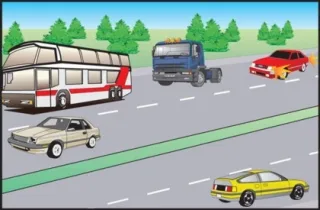
Question #11 On roads with two or more lanes for traffic in one direction, leaving the right lanes:
Topic: Position of vehicles on the road
Answer help
11.5. On roads with two or more lanes for traffic in one direction, entering the far left lane for traffic in the same direction is allowed if the right lanes are occupied, as well as for turning left, making a U-turn, or for stopping or parking on the left side of a road with one-way traffic in populated areas, if this does not contradict the stopping (parking) rules.
14.6. Overtaking is prohibited:
e) on roads with two or more lanes for traffic in one direction; -
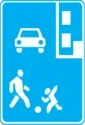
Question #12 What is the maximum speed allowed for passenger cars in the zone indicated by this road sign?
Topic: Speed of movement
Answer help
12.5. In residential and pedestrian zones, the speed of movement must not exceed 20 km/h. -
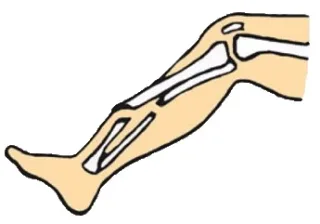
Question #13 As a result of a traffic accident, a motorcyclist has a visible wound on the right shin, from which a bone fragment protrudes. What is the first aid?
Topic: Fundamentals of providing medical assistance in case of a traffic accident
-
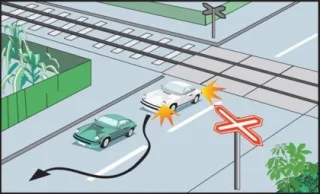
Question #14 Is overtaking allowed in this situation?
Topic: Overtaking
Answer help
14.6. Overtaking is prohibited:
b) at railway crossings and closer than 100 m before them; -
Question #15 Is it allowed for a truck driver to stop in this place?
Topic: Stopping and parking
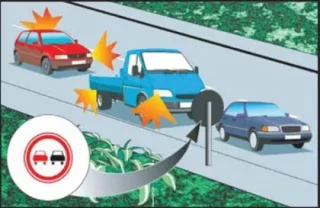
Answer help
15.9. Stopping is prohibited:
h) in places where the vehicle blocks traffic light signals or road signs from other drivers; -
Question #16 The cars will pass the intersection in the following order:
Topic: Passing intersections
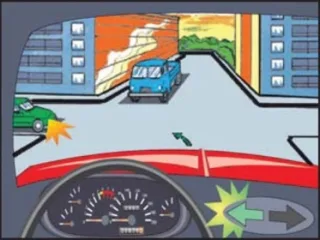
Answer help
16.12. At an intersection of equivalent roads, the driver of a non-rail vehicle must give way to vehicles approaching from the right. Tram drivers must also be guided by this rule among themselves. At any uncontrolled intersection, a tram, regardless of the direction of its further movement, has priority over non-rail vehicles approaching it on an equivalent road.
16.13. Before turning left and making a U-turn, the driver of a non-rail vehicle must give way to a tram traveling in the same direction, as well as to vehicles moving on an equivalent road in the opposite direction straight or to the right. Tram drivers must also be guided by this rule among themselves. -
Question #17 What information is contained in this road sign?
Topic: Road signs (Appendix 1)
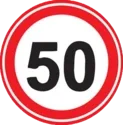
Answer help
3.29. "Maximum speed limit". It is prohibited to drive at a speed exceeding that indicated on the sign. -
Question #18 Is it allowed to overtake a vehicle that has begun to slow down before the intersection?
Topic: Passing pedestrian crossings and stops of vehicles
Answer help
18.4. If a vehicle slows down or stops before an uncontrolled pedestrian crossing, drivers of other vehicles moving in adjacent lanes must slow down, and if necessary stop, and may continue (resume) movement only after making sure that there are no pedestrians on the pedestrian crossing for whom an obstacle or danger may be created.
14.6. Overtaking is prohibited:
a) at an intersection; -
Question #19 Which vehicle driver must yield the right of way?
Topic: Movement on mountain roads and steep descents
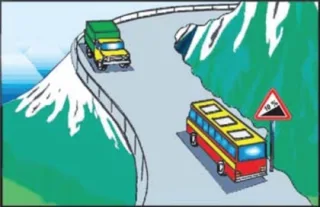
Answer help
28.1. On mountain roads and steep descents where passing oncoming traffic is difficult, the driver of a vehicle moving downhill must give way to vehicles moving uphill. -
Question #20 Which of the listed vehicle drivers is given priority in traffic?
Topic: Passing intersections
Answer help
16.12. At an intersection of equivalent roads, the driver of a non-rail vehicle must give way to vehicles approaching from the right. Tram drivers must also be guided by this rule among themselves. At any uncontrolled intersection, a tram, regardless of the direction of its further movement, has priority over non-rail vehicles approaching it on an equivalent road.