
Practice: ticket #89
Answers are checked instantly. The hint — a rules excerpt — is under the question.
-
Question #1 Is it necessary, in accordance with the requirements of the traffic rules, to coordinate with the State Traffic Inspectorate the placement of an advertising medium if it is placed on an artificial structure?
Topic: Individual traffic rules issues requiring coordination with the State Automobile Inspection
Answer help
32.1. The following are agreed with the State Automobile Inspection bodies:
a) placement in the right-of-way of highways or red lines of city streets and roads and their artificial structures of kiosks, pavilions, advertising media, mobile -
Question #2 Is it allowed to stand in the body of a truck while moving?
Topic: Duties and rights of passengers
Answer help
5.3. Passengers are prohibited from:
g) during movement, standing in the body of a truck, sitting on the sides or in a place not equipped for sitting. -
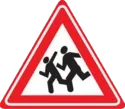
Question #3 What does this road sign warn about?
Topic: Road signs (Appendix 1)
Answer help
1.33. "Children". A section of road where the appearance of children from the territory of a children's institution (preschool institution, school, health camp, etc.) adjacent directly to the road is possible. -
Question #4 Which of these road signs prohibits the movement of tractors?
Topic: Road signs (Appendix 1)
Answer help
3.3. "Movement of trucks prohibited". The movement of trucks and vehicle combinations with a permissible maximum mass exceeding 3.5 t (if the mass is not indicated on the sign) or exceeding that indicated on the sign, as well as tractors, self-propelled machines and mechanisms is prohibited.
3.5. "Movement of tractors prohibited". The movement of tractors, self-propelled machines and mechanisms is prohibited. -
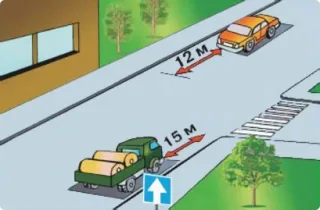
Question #5 Which driver correctly parked their vehicle on a road with one-way traffic?
Topic: Road signs (Appendix 1)
Answer help
5.5. "Road with one-way traffic". A road or separated carriageway on which the movement of vehicles across the entire width is carried out in only one direction.
15.3. In populated areas, stopping and parking of vehicles are allowed on the left side of the road having one lane for traffic in each direction (without tram tracks in the middle) and not divided by marking 1.1, as well as on the left side of a road with one-way traffic.
If the road has a boulevard or a dividing strip, stopping and parking of vehicles near them is prohibited.
15.9. Stopping is prohibited:
g) at intersections and closer than 10 m from the edge of the intersecting carriageway in the absence of a pedestrian crossing on them, except for stopping to give way in traffic -
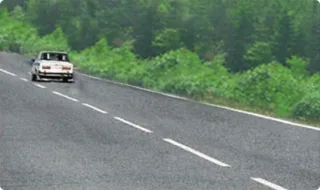
Question #6 This broken line, in which the length of the strokes is three times the gaps between them, indicates:
Topic: Road markings (Appendix 2)
Answer help
1.6. (approach line — a broken line in which the length of strokes is three times the gaps between them) — warns of approaching marking 1.1 or 1.11, separating traffic flows of opposite or same directions; -
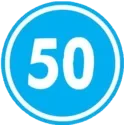
Question #7 Which vehicles are prohibited from moving along the section of road in front of which this road sign is installed?
Topic: Road signs (Appendix 1)
Answer help
4.16. "Minimum speed limit". Movement at a speed not less than indicated on the sign, but not greater than provided for by points 12.4—12.7 of these Rules. -
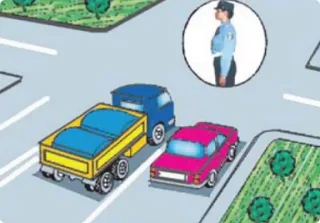
Question #8 Movement is allowed:
Topic: Traffic regulation
Answer help
8.8. Traffic controller signals. The signals of the traffic controller are the positions of his body, as well as hand gestures, including with a rod or a disc with a red reflector,
having the following meanings:
a) arms extended to the sides, lowered, or the right arm bent in front of the chest: from the left and right sides — tram movement straight is allowed, trackless vehicles — straight and -
Question #9 When should the hazard warning lights be turned on on a towed motor vehicle?
Topic: Warning signals
Answer help
9.9. Hazard warning lights must be turned on:
g) on a towed motor vehicle; -
Question #10 What is the acceleration lane for?
Topic: Starting movement and changing its direction
Answer help
10.8. If at the place of leaving the road there is a deceleration lane, the driver who intends to turn onto another road must change lanes to this lane in a timely manner and reduce speed only on it.
If at the place of entering the road there is an acceleration lane, the driver must drive along it and merge into the traffic flow, giving way to vehicles moving along this road. -
Question #11 In which of the listed cases should drivers drive non-rail vehicles as close as possible to the right edge of the roadway?
Topic: Position of vehicles on the road
Answer help
11.2. Trackless vehicles must move as close as possible to the right edge of the carriageway. -
Question #12 In which of the listed cases should the speed be reduced? Give a complete answer,
Topic: Speed of movement
Answer help
12.1. When choosing a safe speed within the established limits, the driver must take into account the road situation, as well as the characteristics of the cargo being transported and the condition of the vehicle, in order to be able to constantly control its movement and safely manage it. -
Question #13 How to apply a transport splint or an object replacing it in case of a fracture of the bones of the middle of the lower leg?
Topic: Fundamentals of providing medical assistance in case of a traffic accident
-
Question #14 This identification sign is placed:
Topic: Number plates, identification signs, inscriptions and markings

Answer help
30.3. The following identification signs are installed on the corresponding vehicles (appendix 4):
i) "Vehicle identification sign" — a special tape made of reflective film with alternating red and white stripes applied at an angle of 45 degrees. -
Question #15 In what way is it allowed to place vehicles at an angle to the edge of the roadway?
Topic: Stopping and parking
Answer help
15.5. Placing vehicles at an angle to the edge of the carriageway is allowed in places where this will not impede the movement of other vehicles.
Near sidewalks or other places with pedestrian traffic, placing vehicles at an angle is allowed only with the front part, and on inclines — only with the rear part. -
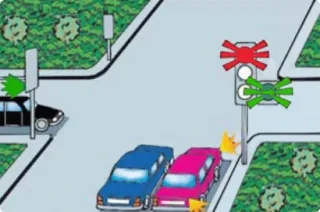
Question #16 The red car will pass the intersection:
Topic: Passing intersections
Answer help
16.8. A driver who has entered an intersection of carriageways according to a traffic light signal permitting movement must proceed in the intended direction regardless of the traffic light signals at the exit. However, if at intersections before the traffic lights on the driver's path there is road marking 1.12 (stop line) or road sign 5.62, he must be guided by the signals of each traffic light. -
Question #17 What can cause intense forward movement of passengers or unsecured cargo?
Topic: Organization and safety of traffic
-
Question #18 Under which of the listed conditions is the operation of vehicles prohibited? Give a complete answer.
Topic: Technical condition of vehicles and their equipment
Answer help
31.4.7. Other structural elements:
g) the door locks of the body or cab, the locks of the sides of the cargo platform, the locks of the necks of tanks and fuel tanks, the adjustment mechanism provided by the design do not work -
Question #19 On a section of road marked with the "Steep descent" sign, where passing in the opposite direction is difficult, it is necessary to give way to a vehicle moving uphill:
Topic: Movement on mountain roads and steep descents
Answer help
28.1. On mountain roads and steep descents where oncoming passing is difficult, the driver of a vehicle moving downhill must give way to vehicles moving uphill. -
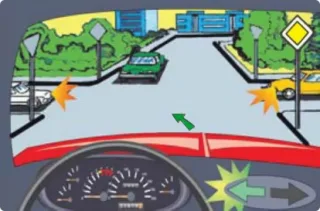
Question #20 The second to pass the intersection will be:
Topic: Passing intersections
Answer help
16.11. At an intersection of unequal roads, the driver of a vehicle moving on a secondary road must give way to vehicles approaching this intersection of carriageways on the main road, regardless of the direction of their further movement.
16.13. Before turning left and making a U-turn, the driver of a trackless vehicle is obliged to give way to a tram of the same direction, as well as to vehicles moving on an equal road in the opposite direction straight or to the right.
Tram drivers must also be guided by this rule among themselves.