
Practice: ticket #88
Answers are checked instantly. The hint — a rules excerpt — is under the question.
-
Question #1 Leaving by drivers, in violation of established rules, the place of a traffic accident to which they are involved, entails:
Topic: Fundamentals of law
-
Question #2 From which side should a passenger get out of a car if the car is stopped at the left edge of the road?
Topic: Duties and rights of passengers
Answer help
5.1. Passengers may board (alight) after the vehicle has stopped only from the boarding platform, and in the absence of such a platform — from the sidewalk or roadside, and if this is impossible, then from the extreme lane of the carriageway (but not from the side of the adjacent lane for movement), provided that this is safe and does not create obstacles for other road users. -
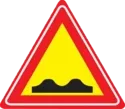
Question #3 What information is contained in this road sign?
Topic: Road signs (Appendix 1)
Answer help
1.10. "Rough road". A road section having irregularities of the carriageway — waviness, bulges, heaves. -
Question #4 Which road sign prohibits passage without a mandatory stop?
Topic: Road signs (Appendix 1)
Answer help
3.40. "Customs". It is prohibited to pass without stopping at customs. -
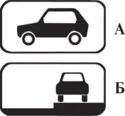
Question #5 Which of these plates extends the effect of the road sign 'Parking place' to passenger cars, as well as to trucks with a permissible maximum mass of up to 3.5 tons?
Topic: Road signs (Appendix 1)
Answer help
7.5.1.—7.5.8. "Type of vehicle". Indicate the type of vehicle to which the sign applies. Plate 7.5.1 extends the effect of the sign to trucks (including with trailer) with a permissible maximum mass over 3.5 t; 7.5.3 — to passenger cars, as well as trucks with a permissible maximum mass up to 3.5 t. 7.6.1.—7.6.5. "Method of placing the vehicle for parking". Indicate: 7.6.1 — all vehicles must be parked on the carriageway along the sidewalk, 7.6.2—7.6.5 — the method of placing passenger cars and motorcycles for parking near the sidewalk and using it. In populated areas where parking is allowed on the left side of the street, plates 7.6.1—7.6.5 with mirror images of symbols may be used. -
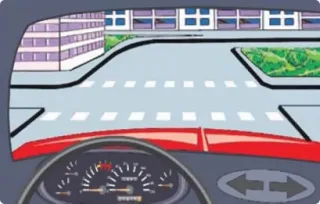
Question #6 What does this road marking mean?
Topic: Road signs (Appendix 1)
Answer help
1.15. — indicates the place where the bicycle path crosses the carriageway; -
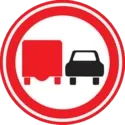
Question #7 Is it allowed for a tractor driver to overtake in the zone of action of this road sign?
Topic: Road signs (Appendix 1)
Answer help
3.27. "Overtaking prohibited for trucks". It is prohibited for trucks with a permissible maximum mass over 3.5 t to overtake all vehicles (except single ones moving at a speed of less than 30 km/h). Tractors are prohibited from overtaking all vehicles, except single bicycles, horse-drawn carts (sledges). -
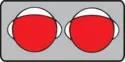
Question #8 This traffic light is used to regulate traffic:
Topic: Traffic regulation
Answer help
8.7.6. To regulate traffic at railway crossings, traffic lights with two red signals or one white-lunar and two red signals are used, having the following meanings: a) flashing red signals prohibit the movement of vehicles through the crossing; b) flashing white-lunar signal indicates that the signaling is working and does not prohibit the movement of vehicles. At railway crossings, simultaneously with the prohibiting traffic light signal, a sound signal may be turned on, additionally informing road users about the prohibition of movement through the crossing. -
Question #9 What must the driver do if he is transporting oversized or heavy cargo?
Topic: Warning signals
Answer help
9.8. During the movement of mechanical vehicles in daylight hours, in order to indicate the moving vehicle, the low beam headlights must be turned on: d) on heavy, large-sized vehicles and vehicles carrying out road transportation of dangerous goods; -
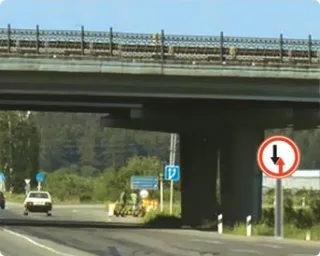
Question #10 In this place under the bridge, the driver is prohibited from:
Topic: Starting movement and changing its direction
Answer help
10.7. Turning around is prohibited: b) on bridges, overpasses, viaducts and under them; 15.9. Stopping is prohibited: c) on viaducts, bridges, overpasses and under them, as well as in tunnels; -
Question #11 When is it allowed for a vehicle whose speed does not exceed 40 km/h to enter the far left lane of the carriageway for movement in the same direction?
Topic: Position of vehicles on the road
Answer help
11.7. Vehicles whose speed should not exceed 40 km/h or which for technical reasons cannot develop such speed must move as close as possible to the right edge of the carriageway, except when overtaking, avoiding an obstacle, or changing lanes before turning left or making a U-turn. -
Question #12 Which vehicles are prohibited from moving outside populated areas at a speed of more than 70 km/h?
Topic: Speed of movement
Answer help
12.6. Outside populated areas on all roads and on roads passing through populated areas marked with sign 5.47, movement is allowed at a speed of: b) vehicles driven by drivers with up to 2 years of experience — no more than 70 km/h; -
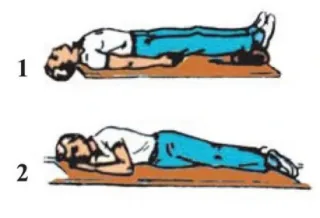
Question #13 Which figure shows the position of the injured person in which it is recommended to transport them with significant blood loss?
Topic: Fundamentals of providing medical assistance in case of a traffic accident
-
Question #14 In which cases do the traffic rules allow overtaking at an intersection?
Topic: Overtaking
Answer help
14.6. Overtaking is prohibited: a) at an intersection; -
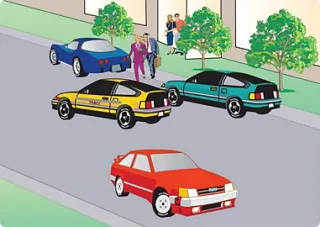
Question #15 Are stopping and parking allowed on the roadway in the second row near an already standing car?
Topic: Stopping and parking
Answer help
15.4. Vehicles are not allowed to be placed on the carriageway in two or more rows. Bicycles, mopeds and motorcycles without a side trailer are allowed to be placed on the carriageway in no more than two rows. -
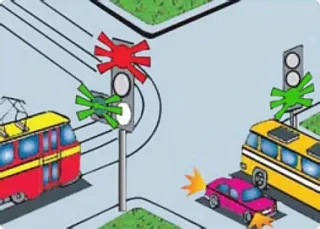
Question #16 The tram driver:
Topic: Passing intersections
Answer help
16.9. When moving in the direction of the arrow included in the additional section simultaneously with the yellow or red traffic light signal, the driver must yield the road to vehicles moving from other directions. When moving in the direction of the green arrow on a plate installed at the level of the red traffic light signal with vertical arrangement of signals, the driver must take the extreme right (left) lane of movement and yield the road to vehicles and pedestrians moving from other directions. -
Question #17 What is the danger of prolonged braking of a car with the gear disengaged on steep long descents?
Topic: Organization and safety of traffic
-
Question #18 Under which of the listed conditions is the operation of vehicles not prohibited?
Topic: Technical condition of vehicles and their equipment
Answer help
31.4.2. Steering: a) the total play in the steering exceeds the following limit values: -
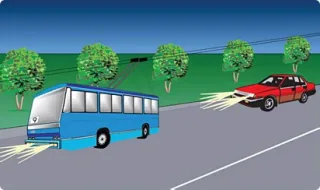
Question #19 At what minimum distance from a vehicle moving ahead in the same direction should the high beam be switched to low beam in the dark?
Topic: Use of external lighting devices
Answer help
19.2. High beam should be switched to low beam at least 250 m before an oncoming vehicle, as well as when it can blind other drivers, in particular those moving in the same direction. The light must be switched at a greater distance if the driver of the oncoming vehicle indicates the need for this by periodically switching the headlights. -
Question #20 The signal prohibiting movement through a railway crossing is the position of the attendant facing the driver:
Topic: Movement through railway crossings
Answer help
20.5. Movement through the crossing is prohibited if:
a) the crossing attendant gives a prohibition signal — stands facing the driver with chest or back with a rod raised above the head (red lantern or flag) or with arms extended to the