
Practice: ticket #87
Answers are checked instantly. The hint — a rules excerpt — is under the question.
-
Question #1 Which of the listed issues, in accordance with the requirements of the Road Traffic Rules, are subject to coordination with the State Automobile Inspection?
Topic: Individual traffic rules issues requiring coordination with the State Automobile Inspection
Answer help
32.1. The following are agreed with the State Automobile Inspection bodies:
d) the procedure for towing two or more vehicles;
e) technical requirements, design and installation on vehicles of special sound and light signaling devices (such as "Siren", flashing beacon, etc.), light
ye) conversion of vehicles. -
Question #2 Is it allowed for pedestrians to linger and stop on the carriageway?
Topic: Duties and rights of pedestrians
Answer help
4.14. Pedestrians are prohibited from:
ґ) lingering and stopping on the carriageway, if this is not related to ensuring road safety; -
Question #3 This road sign prohibits movement:
Topic: Road signs (Appendix 1)
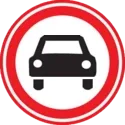
Answer help
3.2. "Several turns". A road section with two or more dangerous turns located one after another: 1.3.1 — with the first turn to the right, 1.3.2 — with the first turn to the left.
The effect of the signs does not apply:
3.1, 3.2, 3.21—3.24, 3.34 — to vehicles moving along established routes;
3.1, 3.2, 3.35—3.38, as well as sign 3.34 with plate 7.18 under it — to disabled drivers driving a motorized wheelchair or a car marked with the identification sign
"Disabled";
3.1—3.8, 3.11 — to vehicles serving citizens or belonging to citizens who live or work in this zone, as well as to vehicles serving enterprises located in the marked zone. In such cases, vehicles must enter the marked zone and leave it at the nearest intersection to the destination;
3.3 — to trucks that have an inclined white stripe on the outer side surface or carry groups of people;
3.35—3.38 — to taxis with the taximeter turned on. -
Question #4 Which road sign indicates a section of road with one-way traffic?
Topic: Road signs (Appendix 1)
Answer help
5.5. "Road with one-way traffic". A road or separated carriageway along which vehicle movement across the entire width is carried out in only one direction. -
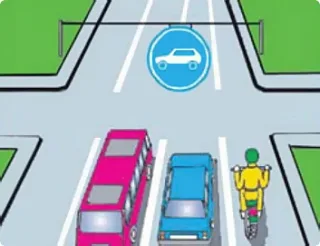
Question #5 Transit movement straight ahead is allowed:
Topic: Road signs (Appendix 1)
Answer help
4.11. "Movement of passenger cars". Only passenger cars, buses, motorcycles, route vehicles and trucks whose permissible maximum mass does not exceed 3.5 t are allowed to move.
The effect of sign 4.11 does not apply to vehicles serving citizens or belonging to citizens who live or work in the marked zone, as well as to vehicles serving enterprises located in this zone. In such cases, vehicles must enter the marked zone and leave it at the nearest intersection to the destination. -
Question #6 For how long can you stop at a yellow intermittent line of horizontal road marking?
Topic: Road markings (Appendix 2)

Answer help
1.10. — indicates places where parking is prohibited. It is used independently or in combination with sign 3.35 and is applied at the edge of the carriageway or on top of the curb; -
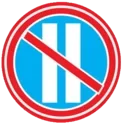
Question #7 What information is contained in this road sign?
Topic: Road signs (Appendix 1)
Answer help
3.37. "Parking prohibited on even days of the month". -
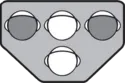
Question #8 This traffic light is used to regulate traffic:
Topic: Traffic regulation
Answer help
8.7.5. To regulate the movement of trams, traffic lights with four white-lunar signals arranged in the shape of the letter "T" may be used.
Movement is allowed only when the lower signal and one or more upper signals are turned on simultaneously, of which the left one allows movement to the left, the middle one — straight, the right one — to the right. If only the three upper signals are turned on — movement is prohibited.
In the event of tram traffic lights being turned off or malfunctioning, tram drivers must be guided by the requirements of traffic lights with red, yellow and green light signals. -
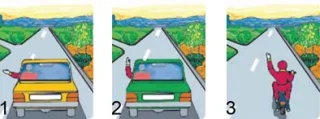
Question #9 In which figure does the driver give a warning signal of a left turn?
Topic: Warning signals
Answer help
9.3. In the absence or malfunction of turn indicators, signals for starting movement from the right edge of the carriageway, stopping on the left, turning left, making a U-turn or changing lanes to the left lane are given by the left hand extended to the side, or the right hand extended to the side and bent at the elbow at a right angle upward.
Signals for starting movement from the left edge of the carriageway, stopping on the right, turning right, changing lanes to the right lane are given by the right hand extended to the side, or the left hand extended to the side and bent at the elbow at a right angle upward.
In the absence or malfunction of brake signals, such a signal is given by the left or right hand raised up. -
Question #10 In an unfamiliar city, while crossing an intersection straight ahead in the second lane, the driver suddenly realized that he should have turned right here. How should he proceed?
Topic: Starting movement and changing its direction
Answer help
10.3. When changing lanes, the driver must give way to vehicles moving in the same direction on the lane he intends to enter.
During simultaneous lane changes of vehicles moving in the same direction, the driver who is on the left must give way to the vehicle on the right.
10.4. Before turning right, left or making a U-turn, the driver must take in advance the appropriate extreme position on the carriageway intended for movement in this direction, except when turning when entering an intersection where circular traffic is organized, the direction of movement is determined by road signs or road markings, or movement is possible only in one direction established by the configuration of the carriageway, road signs or markings.
The driver making a left turn or U-turn outside an intersection from the corresponding extreme position on the carriageway of this direction must give way to oncoming vehicles, and when performing these maneuvers not from the extreme left position on the carriageway — also to vehicles traveling in the same direction.
If there is a tram track in the middle of the carriageway, the driver of a non-rail vehicle making a left turn or U-turn outside an intersection must give way to the tram. -
Question #11 In which of the listed cases is it allowed to enter the oncoming lane on a two-way road with one lane for each direction?
Topic: Position of vehicles on the road
Answer help
11.3. On roads with two-way traffic having one lane for movement in each direction, in the absence of a solid road marking line or corresponding road signs, driving onto the lane of oncoming traffic is allowed only for overtaking and avoiding an obstacle, or for stopping or parking at the left edge of the carriageway in populated areas in permitted cases, while drivers of oncoming direction have the right of way. -
Question #12 What is the maximum speed allowed for a passenger car in the dark outside a populated area?
Topic: Speed of movement
Answer help
12.2. At night and in conditions of insufficient visibility, the speed of movement must be such that the driver has the ability to stop the vehicle within the visibility range of the road. -
Question #13 What should the driver of a vehicle do if he is driving on a two-way road and there is an obstacle in his lane?
Topic: Distance, interval, oncoming passing
Answer help
13.4. If oncoming passing is difficult, the driver on whose lane there is an obstacle or whose vehicle's dimensions interfere with oncoming traffic must yield the road. On road sections marked with signs 1.6 "Steep ascent" and 1.7 "Steep descent", in the presence of an obstacle, the driver of the vehicle moving downhill must yield the road. -
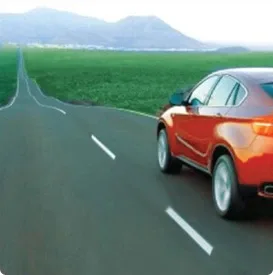
Question #14 The driver of the vehicle being overtaken:
Topic: Overtaking
Answer help
14.3. The driver of the overtaken vehicle is prohibited from preventing overtaking by increasing speed or by other actions. -
Question #15 If the road has a boulevard or a dividing strip, then stopping and parking of vehicles near them:
Topic: Stopping and parking
Answer help
15.3. In populated areas, stopping and parking of vehicles are allowed on the left side of the road that has one lane for movement in each direction (without tram tracks in the middle) and is not divided by marking 1.1, as well as on the left side of a road with one-way traffic. If the road has a boulevard or a dividing strip, stopping and parking of vehicles near them is prohibited. -
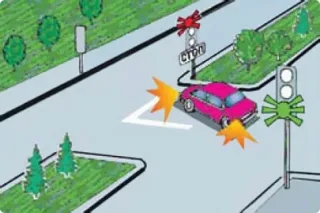
Question #16 Must the driver of a car stop before the 'stop line'?
Topic: Passing intersections
Answer help
16.8. A driver who has entered an intersection of carriageways according to a traffic light signal permitting movement must proceed in the intended direction regardless of the traffic light signals at the exit. However, if at intersections before the traffic lights on the driver's path there is road marking 1.12 (stop line) or road sign 5.62, he must be guided by the signals of each traffic light. -
Question #17 Does the trailer of a road train shift when moving on a turn?
Topic: Organization and safety of traffic
-
Question #18 Is it allowed to proceed to a parking or repair place with a damaged coupling device of a road train?
Topic: Technical condition of vehicles and their equipment
Answer help
31.6. Further movement of vehicles is prohibited if: a) the service brake system or steering does not allow the driver to stop the vehicle or perform a maneuver while moving at minimum speed; b) at night or in conditions of insufficient visibility, the lamps of headlights or rear side lights are not lit; c) during rain or snowfall, the windshield wiper on the side of the steering wheel does not work; d) the towing coupling device of the road train is damaged. -
Question #19 Is it allowed to drive a passenger car with only parking lights on in the dark?
Topic: Use of external lighting devices
Answer help
19.1. At night and in conditions of insufficient visibility, regardless of the degree of road illumination, as well as in tunnels, the following lighting devices must be turned on on a moving vehicle: a) on all mechanical vehicles — low beam (high beam) headlights; b) on mopeds (bicycles) and horse-drawn carts (sledges) — headlights or lanterns; c) on trailers and towed vehicles — side lights. Note. In conditions of insufficient visibility, on mechanical vehicles it is allowed to turn on fog lights instead of low beam (high beam) headlights. -
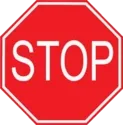
Question #20 Approaching a railway crossing, in front of which this road sign is installed, the driver of a non-rail vehicle must:
Topic: Movement through railway crossings
Answer help
20.2. Approaching the crossing, as well as starting to move after stopping before it, the driver must be guided by the instructions and signals of the crossing attendant, the position of the barrier, light and sound signaling, road signs and road markings, and also make sure that no train (locomotive, railcar) is approaching. 2.2. "No stopping without stopping". It is prohibited to pass without stopping before marking 1.12 (stop line), and if it is absent — before the sign.