
Practice: ticket #86
Answers are checked instantly. The hint — a rules excerpt — is under the question.
-
Question #1 Administrative detention of a person who has committed an administrative offense may last no more than:
Topic: Fundamentals of law
-
Question #2 What should the driver of the red car do when a vehicle with special sound and light signals approaches?
Topic: Movement of vehicles with special signals
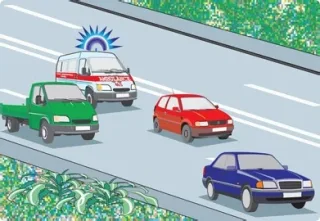
Answer help
3.2. In the event of approaching a vehicle with a blue flashing beacon and (or) a special sound signal, drivers of other vehicles that may create an obstacle to its movement must give way to it and ensure unhindered passage of the specified vehicle (and vehicles accompanied by it).
On vehicles moving in an accompanied column, the low beam headlights must be switched on.
If on such a vehicle flashing beacons of blue and red or only red color are switched on, drivers of other vehicles must stop at the right edge of the carriageway (on the right roadside). On a road with a dividing strip, this requirement must be fulfilled by drivers of vehicles moving in the same direction. -
Question #3 A driver is approaching a section of road before which this road sign, covered with snow, is installed. What is this sign?
Topic: Road signs (Appendix 1)

Answer help
2.2. "Passing without stopping prohibited". It is prohibited to pass without stopping before marking 1.12 (stop line), and if it is absent — before the sign. -
Question #4 What information is contained in this road sign with a plate?
Topic: Road signs (Appendix 1)
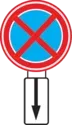
Answer help
3.34. "Stopping prohibited". Stopping and parking of vehicles are prohibited, except for taxis carrying out boarding or disembarkation of passengers (unloading or loading of cargo).
7.2.1.—7.2.6. "Area of operation". They indicate: 7.2.1 — the length of the dangerous section indicated by warning signs, or the area of operation of prohibition and information-indication signs;
7.2.2 — the area of operation of prohibition signs 3.34—3.37, as well as the length of one or several stopping areas located one after another; 7.2.3 — the end of the area of operation of signs 3.34—3.37;
7.2.4 — that the vehicle is in the area of operation of signs 3.34—3.37; 7.2.5, 7.2.6 — the direction and area of operation of signs 3.34—3.37 in the case of prohibition of stopping or parking along one side of a square, building facade, etc. When used together with prohibition signs, the plates reduce the area of operation of the signs. -
Question #5 This road sign prohibits you from moving in the direction:
Topic: Road signs (Appendix 1)
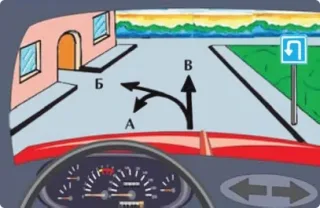
Answer help
5.26. "Turning Place". Indicates a place for turning vehicles. Left turns are prohibited. -
Question #6 Which vehicles are prohibited from moving on roads for cars?
Topic: Requirements for drivers of mopeds and bicycles
Answer help
6.7. Drivers of mopeds and bicycles are prohibited from:
b) driving on motorways and roads for automobiles, as well as on the carriageway if there is a bicycle path nearby;
24.9. Teaching driving of vehicles in residential areas, on roads for automobiles, and on motorways is prohibited. The list of roads where teaching driving of vehicles is allowed is agreed with the State Automobile Inspection.
27.2. On motorways and roads for automobiles, it is prohibited:
a) movement of tractors, self-propelled machines and mechanisms; -
Question #7 If the load on the vehicle's axle is greater than that indicated on this road sign, the driver must:
Topic: Road signs (Appendix 1)
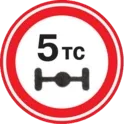
Answer help
3.16. "Movement of vehicles whose axle load exceeds ...t is prohibited". Movement of vehicles with an actual load on any axle greater than indicated on the sign is prohibited. -
Question #8 The blue car will pass the intersection:
Topic: Traffic regulation
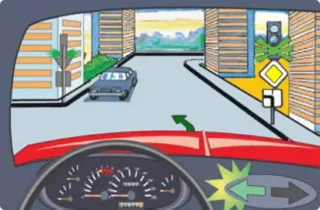
Answer help
8.3. Traffic controller signals have priority over traffic light signals and requirements of priority road signs and are mandatory for execution.
Traffic light signals, except for the yellow flashing one, have priority over priority road signs.
Drivers and pedestrians must comply with additional requirements of the traffic controller, even if they contradict traffic light signals, requirements of road signs and markings.
16.6. When turning left or making a U-turn at a green signal of the main traffic light, the driver of a non-rail vehicle must give way to a tram traveling in the same direction, as well as to vehicles moving in the opposite direction straight or turning right.
Tram drivers must also be guided by this rule among themselves. -
Question #9 The hazard warning lights must be turned on:
Topic: Warning signals
Answer help
9.9. Hazard warning lights must be turned on:
a) in case of a forced stop on the road;
b) in case of blinding the driver by headlights;
e) in case of a traffic accident.
19.4. During a stop on the road at night and in conditions of insufficient visibility, the vehicle must have its parking lights or side lights on, and in case of a forced stop, additionally the hazard warning lights.
In conditions of insufficient visibility, it is allowed to additionally turn on low beam or fog lights and rear fog lights.
If the parking lights are faulty, the vehicle should be removed from the road, and if this is impossible, it must be marked in accordance with the requirements of paragraphs
9.10 and 9.11 of these Rules. -
Question #10 A U-turn is prohibited:
Topic: Starting movement and changing its direction
Answer help
10.7. U-turn is prohibited:
ґ) at pedestrian crossings and closer than 10 m from them on both sides, except for the case of a permitted U-turn at an intersection; -
Question #11 How should vehicles move on roads where the carriageway is divided into traffic lanes by road marking lines?
Topic: Position of vehicles on the road
Answer help
11.10. On roads where the carriageway is divided into traffic lanes by road marking lines, it is prohibited to move while occupying two lanes simultaneously. Driving onto broken marking lines is allowed only during lane changing. -
Question #12 At what maximum speed is it allowed to drive trucks with a permissible maximum mass of more than 3.5 tons on road sections not classified by traffic conditions as 'roads for cars' and marked with this road sign?
Topic: Speed of movement

Answer help
12.6. Outside populated areas on all roads and on roads passing through populated areas marked with sign 5.47, movement is allowed at a speed of:
ґ) other vehicles: on a road marked with road sign 5.1 – no more than 130 km/h, on a road with separate carriageways, -
Question #13 The driver of which vehicle must give way?
Topic: Distance, interval, oncoming passing
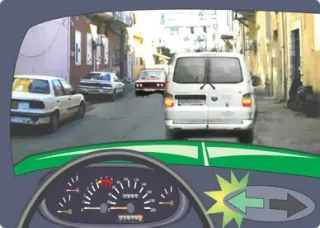
Answer help
13.4. If oncoming passage is difficult, the driver on whose lane there is an obstacle or whose vehicle dimensions interfere with oncoming traffic
must give way. On road sections marked with signs 1.6 "Steep ascent" and 1.7 "Steep descent", in the presence of an obstacle, the driver of the vehicle moving downhill must give way. -
Question #14 Which of the indicated actions must the driver perform before starting to overtake?
Topic: Overtaking
Answer help
14.2. Before starting to overtake, the driver must make sure that:
c) the oncoming lane into which he will enter is free of vehicles at a sufficient distance for overtaking; -
Question #15 Parking of vehicles is prohibited:
Topic: Stopping and parking
Answer help
15.10. Parking is prohibited:
b) on sidewalks (except for places marked with appropriate road signs installed with plates);
ґ) outside populated areas in zones of dangerous turns and convex breaks in the longitudinal profile of the road with visibility or view less than 100 m in at least one direction of movement; -
Question #16 The cars will pass the intersection in the following order:
Topic: Passing intersections
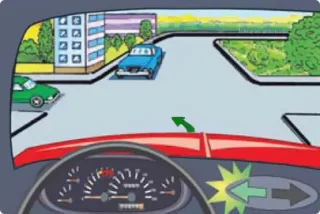
Answer help
16.12. At an intersection of equivalent roads, the driver of a non-rail vehicle must give way to vehicles approaching from the right.
Tram drivers must also be guided by this rule among themselves.
At any uncontrolled intersection, a tram, regardless of the direction of its further movement, has priority over non-rail vehicles approaching it on an equivalent road.
16.13. Before turning left and making a U-turn, the driver of a non-rail vehicle must give way to a tram traveling in the same direction, as well as to vehicles moving on an equivalent road in the opposite direction straight or to the right.
Tram drivers must also be guided by this rule among themselves. -
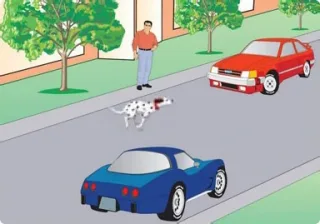
Question #17 What should the driver do if he sees an animal suddenly appearing on the carriageway?
Topic: Organization and safety of traffic
-
Question #18 If the pressure gauge of the pneumatic brake drive is not working, the driver must:
Topic: Technical condition of vehicles and their equipment
Answer help
31.4.1. Brake systems:
ґ) the pressure gauge of the pneumatic or pneumohydraulic brake drive does not work;
31.5. In the event of malfunctions specified in paragraph 31.4 of these Rules occurring on the road, the driver must take measures to eliminate them, and if this is impossible, move as short a way as possible to the place of parking or repair, observing precautions and fulfilling the requirements of paragraphs 9.9 and 9.11 of these Rules.
In the event of malfunctions specified in paragraph 31.4.7 ("ї"; "д" — as part of a road train) occurring on the road, further movement is prohibited until they are eliminated. The driver of the faulty vehicle must take measures to remove it from the carriageway. -
Question #19 Give a complete answer: what of the listed items must be in the car?
Topic: Technical condition of vehicles and their equipment
Answer help
31.4.7. Other structural elements:
є) missing: a medical first aid kit with information on it about the type of vehicle for which it is intended — on a motorcycle with a sidecar, passenger car, -
Question #20 Where is it allowed for drivers of non-rail vehicles to cross railway tracks?
Topic: Movement through railway crossings
Answer help
20.1. Drivers of vehicles may cross railway tracks only at railway crossings.