
Practice: ticket #85
Answers are checked instantly. The hint — a rules excerpt — is under the question.
-
Question #1 "Safe interval" is the distance:
Topic: General provisions
Answer help
safe interval — the distance between the side parts of moving vehicles or between them and other objects, at which road safety is ensured; -
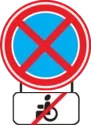
Question #2 Is it allowed for a disabled driver, driving a vehicle marked with the "Disabled" identification sign, to stop in the zone of this road sign with a plate?
Topic: Road signs (Appendix 1)
Answer help
2.8. A disabled driver driving a motorized wheelchair or a car marked with the identification sign "Disabled" may deviate from the requirements of road signs 3.1, 3.2 and 3.35—3.38, as well as sign 3.34 if there is a plate 7.18 under it.
3.34. "Stopping prohibited". Stopping and parking of vehicles are prohibited, except for taxis carrying out boarding or disembarkation of passengers (unloading or loading of cargo).
7.18. "Except for disabled persons". Indicates that the effect of the sign does not apply to motorized wheelchairs and cars on which the identification sign "Disabled" is installed in accordance with the requirements of these Rules. It is used with signs 3.1, 3.34—3.38 -
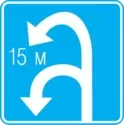
Question #3 What information is contained in this road sign?
Topic: Road signs (Appendix 1)
Answer help
5.27. "U-turn zone". Designates a zone along the length for turning vehicles around. Turning left is prohibited. -
Question #4 Which road sign indicates the mandatory direction of travel at an intersection?
Topic: Road signs (Appendix 1)
Answer help
4.3. "Direction of turn". Signs (1.4.1 — movement to the right, 1.4.2 — movement to the left) show the direction of the turn of the road indicated by signs 1.1 and 1.2, the direction of detour around an obstacle on the road, and sign 1.4.1, in addition, — the direction of detour around the center of an intersection with circular traffic; sign 1.4.3 (movement to the right or left) shows the direction of movement at T-shaped intersections, road forks, or detour around a repaired section of the road. -
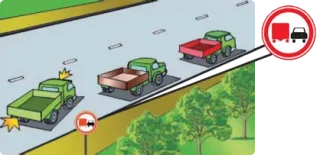
Question #5 Is it allowed for a driver of a truck with a permissible maximum mass of more than 3.5 tons to overtake vehicles moving ahead at a speed of less than 30 km/h in the zone of this road sign?
Topic: Road signs (Appendix 1)
Answer help
3.27. "Overtaking by trucks prohibited". It is prohibited for trucks with a permissible maximum mass over 3.5 t to overtake all vehicles (except single vehicles moving at a speed of less than 30 km/h). Tractors are prohibited from overtaking all vehicles, except single bicycles, horse-drawn carts (sledges). -
Question #6 Is it allowed for cyclists to ride on sidewalks?
Topic: Requirements for drivers of mopeds and bicycles
Answer help
6.7. Drivers of mopeds and bicycles are prohibited from:
c) moving on sidewalks and pedestrian paths (except for children under 7 years old on children's bicycles under adult supervision); -
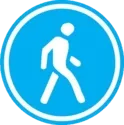
Question #7 What information is contained in this road sign?
Topic: Road signs (Appendix 1)
Answer help
4.13. "Pedestrian path". Only pedestrian movement. -
Question #8 Which answer most fully presents the difference between traffic controller signals and additional requirements of the traffic controller?
Topic: Traffic regulation
Answer help
8.3. Traffic controller signals have priority over traffic light signals and requirements of priority road signs and are mandatory for execution.
Traffic light signals, except for the yellow flashing one, have priority over priority road signs.
Drivers and pedestrians must comply with additional requirements of the traffic controller, even if they contradict traffic light signals, requirements of road signs and markings.
8.8. Traffic controller signals. Traffic controller signals are the positions of his body, as well as hand gestures, including with a baton or a disc with a red reflector, having the following meanings:
a) arms extended to the sides, lowered, or the right arm bent in front of the chest: from the left and right sides — movement of the tram straight is allowed, non-rail vehicles — straight and to the right; pedestrians are allowed to cross the carriageway behind the back and in front of the chest of the traffic controller; from the chest and back side — movement of all vehicles and pedestrians is prohibited;
b) right arm extended forward: from the left side — movement of the tram to the left is allowed, non-rail vehicles — in all directions; pedestrians are allowed to cross the carriageway behind the back of the traffic controller; from the chest side — all vehicles are allowed to move only to the right; from the right side and back — movement of all vehicles is prohibited; pedestrians are allowed to cross the carriageway behind the back of the traffic controller;
c) arm raised up: movement of all vehicles and pedestrians is prohibited in all directions. The baton is used only by employees of the State Automobile Inspection units and the military road safety inspection. To attract the attention of road users, a signal given by a whistle is used. The traffic controller may give other signals understandable to drivers and pedestrians.
8.9. The requirement to stop a vehicle is given by a police officer:
a) with a baton or hand pointing at that vehicle;
b) with the help of a flashing beacon of blue and red or only red color and (or) a special sound signal;
c) with the help of a loudspeaker device;
d) with the help of a special board on which the requirement to stop the vehicle is indicated. The driver must stop the vehicle at the place indicated to him, observing the stopping rules. -
Question #9 What should a driver do in the event of a forced stop outside a populated area with limited road visibility of less than 100 m?
Topic: Warning signals
Answer help
9.9. The hazard warning lights must be switched on:
a) in the event of a forced stop on the road;
9.10. Together with switching on the hazard warning lights, a warning triangle or a flashing red lantern should be installed at a distance ensuring road safety, but not closer than 20 m to the vehicle in populated areas and 40 m outside them, in the case of:
b) a forced stop in places with limited visibility of the road in at least one direction of less than 100 m. -
Question #10 A U-turn is prohibited:
Topic: Starting movement and changing its direction
Answer help
10.7. U-turn is prohibited:
d) when road visibility is less than 100 m in at least one direction;
e) on motorways, as well as on roads for cars, except for intersections and places indicated by road signs 5.26 or 5.27 -
Question #11 When must a vehicle drive in the far right lane?
Topic: Position of vehicles on the road
Answer help
11.7. Vehicles whose speed must not exceed 40 km/h or which for technical reasons cannot develop such speed must move as close as possible to the right edge of the carriageway, except when overtaking, avoiding an obstacle, or changing lanes before turning left or making a U-turn. -
Question #12 At what maximum speed is it allowed to drive when transporting passengers in the body of a truck?
Topic: Speed of movement
Answer help
12.6. Outside populated areas on all roads and on roads passing through populated areas indicated by sign 5.47, movement is allowed at a speed of:
c) for trucks carrying people in the body — no more than 60 km/h; -
Question #13 How should a driver act if another vehicle is approaching on a narrow section of road?
Topic: Distance, interval, oncoming passing
Answer help
13.4. If oncoming passing is difficult, the driver on whose lane there is an obstacle or the dimensions of the vehicle he is driving interfere with oncoming traffic must give way. On road sections indicated by signs 1.6 "Steep ascent" and 1.7 "Steep descent", in the presence of an obstacle, the driver of the vehicle moving downhill must give way. -
Question #14 In which figure does the driver correctly perform overtaking?
Topic: Overtaking
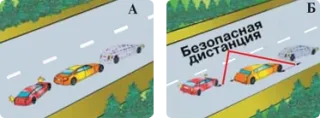
Answer help
14.2. Before starting to overtake, the driver must make sure that:
d) after overtaking, he will be able, without creating an obstacle to the vehicle being overtaken, to return to the occupied lane. -
Question #15 Are stopping and parking allowed opposite a stop for route vehicles?
Topic: Stopping and parking
Answer help
15.9. Stopping is prohibited:
g) in places where oncoming passing or passing around a stopped vehicle will be impossible; -
Question #16 Vehicles will cross the intersection in the following order:
Topic: Passing intersections
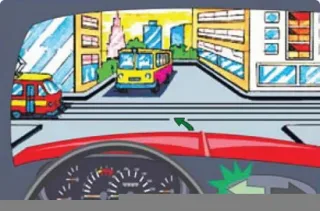
Answer help
16.12. At an intersection of equal roads, the driver of a non-rail vehicle must give way to vehicles approaching from the right.
Tram drivers must also be guided by this rule among themselves.
At any uncontrolled intersection, a tram, regardless of the direction of its further movement, has priority over non-rail vehicles approaching it on an equal road.
16.13. Before turning left and making a U-turn, the driver of a non-rail vehicle must give way to a tram of the same direction, as well as to vehicles moving on an equal road in the opposite direction straight or to the right.
Tram drivers must also be guided by this rule among themselves. -
Question #17 In rainy weather, what distance should be maintained?
Topic: Organization and safety of traffic
-
Question #18 Under which of the listed conditions is the operation of vehicles prohibited? Give a complete answer.
Topic: Technical condition of vehicles and their equipment
Answer help
31.4.1. Brake systems:
d) the pressure gauge of the pneumatic or pneumohydraulic brake drive does not work; -
Question #19 The residual tread depth of passenger car tires must be at least:
Topic: Technical condition of vehicles and their equipment
Answer help
31.4.5. Wheels and tires:
a) tires of passenger cars and trucks with a permissible maximum mass up to 3.5 t have a residual tread pattern height of less than 1.6 mm, trucks with -
Question #20 Approaching an uncontrolled intersection of equivalent roads, before which a "Maximum Speed Limit" sign is installed, the driver of a car must:
Topic: Passing intersections
Answer help
16.12. At an intersection of equal roads, the driver of a non-rail vehicle must give way to vehicles approaching from the right.
Tram drivers must also be guided by this rule among themselves.
At any uncontrolled intersection, a tram, regardless of the direction of its further movement, has priority over non-rail vehicles approaching it on an equal road.