
Practice: ticket #84
Answers are checked instantly. The hint — a rules excerpt — is under the question.
-
Question #1 A stop is considered 'forced' if the vehicle's movement is stopped due to:
Topic: General provisions
Answer help
forced stop — cessation of vehicle movement due to its technical condition or danger created by the transported cargo, the condition of the driver (passenger), or an obstacle on the road; -
Question #2 Is it allowed for a driver to drive a vehicle under the influence of medications that reduce reaction speed and attention?
Topic: Duties and rights of drivers of mechanical vehicles
Answer help
2.9. The driver is prohibited from:
b) driving a vehicle in a sick state, in a state of fatigue, as well as under the influence of medications that reduce the speed of reaction and -
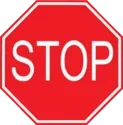
Question #3 If this road sign is installed before a railway crossing, the driver must:
Topic: Duties and rights of drivers of mechanical vehicles
Answer help
2.2. "No stopping without stopping." It is prohibited to pass without stopping before marking 1.12 (stop line), and if it is absent — before the sign.
If sign 2.2 is installed before a railway crossing that is not guarded and is not equipped with traffic light signaling, the driver must stop before the stop line, and if it is absent — before this sign.
20.2. When approaching a crossing, as well as when starting to move after stopping before it, the driver must be guided by the instructions and signals of the crossing attendant, the position of the barrier, light and sound signaling, road signs and road markings, and also make sure that no train (locomotive, draisine) is approaching.
20.3. To let an approaching train pass and in other cases when movement through a railway crossing is prohibited, the driver must stop before road marking 1.12 (stop line), road sign 2.2, barrier or traffic light so as to see the signals, and if traffic management means are absent — no closer than 10 m to the nearest rail. -
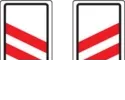
Question #4 Where and at what distance before a railway crossing are these road signs installed?
Topic: Road signs (Appendix 1)
Answer help
1.31.1—1.31.6. "Approaching a railway crossing." Additional warning about approaching a railway crossing outside built-up areas.
Warning signs, except signs 1.4.1—1.4.3, 1.29—1.31.6, are installed outside built-up areas at a distance of 150—300 m, in built-up areas — at a distance of 50—100 m to the beginning of the dangerous section. If necessary, signs are installed at a different distance, which is indicated on plate 7.1.1 -
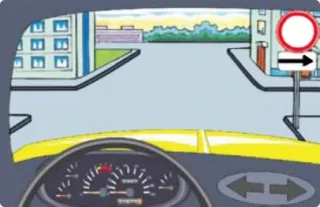
Question #5 In which direction is transit traffic through the intersection prohibited?
Topic: Road signs (Appendix 1)
Answer help
3.1. "Movement prohibited." The movement of all vehicles is prohibited.
7.3.1.—7.3.3. "Direction of action." They show the directions of action of signs located before an intersection, or directions of movement to designated objects located directly near the road. -
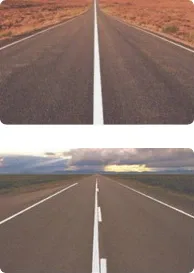
Question #6 In which cases is it allowed to cross the solid white line of road markings separating traffic flows in opposite directions?
Topic: Road markings (Appendix 2)
Answer help
1.1. (narrow solid line) — separates traffic flows of opposite directions and marks the boundaries of traffic lanes on roads; marks the boundaries of the carriageway onto which entry is prohibited; marks the boundaries of parking areas for vehicles and the edge of the carriageway of roads not classified by traffic conditions as motorways;
Lines 1.1 and 1.3 are prohibited to cross. If line 1.1 marks a parking place or the edge of the carriageway adjacent to the shoulder, it is allowed to cross this line.
As an exception, provided that road safety is ensured, it is allowed to cross line 1.1 to bypass a stationary obstacle whose dimensions do not allow its safe bypass without crossing this line, as well as to overtake single vehicles moving at a speed of less than 30 km/h.
1.11. — separates traffic flows of opposite or same directions on road sections where lane changing is allowed only from one lane; marks places intended for turning around, entering and exiting parking areas, etc., where movement is allowed only in one direction; -
Question #7 What information is contained in this road sign?
Topic: Road signs (Appendix 1)
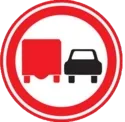
-
Question #8 Movement is prohibited:
Topic: Traffic regulation
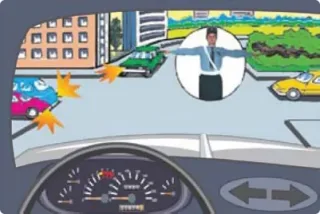
Answer help
8.8. Traffic controller signals. The signals of the traffic controller are the positions of his body, as well as hand gestures, including with a baton or a disk with a red reflector, having the following meanings:
a) arms extended to the sides, lowered, or the right arm bent in front of the chest: from the left and right sides — tram movement straight is allowed, non-rail vehicles — straight and -
Question #9 During boarding of children into a bus marked with the 'Children' identification sign, the following is turned on:
Topic: Warning signals
Answer help
9.9. Hazard warning lights must be turned on:
ґ) on a mechanical vehicle marked with the identification sign "Children" transporting an organized group of children, during their boarding or disembarkation; -
Question #10 What should a driver do when reversing if he cannot ensure road safety?
Topic: Starting movement and changing its direction
Answer help
10.9. When moving a vehicle in reverse, the driver must not create danger or obstacles to other road users. To ensure traffic safety, he must, if necessary, seek help from other persons. -
Question #11 On which lanes is it allowed for passenger cars and motorcycles to move in populated areas with heavy traffic on a four-lane carriageway in this direction?
Topic: Position of vehicles on the road
Answer help
11.6. On roads with three or more lanes for movement in one direction, trucks with a permitted maximum mass over 3.5 t, tractors, self-propelled machines and mechanisms are allowed to enter the far left lane only for turning left and making a U-turn, and in built-up areas on roads with one-way traffic, in addition, for stopping on the left, in permitted cases, for loading or unloading. -
Question #12 What is the maximum speed allowed for all vehicles in the zone marked with this road sign?
Topic: Speed of movement
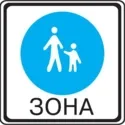
Answer help
12.5. In residential and pedestrian zones, the speed of movement must not exceed 20 km/h. -
Question #13 How to provide first aid for angina (heart pain) on the way?
Topic: Fundamentals of providing medical assistance in case of a traffic accident
-
Question #14 According to special rules, the movement of vehicles whose dimensions in height from the road surface minimally exceed (except for container ships on established routes) is carried out:
Topic: Transportation of cargo
Answer help
22.5. According to special rules, road transportation of dangerous goods, movement of vehicles and their combinations is carried out if at least one of their dimensions exceeds 2.6 m in width, 4 m in height from the road surface (for container carriers on routes established by Ukravtodor and the State Automobile Inspectorate — 4.35 m), 22 m in length (for route vehicles — 25 m), actual mass over 38 t (on routes established by Ukravtodor and the State Automobile Inspectorate — up to 40 t; for container carriers — over 44 t, on routes established for them — 46 t), load on a single axle — 11 t (for buses, trolleybuses — 11.5 t), twin axles — 16 t, triple axles — 22 t (for container carriers, load on a single axle — 11 t, twin axles — 18 t, triple axles — 24 t) or if the cargo protrudes beyond the rear dimension of the vehicle by more than 2 m.
Axles should be considered twin or triple if the distance between them (adjacent) does not exceed 2.5 m. -
Question #15 Are stopping and parking allowed in the area of road works?
Topic: Stopping and parking
Answer help
15.9. Stopping is prohibited:
є) closer than 10 m from the designated place of road works and in the zone of their execution, where this will create obstacles for working technological vehicles; -
Question #16 Vehicles will pass the intersection in the following order:
Topic: Passing intersections
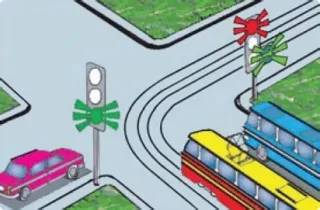
Answer help
16.9. When moving in the direction of the arrow turned on in the additional section simultaneously with the yellow or red traffic light signal, the driver must give way to vehicles moving from other directions.
When moving in the direction of the green arrow on a plate installed at the level of the red traffic light signal with vertical arrangement of signals, the driver must take the far right (left) lane and give way to vehicles and pedestrians moving from other directions. -
Question #17 How to use brakes on a slippery road?
Topic: Organization and safety of traffic
-
Question #18 Which drivers are required to stop?
Topic: Passing pedestrian crossings and stops of vehicles
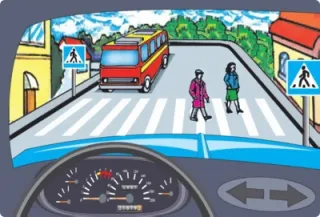
Answer help
18.1. The driver of a vehicle approaching an uncontrolled pedestrian crossing where pedestrians are present must reduce speed, and if necessary, stop to give way to pedestrians for whom an obstacle or danger may be created. -
Question #19 Is it allowed to move with the clutch or gear disengaged (coasting) on mountain roads?
Topic: Movement on mountain roads and steep descents
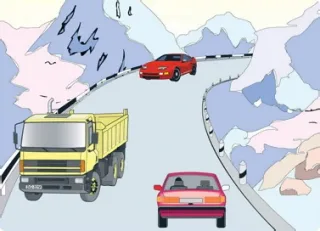
Answer help
28.3. On mountain roads it is prohibited:
a) to move with the engine not running and with the clutch or gear disengaged; -
Question #20 The third to cross the intersection will be:
Topic: Passing intersections
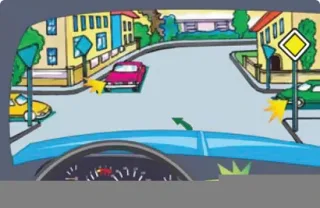
Answer help
16.11. At an intersection of unequal roads, the driver of a vehicle moving on a secondary road must give way to vehicles approaching this intersection of carriageways on the main road, regardless of the direction of their further movement.
16.13. Before turning left and making a U-turn, the driver of a non-rail vehicle must give way to a tram of the same direction, as well as to vehicles moving on an equal road in the opposite direction straight or to the right.
Tram drivers must also be guided by this rule among themselves.