
Practice: ticket #82
Answers are checked instantly. The hint — a rules excerpt — is under the question.
-
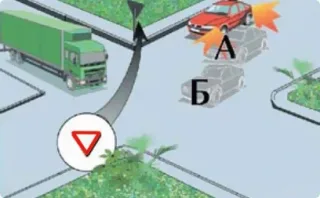
Question #1 In what position must the driver of a passenger car stop to comply with the requirement of the road sign 'Give way'?
Topic: Duties and rights of drivers of mechanical vehicles
Answer help
2.1. "Give way". The driver must give way to vehicles approaching an uncontrolled intersection on the main road, and if there is a plate 7.8 — to vehicles moving on the main road.
Give way — a requirement for a road user not to continue or resume movement, not to carry out any maneuvers (except for the requirement to vacate the occupied lane), if this may force other road users who have priority to change direction or speed; -
Question #2 Is it allowed for a driving instructor not to fasten seat belts?
Topic: Duties and rights of drivers of mechanical vehicles
Answer help
2.3. To ensure road safety, the driver is obliged to:
c) on cars equipped with passive safety devices (head restraints, seat belts), use them and not carry passengers not wearing seat belts -
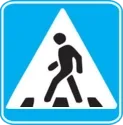
Question #3 This road sign:
Topic: Road signs (Appendix 1)
Answer help
5.35.1.—5.35.2. "Pedestrian crossing". Sign 5.35.1 is installed on the right side of the road at the near boundary of the crossing, and sign 5.35.2 — on the left side of the road at the far boundary of the crossing. -
Question #4 The effect of which of these road signs does not apply to vehicles that move along established routes?
Topic: Road signs (Appendix 1)
Answer help
3.34. "Stopping prohibited". Stopping and parking of vehicles is prohibited, except for taxis carrying out boarding or disembarkation of passengers (unloading or loading of cargo).
The effect of signs does not apply:
3.1, 3.2, 3.21—3.24, 3.34 — to vehicles moving along established routes;
3.1, 3.2, 3.35—3.38, as well as sign 3.34 if there is plate 7.18 under it — to disabled drivers driving a motorized wheelchair or a car marked with the identification sign "Disabled";
3.1—3.8, 3.11 — to vehicles serving citizens or belonging to citizens who live or work in this zone, as well as to vehicles serving enterprises located in the marked zone. In such cases, vehicles must enter the marked zone and leave it at the nearest intersection to the destination;
3.3 — to trucks that have an oblique white stripe on the outer side surface or carry groups of people;
3.35—3.38 — to taxis with the taximeter turned on. -
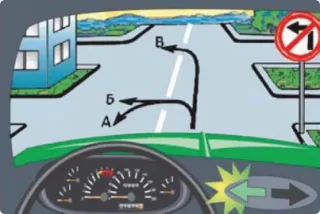
Question #5 On which path among those indicated by arrows is movement allowed?
Topic: Road signs (Appendix 1)
Answer help
3.23. "Left turn prohibited". Left turn of vehicles is prohibited. At the same time, a U-turn is allowed. -
Question #6 What information is contained in this road marking?
Topic: Road markings (Appendix 2)

Answer help
1.9. — denotes the boundaries of traffic lanes on which reversible regulation is carried out; separates traffic flows of opposite directions (when reversible traffic lights are turned off) on roads where reversible regulation is carried out; -
Question #7 At what speed is it permitted to drive a passenger car in a built-up area indicated by this road sign?
Topic: Road signs (Appendix 1)

Answer help
5.47. "Beginning of a built-up area". Name and beginning of the development of a built-up area in which the requirements of these Rules determining the order of movement in built-up areas do not apply on this road.
12.6. Outside built-up areas on all roads and on roads passing through built-up areas marked with sign 5.47, movement is allowed at a speed:
g) for other vehicles: on a motor road marked with road sign 5.1 — not more than 130 km/h, on a motor road with separate carriageways, -
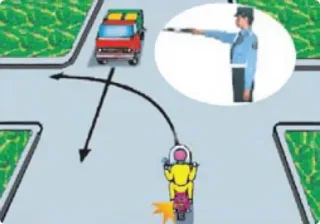
Question #8 In which case did the motorcycle driver turn left correctly?
Topic: Traffic regulation
Answer help
8.8. Traffic controller signals. Traffic controller signals are the positions of his body, as well as hand gestures, including with a baton or a disk with a red reflector, having the following meanings:
b) right arm extended forward: from the left side — tram movement to the left is allowed, non-rail vehicles — in all directions; pedestrians are allowed to cross -
Question #9 During a stop on an unlit roadside at night, the following must be turned on on the vehicle:
Topic: Use of external lighting devices
Answer help
19.4. During a stop on the road at night and in conditions of insufficient visibility, the vehicle must have side or parking lights on, and in case of a forced stop additionally — hazard warning lights.
In conditions of insufficient visibility, it is allowed to additionally turn on low beam or fog headlights and rear fog lights.
If the side lights are faulty, the vehicle should be removed outside the road, and if this is impossible, it must be marked in accordance with the requirements of paragraphs 9.10 and 9.11 of these Rules. -
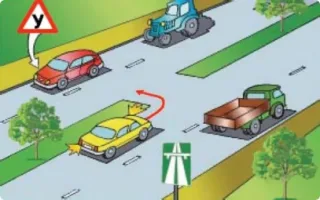
Question #10 Drivers of which vehicles violate the traffic rules?
Topic: Movement on highways and roads for cars
Answer help
27.2. On motorways and roads for cars it is prohibited:
a) movement of tractors, self-propelled machines and mechanisms;
g) U-turn and entry into technological gaps of the dividing strip;
d) driving instruction.
24.9. It is prohibited to teach driving vehicles in a residential area, on roads for cars and on motorways. The list of roads on which driving instruction is allowed is agreed with the State Automobile Inspection. -
Question #11 A mechanical vehicle with a faulty service brake system is allowed to be towed:
Topic: Towing and operation of vehicle combinations
Answer help
23.4. When towing a mechanical vehicle on a flexible coupling, the towed vehicle must have working service brake system and steering, and on a rigid coupling — steering.
23.10. Towing is prohibited:
a) if the actual mass of the towed vehicle with a faulty brake system (or in its absence) exceeds half of the actual mass of the towing vehicle -
Question #12 If a vehicle is equipped with an identification sign 'Maximum Speed Limit', then the driver of this vehicle:
Topic: Speed of movement
Answer help
12.9. The driver is prohibited:
b) to exceed the maximum speed specified in paragraphs 12.4—12.7, on a road section where road signs 3.29, 3.31 are installed, or on a vehicle on which is installed -
Question #13 How to transport a victim with a clavicle fracture?
Topic: Fundamentals of providing medical assistance in case of a traffic accident
-
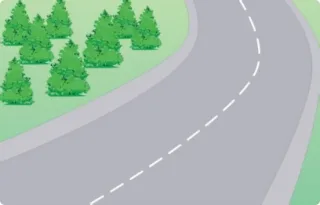
Question #14 A white broken line separates traffic flows in opposite directions. On this section of the road, overtaking:
Topic: Overtaking
Answer help
14.6. Overtaking is prohibited:
e) on roads having two or more lanes for movement in one direction;
1.5. — separates traffic flows of opposite directions on roads having two or three lanes; denotes the boundaries of traffic lanes when there are two or more lanes intended for movement in one direction; -
Question #15 Placing vehicles at an angle to the edge of the roadway:
Topic: Stopping and parking
Answer help
15.5. Placing vehicles at an angle to the edge of the carriageway is allowed in places where this will not impede the movement of other vehicles.
At sidewalks or other places with pedestrian movement, placing vehicles at an angle is allowed only with the front part, and on ascents — only with the rear part. -
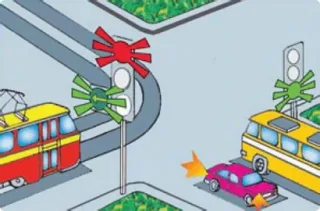
Question #16 Drivers of which vehicles will pass the intersection first?
Topic: Passing intersections
Answer help
16.9. When moving in the direction of the arrow included in the additional section simultaneously with the yellow or red traffic light signal, the driver must give way to vehicles moving from other directions.
When moving in the direction of the green arrow on a plate installed at the level of the red traffic light signal with vertical arrangement of signals, the driver must take the extreme right (left) lane and give way to vehicles and pedestrians moving from other directions. -
Question #17 Give a complete answer: what safe distance between vehicles is recommended when driving in urban conditions?
Topic: Organization and safety of traffic
-
Question #18 Under what conditions is the operation of mechanical vehicles prohibited?
Topic: Technical condition of vehicles and their equipment
Answer help
31.3. It is prohibited to operate vehicles in accordance with the legislation:
b) if they have not passed state technical inspection or do not have a coupon about its passage; -
Question #19 During a forced stop at night on unlit sections of roads in case of malfunction of side or parking lights, it is necessary to:
Topic: Use of external lighting devices
Answer help
19.4. During a stop on the road at night and in conditions of insufficient visibility, the vehicle must have side or parking lights on, and in case of a forced stop additionally — hazard warning lights.
In conditions of insufficient visibility, it is allowed to additionally turn on low beam or fog headlights and rear fog lights.
If the side lights are faulty, the vehicle should be removed outside the road, and if this is impossible, it must be marked in accordance with the requirements of paragraphs 9.10 and 9.11 of these Rules. -
Question #20 Is the driver obliged to yield to anyone when entering an intersection on a green traffic light?
Topic: Passing intersections
Answer help
16.5. When a traffic controller signal or a traffic light signal permitting movement is given, the driver must give way to vehicles completing movement through the intersection, as well as to pedestrians finishing crossing.