
Practice: ticket #81
Answers are checked instantly. The hint — a rules excerpt — is under the question.
-
Question #1 According to the definition of the Traffic Rules, a 'dividing strip' is:
Topic: General provisions
Answer help
dividing strip — a road element structurally separated or with the help of solid lines of road marking 1.1 or 1.2, which separates adjacent roadways. The dividing strip is not intended for the movement or parking of vehicles. If there is a sidewalk on the dividing strip, pedestrian movement is allowed on it; -
Question #2 Must a driver transporting oversized or heavy cargo have a permit for movement with them?
Topic: Duties and rights of drivers of mechanical vehicles
Answer help
2.1. The driver of a mechanical vehicle must have with him:
d) in cases established by legislation, a waybill and documents for the cargo being transported; on route vehicles — a route diagram and a timetable; on -
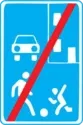
Question #3 What information is contained in this road sign?
Topic: Road signs (Appendix 1)
Answer help
5.32. "End of residential zone." -
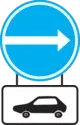
Question #4 Which vehicles does the effect of this road sign with a plate apply to?
Topic: Road signs (Appendix 1)
Answer help
4.2. "Turn right."
7.5.1.—7.5.8. "Type of vehicle." Indicate the type of vehicle to which the sign applies. Plate 7.5.1 extends the effect of the sign to trucks (including those with a trailer) with a permissible maximum mass over 3.5 t; 7.5.3 — to passenger cars, as well as trucks with a permissible maximum mass up to 3.5 t. -
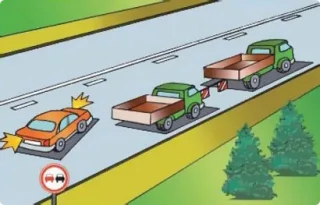
Question #5 Is overtaking allowed in the zone of the sign if the towing vehicle is moving at a speed of less than 30 km/h?
Topic: Road signs (Appendix 1)
Answer help
3.25. "Overtaking prohibited." Overtaking of all vehicles is prohibited (except single * vehicles moving at a speed of less than 30 km/h).* Single vehicles are considered to be individual vehicles, road trains, as well as a towing vehicle coupled with a towed one.
1.11. — separates traffic flows of opposite or same directions on road sections where changing lanes is allowed only from one lane; denotes places intended for turning around, entering and exiting parking areas, etc., where movement is allowed only in one direction; -
Question #6 Which road users are prohibited from driving on motorways and roads for cars?
Topic: Requirements for drivers of mopeds and bicycles
Answer help
6.7. Drivers of mopeds and bicycles are prohibited from:
b) moving on motorways and roads for cars, as well as on the roadway if there is a bicycle path nearby;
24.9. It is prohibited to teach driving of vehicles in a residential zone, on roads for cars, and on motorways. The list of roads on which driving instruction is allowed is agreed with the State Automobile Inspection.
27.2. On motorways and roads for cars, it is prohibited:
a) movement of tractors, self-propelled machines and mechanisms; -
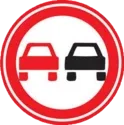
Question #7 Is overtaking vehicles allowed on the road section after this road sign?
Topic: Road signs (Appendix 1)
Answer help
3.25. "Overtaking prohibited." Overtaking of all vehicles is prohibited (except single * vehicles moving at a speed of less than 30 km/h).* Single vehicles are considered to be individual vehicles, road trains, as well as a towing vehicle coupled with a towed one. -
Question #8 What does the green traffic light signal in the form of an arrow pointing down mean?
Topic: Traffic regulation
Answer help
8.7.4. To regulate the movement of vehicles on streets, roads, or along lanes of the roadway, the direction of movement on which may change to the opposite, reversible traffic lights with a red X-shaped signal and a green signal in the form of an arrow pointing down are used. These signals prohibit or allow movement along the lane above which they are located.
The main signals of a reversible traffic light may be supplemented with a yellow signal in the form of an arrow inclined diagonally down to the right, the activation of which prohibits movement along the lane marked on both sides by road marking 1.9 and informs about the change of the reversible traffic light signal and the need to change lanes to the right.
When the signals of the reversible traffic light located above the lane marked on both sides by road marking 1.9 are turned off, entry into this lane is prohibited. -
Question #9 For transporting which passengers is it necessary to use special devices that allow securing a child with seat belts on the front seat of a passenger car?
Topic: Transportation of passengers
Answer help
21.11. It is prohibited to transport:
b) children whose height is less than 145 cm or who have not reached 12 years of age — in vehicles equipped with seat belts, without the use of special devices, -
Question #10 In which of the listed places is stopping vehicles prohibited?
Topic: Stopping and parking
Answer help
15.9. Stopping is prohibited:
e) closer than 10 m from the designated place of road works and in the zone of their implementation, where this will create obstacles for working technological vehicles; -
Question #11 In what way is it allowed to tow a vehicle with a faulty brake system?
Topic: Towing and operation of vehicle combinations
Answer help
23.4. When towing a mechanical vehicle on a flexible coupling, the towed vehicle must have working service brake system and steering, and on a rigid coupling — steering. -
Question #12 What is prohibited for a driver when choosing speed?
Topic: Speed of movement
Answer help
12.9. The driver is prohibited from:
a) exceeding the maximum speed determined by the technical characteristics of this vehicle;
b) exceeding the maximum speed specified in points 12.4—12.7 on a road section where road signs 3.29, 3.31 are installed, or on a vehicle on which an identification sign is installed in accordance with subparagraph "i" of point 30.3 of these Rules;
c) obstructing other vehicles by moving without necessity at a very low speed;
d) braking sharply (except in cases when it is impossible to prevent a traffic accident without this). -
Question #13 In which figure is the position of the victim shown, in which it is recommended to transport them in case of a chest wound?
Topic: Fundamentals of providing medical assistance in case of a traffic accident
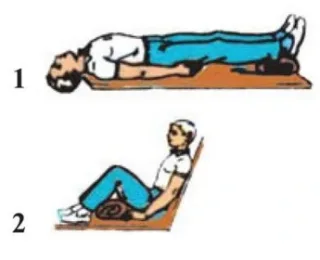
-
Question #14 Is overtaking allowed in this situation outside a populated area?
Topic: Overtaking
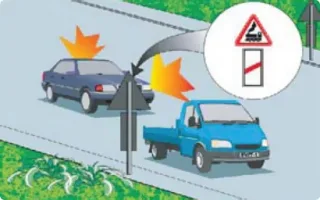
Answer help
14.6. Overtaking is prohibited:
b) at railway crossings and closer than 100 m before them; -
Question #15 Is parking vehicles on sidewalks allowed?
Topic: Stopping and parking
Answer help
15.10. Parking is prohibited:
c) on sidewalks, except for passenger cars and motorcycles, which may be placed at the edge of sidewalks where at least 2 m remains for pedestrian movement; -
Question #16 The driver of which vehicle has the right to priority movement?
Topic: Passing intersections
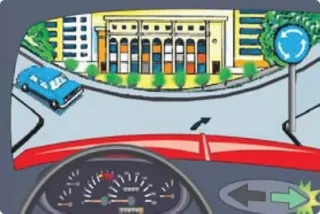
Answer help
16.12. At an intersection of equal roads, the driver of a non-rail vehicle must give way to vehicles approaching from the right.
Tram drivers must also be guided by this rule among themselves.
At any uncontrolled intersection, a tram, regardless of the direction of its further movement, has priority over non-rail vehicles approaching it on an equal road. -
Question #17 How is it recommended to drive on a road section that is flooded with water?
Topic: Organization and safety of traffic
-
Question #18 In which of the listed cases is the operation of vehicles prohibited according to legislation?
Topic: Technical condition of vehicles and their equipment
Answer help
31.3. It is prohibited to operate vehicles according to legislation:
d) in the case of equipping without the permission of the State Automobile Inspection with special sound and light signals. -
Question #19 Is it allowed to drive a car at night or in conditions of insufficient visibility if only parking lights are on?
Topic: Use of external lighting devices
Answer help
19.1. At night and in conditions of insufficient visibility, regardless of the degree of road lighting, as well as in tunnels, the following lighting devices must be switched on on a moving vehicle:
a) on all mechanical vehicles — low beam (high beam) headlights; -
Question #20 At what distance from the road marking 'stop line' or the road sign 'No stopping' must the driver stop to let an approaching train pass?
Topic: Movement through railway crossings
Answer help
20.3. To let an approaching train pass and in other cases when movement through a railway crossing is prohibited, the driver must stop before road marking 1.12 (stop line), road sign 2.2, barrier or traffic light so as to see the signals, and if traffic management devices are absent — no closer than 10 m to the nearest rail.