
Practice: ticket #8
Answers are checked instantly. The hint — a rules excerpt — is under the question.
-
Question #1 A driver leaving an unpaved road onto an asphalt one:
Topic: Passing intersections
Answer help
16.11. At an intersection of unequal roads, the driver of a vehicle moving on a secondary road must give way to vehicles approaching this intersection of roadways on the main road, regardless of the direction of their further movement. -
Question #2 Should drivers of operational vehicles, while performing an urgent official task, turn on a special sound signal when moving?
Topic: Movement of vehicles with special signals
Answer help
3.1. Drivers of operational vehicles, performing an urgent official task, may deviate from the requirements of sections 8 (except for traffic controller signals), 10—18, 26, 27 and paragraph
28.1 of these Rules, provided that a flashing beacon of blue or red color and a special sound signal are turned on and road safety is ensured. If there is no need to additionally attract the attention of road users, the special sound signal may be turned off. -
Question #3 What information is contained in this road sign?
Topic: Road signs (Appendix 1)

Answer help
5.7.1 and 5.7.2 "Exit onto a road with one-way traffic." Indicate the direction of traffic on the road being crossed if one-way traffic is organized on it. Movement of vehicles on this road or carriageway is permitted only in the direction of the arrow. -
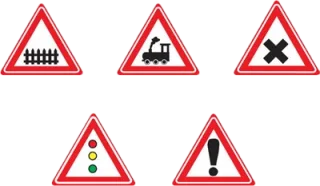
Question #4 At what distance before the beginning of a dangerous section are these road signs installed in populated areas?
Topic: Road signs (Appendix 1)
Answer help
Warning signs, except for signs 1.4.1—1.4.3, 1.29—1.31.6, are installed outside populated areas at a distance of 150—300 m, in populated areas — at a distance of 50—100 m before the beginning of the dangerous section. If necessary, signs are installed at a different distance, which is indicated on plate 7.1.1 -
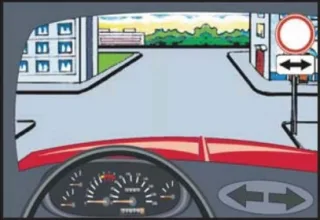
Question #5 In which direction is transit traffic through the intersection prohibited?
Topic: Road signs (Appendix 1)
Answer help
3.1. "Movement prohibited." Movement of all vehicles is prohibited.
7.3.1.—7.3.3. "Direction of action." Show the directions of action of signs located before an intersection, or the directions of movement to designated objects located directly near the road. -
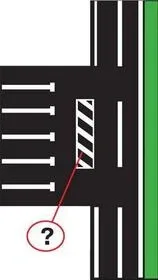
Question #6 Road marking in the form of white diagonal stripes indicates:
Topic: Road markings (Appendix 2)
Answer help
1.1. (narrow solid line) — separates traffic flows of opposite directions and marks the boundaries of traffic lanes on roads; marks the boundaries of the carriageway onto which entry is prohibited; marks the boundaries of parking places for vehicles and the edge of the carriageway of roads not classified as motorways according to traffic conditions;
Lines 1.1 and 1.3 are prohibited to cross. If line 1.1 marks a parking place or the edge of the carriageway adjacent to the shoulder, crossing this line is permitted.
As an exception, provided that road safety is ensured, it is permitted to cross line 1.1 to bypass a stationary obstacle whose dimensions do not allow its safe bypass without crossing this line, as well as to overtake single vehicles moving at a speed of less than 30 km/h. -
Question #7 What information is contained in this road sign?
Topic: Road signs (Appendix 1)

Answer help
4.12. "Bicycle path." Movement only on bicycles and mopeds. If there is no sidewalk or pedestrian path, pedestrian movement is also permitted. -
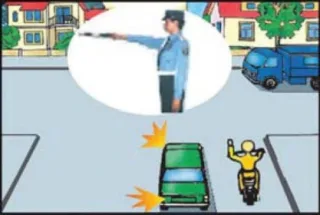
Question #8 Which vehicles are prohibited from moving?
Topic: Traffic regulation
Answer help
8.8. Traffic controller signals. Traffic controller signals are the positions of his body, as well as hand gestures, including with a baton or a disc with a red reflector,
having the following meanings:
b) right arm extended forward: from the left side — tram movement to the left is permitted, trackless vehicles — in all directions; pedestrians are allowed to cross -
Question #9 In which of the listed cases is it not required to turn on the low beam headlights to indicate a mechanical vehicle in daylight?
Topic: Warning signals
Answer help
9.8. During the movement of mechanical vehicles in daylight hours, for the purpose of marking the moving vehicle, the low beam headlights must be turned on:
a) in a column;
b) on route vehicles moving along a lane marked by road sign 5.8, against the general flow of vehicles;
c) on buses (minibuses) carrying organized groups of children;
d) on heavy, large-sized vehicles and vehicles carrying out road transportation of dangerous goods;
e) on the towing vehicle;
f) in tunnels.
In conditions of insufficient visibility on mechanical vehicles, high beam headlights or additionally fog lights may be turned on, provided that this does not blind other drivers. -
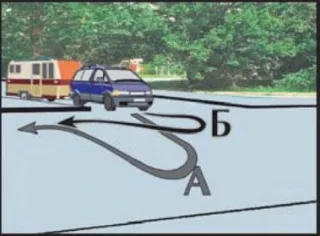
Question #10 Which path indicated by arrows is allowed for the driver of a road train to make a right turn?
Topic: Starting movement and changing its direction
Answer help
10.6. If a vehicle, due to its dimensions or for other reasons, cannot perform a turn or U-turn from the corresponding extreme position, it is permitted to deviate from the requirements of point 10.4 of these Rules, if this does not contradict the requirements of prohibiting or mandatory road signs, road markings and will not create danger or obstacles for other road users. If necessary, to ensure road safety, one should seek help from other persons. -
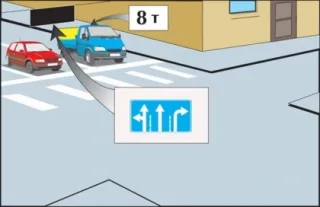
Question #11 Which driver has correctly taken the lane for going straight?
Topic: Position of vehicles on the road
Answer help
11.6. On roads having three or more lanes for traffic in one direction, trucks with a permitted maximum mass over 3.5 t, tractors, self-propelled machines and mechanisms are allowed to enter the far left lane only for turning left and making a U-turn, and in populated areas on roads with one-way traffic, in addition, for stopping on the left, in permitted cases, for loading or unloading. -
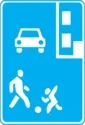
Question #12 What is the maximum speed allowed for motorcycles in the zone indicated by this road sign?
Topic: Speed of movement
Answer help
12.5. In residential and pedestrian zones, the speed of movement should not exceed 20 km/h. -
Question #13 How to provide first aid for poisoning by gasoline vapors?
Topic: Fundamentals of providing medical assistance in case of a traffic accident
-
Question #14 According to special rules, movement of vehicles whose dimensions in length minimally exceed (except for route vehicles) is carried out:
Topic: Transportation of cargo
Answer help
22.5. According to special rules, road transportation of dangerous goods, movement of vehicles and their combinations is carried out if at least one of their dimensions exceeds 2.6 m in width, 4 m in height from the road surface (for container carriers on routes established by Ukravtodor and the State Automobile Inspectorate — 4.35 m), 22 m in length (for route vehicles — 25 m), actual mass over 38 t (on routes established by Ukravtodor and the State Automobile Inspectorate — up to 40 t; for container carriers — over 44 t, on routes established for them — 46 t), load on a single axle — 11 t (for buses, trolleybuses — 11.5 t), twin axles — 16 t, triple axles — 22 t (for container carriers, load on a single axle — 11 t, twin axles — 18 t, triple axles — 24 t) or if the load protrudes beyond the rear dimension of the vehicle by more than 2 m. Axles should be considered twin or triple if the distance between them (adjacent) does not exceed 2.5 m. -
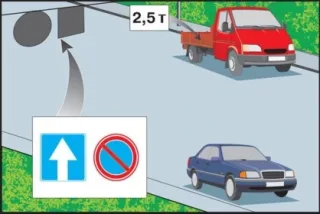
Question #15 Which drivers of vehicles have not violated parking rules in a populated area?
Topic: Stopping and parking
Answer help
15.3. In populated areas, stopping and parking of vehicles are permitted on the left side of a road having one lane for traffic in each direction (without tram tracks in the middle) and not divided by marking 1.1, as well as on the left side of a road with one-way traffic. If the road has a boulevard or a dividing strip, stopping and parking of vehicles near them is prohibited. -
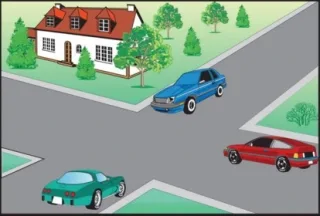
Question #16 Cars will pass the intersection in the following order:
Topic: Passing intersections
Answer help
16.12. At an intersection of equivalent roads, the driver of a trackless vehicle is obliged to give way to vehicles approaching from the right.
This rule should also be followed by tram drivers among themselves.
At any uncontrolled intersection, a tram, regardless of the direction of its further movement, has priority over trackless vehicles approaching it on an equivalent road. -
Question #17 What threatens traffic safety by sharply opening the carburetor throttle valve when driving on a slippery road?
Topic: Organization and safety of traffic
-
Question #18 You are approaching an uncontrolled pedestrian crossing, in front of which a vehicle has stopped in the lane adjacent to yours. You must:
Topic: Passing pedestrian crossings and stops of vehicles
Answer help
18.4. If before an uncontrolled pedestrian crossing a vehicle reduces speed or stops, drivers of other vehicles moving along adjacent lanes must reduce speed, and if necessary stop and may continue (resume) movement only after making sure that there are no pedestrians on the pedestrian crossing for whom an obstacle or danger may be created. -
Question #19 What should a driver do if, in the dark on unlit sections of roads, the low beam of the left headlight does not turn on?
Topic: Use of external lighting devices
Answer help
19.5. Fog lights can be used in conditions of insufficient visibility both separately and with low or high beam headlights, and in the dark on unlit sections of roads — only together with low or high beam headlights.
31.5. In the event of malfunctions on the road specified in point 31.4 of these Rules, the driver must take measures to eliminate them, and if this is impossible — move as short a path as possible to the place of parking or repair, observing precautionary measures with the fulfillment of the requirements of points 9.9 and 9.11 of these Rules.
In the event of malfunctions on the road specified in point 31.4.7 ("ї"; "д" — as part of a road train), further movement is prohibited until they are eliminated. The driver of the faulty vehicle must take measures to remove it beyond the carriageway. -
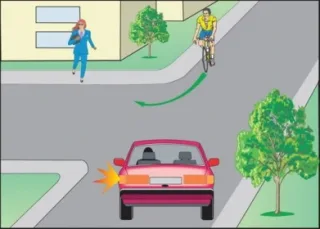
Question #20 Which vehicle driver has the right of way in traffic?
Topic: Passing intersections
Answer help
16.13. Before turning left and making a U-turn, the driver of a trackless vehicle is obliged to give way to a tram of the same direction, as well as to vehicles moving on an equivalent road in the opposite direction straight or to the right. This rule should also be followed by tram drivers among themselves.