
Practice: ticket #79
Answers are checked instantly. The hint — a rules excerpt — is under the question.
-
Question #1 The movement of a column is coordinated with the State Automobile Inspectorate if the minimum number of motor vehicles in it is more than:
Topic: Individual traffic rules issues requiring coordination with the State Automobile Inspection
Answer help
32.1. The following are agreed with the State Automobile Inspection authorities:
c) conditions and order of movement of columns consisting of more than 5 mechanical vehicles; -
Question #2 Is it allowed for pedestrians to cross the roadway outside a pedestrian crossing if there is a dividing strip on the road?
Topic: Duties and rights of pedestrians
Answer help
4.14. Pedestrians are prohibited from:
d) crossing the roadway outside a pedestrian crossing if there is a dividing strip or the road has four or more lanes for traffic in both directions, as well as in places where -
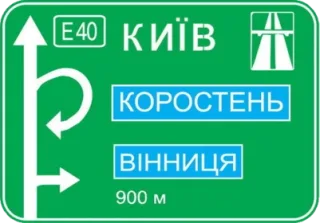
Question #3 On which road is this road sign installed?
Topic: Road signs (Appendix 1)
Answer help
5.51. "Preliminary direction indicator". Direction of movement to the populated areas and other objects indicated on the sign. The signs may have images of signs 3.2—3.8, 3.11—3.20, 3.29, 3.31, 5.1, 5.3, 5.28.1—5.30, 5.61.1, 6.1—6.24, airport symbols, sports and other pictograms, etc. The lower part of sign 5.51 indicates the distance from the place of installation of the sign to the intersection or the beginning of the deceleration lane.
Sign 5.51 is also used to indicate a detour around sections of roads on which one of the prohibitory signs 3.15—3.19 is installed.
Signs 5.51—5.54 installed outside a populated area have a green or blue background if they are installed respectively on a motorway or another road. An insert on a blue or green background means that movement to the indicated populated area or object is carried out respectively on a road other than a motorway, or on a motorway. Signs 5.51—5.54 installed in a populated area must have a white background. Inserts on a blue or green background mean that movement to the indicated populated area or object is carried out respectively on a road other than a motorway, or on a motorway. -
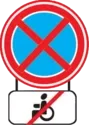
Question #4 These road sign and plate, according to the Road Traffic Rules, prohibit stopping of vehicles:
Topic: Road signs (Appendix 1)
Answer help
3.34. "Stopping prohibited". Stopping and parking of vehicles are prohibited, except for taxis picking up or dropping off passengers (loading or unloading cargo).
7.18. "Except for the disabled". Indicates that the sign does not apply to invalid carriages and cars on which the "Disabled" identification sign is installed in accordance with the requirements of these Rules. Used with signs 3.1, 3.34—3.38
2.8. A disabled driver driving an invalid carriage or a car marked with the "Disabled" identification sign may deviate from the requirements of road signs 3.1, 3.2 and 3.35—3.38,
as well as sign 3.34 if there is a plate 7.18 under it -
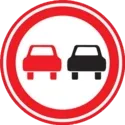
Question #5 In which of the indicated answers did the driver perform overtaking in accordance with the requirements of the Road Traffic Rules in the zone of action of this road sign?
Topic: Road signs (Appendix 1)
Answer help
3.25. "Overtaking prohibited". Overtaking of all vehicles is prohibited (except for single *, moving at a speed of less than 30 km/h).
* Single vehicles are considered to be single vehicles, road trains, as well as a towing vehicle coupled with a towed one. -
Question #6 What does this road marking mean?
Topic: Road markings (Appendix 2)

Answer help
1.22. — indicates the road number (route); -
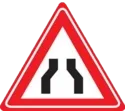
Question #7 What information is contained in this road sign?
Topic: Road signs (Appendix 1)
Answer help
1.5.1—1.5.3. "Road narrowing". Sign 1.5.1 — narrowing of the road on both sides, 1.5.2 — on the right, 1.5.3 — on the left side. -
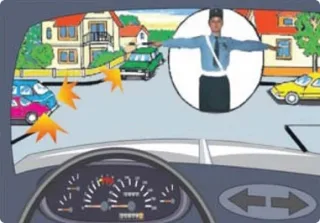
Question #8 Is it allowed for the red car to move?
Topic: Traffic regulation
Answer help
8.8. Traffic controller signals. Traffic controller signals are the positions of his body, as well as hand gestures, including with a baton or a disc with a red reflector,
having the following meanings:
a) arms extended to the sides, lowered or the right arm bent in front of the chest: from the left and right sides — tram movement straight is allowed, trackless vehicles — straight and -
Question #9 In which of the listed cases can fog lights be turned on?
Topic: Warning signals
Answer help
9.8. During the movement of mechanical vehicles in daylight hours, in order to indicate a moving vehicle, the dipped headlights must be switched on:
a) in a column;
b) on route vehicles moving along a lane marked with road sign 5.8, towards the general flow of vehicles;
c) on buses (minibuses) carrying organized groups of children;
d) on heavy, large-sized vehicles and vehicles carrying out road transportation of dangerous goods;
e) on the towing vehicle;
f) in tunnels.
In conditions of insufficient visibility, on mechanical vehicles you can turn on the high beam headlights or additionally fog lights, provided that this does not blind other drivers.
19.5. Fog lights can be used in conditions of insufficient visibility both separately and with low or high beam headlights, and in the dark on unlit sections of roads — only together with low or high beam headlights. -
Question #10 A U-turn is prohibited:
Topic: Starting movement and changing its direction
Answer help
10.7. U-turn is prohibited:
a) at railway crossings;
b) on bridges, overpasses, viaducts and under them;
c) in tunnels;
d) when road visibility is less than 100 m in at least one direction;
e) at pedestrian crossings and closer than 10 m from them on both sides, except for the case of a permitted U-turn at an intersection;
f) on motorways, as well as on roads for cars, except for intersections and places marked with road signs 5.26 or 5.27 -
Question #11 Non-rail vehicles must move:
Topic: Position of vehicles on the road
Answer help
11.2. Trackless vehicles must move as close as possible to the right edge of the carriageway. -
Question #12 What should the driver take into account when choosing the speed within the established limits?
Topic: Speed of movement
Answer help
12.1. When choosing a safe speed within the established limits, the driver must take into account the road situation, as well as the characteristics of the cargo being transported and the condition of the vehicle, in order to be able to constantly control its movement and safely drive it. -
Question #13 What distance must drivers of vehicles whose speed does not exceed 40 km/h observe on roads outside populated areas?
Topic: Distance, interval, oncoming passing
Answer help
13.2. On roads outside populated areas, drivers of vehicles whose speed does not exceed 40 km/h must maintain such a distance that vehicles,
overtaking, have the opportunity to return unhindered to the previously occupied lane.
This requirement does not apply if the driver of a slow-moving vehicle gives warning signals about overtaking or passing. -
Question #14 In which answer is one of the conditions correctly named that the driver must make sure of before starting to overtake?
Topic: Overtaking
Answer help
14.2. Before starting to overtake, the driver must make sure that:
b) the driver of the vehicle moving ahead in the same lane has not given a signal of intention to turn (change lanes) to the left; -
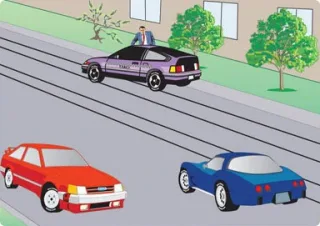
Question #15 Is it allowed to stop a passenger car on a tram track of the same direction located at the right edge of the roadway?
Topic: Stopping and parking
Answer help
15.8. On a tram track of the same direction, located on the left at the same level as the carriageway for the movement of trackless vehicles, stopping is allowed only to comply with the requirements of these Rules, and on those located at the right edge of the carriageway — only for boarding (alighting) of passengers or to comply with the requirements of these Rules.
In these cases, no obstacles should be created for the movement of trams. -
Question #16 When turning onto the intersecting road at a permissive traffic light signal, the driver:
Topic: Passing intersections
Answer help
16.5. When a traffic controller signal or a traffic light signal permitting movement is given, the driver must give way to vehicles completing movement through the intersection, as well as to pedestrians finishing crossing. -
Question #17 In which of the listed cases can a driver underestimate their own speed and exceed it?
Topic: Organization and safety of traffic
-
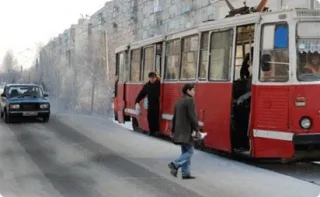
Question #18 What must the driver do in this situation?
Topic: Passing pedestrian crossings and stops of vehicles
Answer help
18.8. The driver of a vehicle must stop to give way to pedestrians walking from the side of open doors to the tram (or from the tram) that is standing at a stop,
if boarding or alighting is carried out from the carriageway or a landing area located on it.
It is allowed to continue driving only when pedestrians leave the carriageway and the tram doors close. -
Question #19 At night and in conditions of insufficient visibility, on a moving mechanical vehicle must be turned on:
Topic: Use of external lighting devices
Answer help
19.1. In the dark and in conditions of insufficient visibility, regardless of the degree of road lighting, as well as in tunnels, the following lighting devices must be switched on on a moving vehicle:
a) on all mechanical vehicles — low (high) beam headlights;
19.5. Fog lights can be used in conditions of insufficient visibility both separately and with low or high beam headlights, and in the dark on unlit sections of roads — only together with low or high beam headlights.
19.9. The rear fog light is allowed to be used in conditions of insufficient visibility both in daylight and in the dark. -
Question #20 If there is no road marking or road signs before a railway crossing that determine the number of lanes for traffic, the movement of vehicles through the crossing is allowed.
Topic: Movement through railway crossings
Answer help
20.4. If there is no road marking or road signs in front of the crossing that determine the number of traffic lanes, the movement of vehicles through the crossing is allowed only in one row.