
Practice: ticket #75
Answers are checked instantly. The hint — a rules excerpt — is under the question.
-
Question #1 According to the definition in the Traffic Rules, 'safe speed' is:
Topic: General provisions
Answer help
safe speed — a speed at which the driver has the ability to safely operate the vehicle and control its movement in specific road conditions; -
Question #2 Which vehicles does the effect of this road sign not apply to?
Topic: Road signs (Appendix 1)
Answer help
2.8. A disabled driver operating a motorized wheelchair or a vehicle marked with the identification sign "Disabled Person" may deviate from the requirements of road signs 3.1, 3.2, and 3.35—3.38, as well as sign 3.34 when accompanied by plate 7.18.
3.35. "No Parking". Parking of all vehicles is prohibited. -
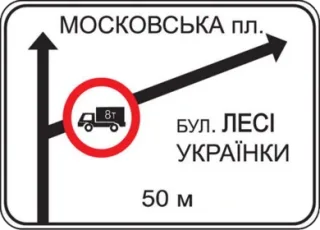
Question #3 What information is contained in this road sign?
Topic: Road signs (Appendix 1)
Answer help
5.51. "Advance Direction Sign". Direction of travel to the populated areas and other objects indicated on the sign. The signs may bear images of signs 3.2—3.8, 3.11—3.20, 3.29, 3.31, 5.1, 5.3, 5.28.1—5.30, 5.61.1, 6.1—6.24, airport symbols, sports and other pictograms, etc. The lower part of sign 5.51 indicates the distance from the place of installation of the sign to the intersection or the beginning of the deceleration lane.
Sign 5.51 is also used to indicate a detour around sections of roads on which one of the prohibitory signs 3.15—3.19 is installed. -
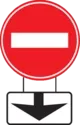
Question #4 What information is contained in this road sign with a plate?
Topic: Road signs (Appendix 1)
Answer help
3.21. "No Entry". Entry of all vehicles is prohibited.
7.9. "Traffic Lane". Defines the traffic lane to which the effect of the sign or traffic light applies. -
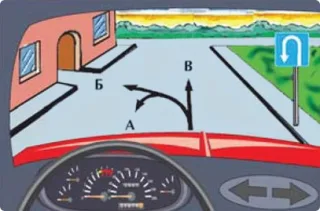
Question #5 This road sign permits the movement of a vehicle:
Topic: Road signs (Appendix 1)
Answer help
5.26. "Turning Area". Indicates a place for turning vehicles around. Left turns are prohibited. -
Question #6 Which of the figures shows the marking of a pedestrian crossing where traffic is regulated by a traffic light?
Topic: Road markings (Appendix 2)
Answer help
1.14.3. — indicates a pedestrian crossing where traffic is regulated by a traffic light; -
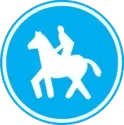
Question #7 What information is contained in this road sign?
Topic: Road signs (Appendix 1)
Answer help
4.15. "Horse Rider Path". Movement of horse riders only. -
Question #8 Which answer correctly indicates the permitted direction of travel?
Topic: Traffic regulation
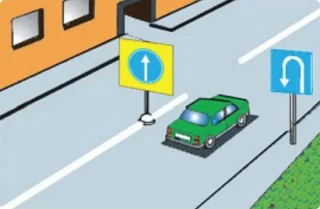
Answer help
8.2. Road signs may be permanent, temporary, and with variable information. Temporary road signs are placed on portable devices or road equipment, or are attached to a shield with a yellow background and have priority over permanent road signs and road markings. -
Question #9 Giving an audible signal in populated areas is allowed:
Topic: Warning signals
Answer help
9.5. Sounding audible signals in populated areas is prohibited, except when it is impossible to prevent a traffic accident without it. -
Question #10 How, according to the requirements of the Traffic Rules, should one correctly make a left turn from a road with two-way traffic onto a road with one-way two-lane traffic?
Topic: Starting movement and changing its direction
Answer help
10.4. Before turning right, left, or making a U-turn, the driver must take the appropriate extreme position on the carriageway intended for movement in that direction in advance, except when making a turn when entering an intersection where circular traffic is organized, the direction of movement is determined by road signs or road markings, or movement is possible only in one direction established by the configuration of the carriageway, road signs, or markings.
A driver making a left turn or U-turn outside an intersection from the corresponding extreme position on the carriageway of this direction must yield to oncoming vehicles, and when performing these maneuvers not from the extreme left position on the carriageway — also to vehicles traveling in the same direction.
If there is a tram track in the middle of the carriageway, the driver of a non-rail vehicle making a left turn or U-turn outside an intersection must yield to the tram.
10.5. The turn must be performed so that when leaving the intersection of carriageways, the vehicle does not end up on the lane of oncoming traffic, and when turning right, one should drive closer to the right edge of the carriageway, except when leaving an intersection where circular traffic is organized, where the direction of movement is determined by road signs or road markings, or where movement is possible only in one direction. -
Question #11 Is it allowed to make a left turn or a U-turn when driving bicycles and mopeds on the roadway?
Topic: Position of vehicles on the road
Answer help
11.14. Movement on the carriageway on bicycles, mopeds, horse-drawn carts (sleds), and horse riders is allowed only in one row along the rightmost lane as far to the right as possible, except when overtaking. Left turns and U-turns are allowed on roads with one lane for movement in each direction and without a tram track in the middle.
Movement on the shoulder is allowed if it does not create obstacles for pedestrians. -
Question #12 At what maximum speed is the driver of a truck allowed to drive if he is towing a passenger car?
Topic: Speed of movement
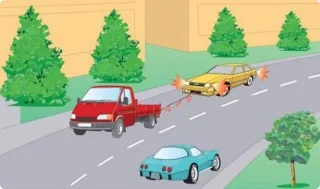
Answer help
12.7. During towing, the speed must not exceed 50 km/h. -
Question #13 Which figure shows the position of the victim in which it is recommended to transport him in case of shock?
Topic: Fundamentals of providing medical assistance in case of a traffic accident
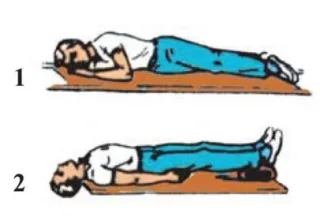
-
Question #14 Which of the listed actions should the driver approaching a railway crossing perform?
Topic: Overtaking
Answer help
14.6. Overtaking is prohibited:
b) at railway crossings and closer than 100 m before them;
20.2. When approaching a crossing, as well as when starting to move after stopping before it, the driver must be guided by the instructions and signals of the crossing attendant, the position of the barrier, light and sound signaling, road signs and road markings, and also make sure that no train (locomotive, railcar) is approaching. -
Question #15 Stopping is prohibited:
Topic: Stopping and parking
Answer help
15.10. Parking is prohibited:
d) in places where a parked vehicle would make it impossible for other vehicles to move or would create an obstacle for pedestrian movement. -
Question #16 Which driver has the right to priority movement?
Topic: Passing intersections
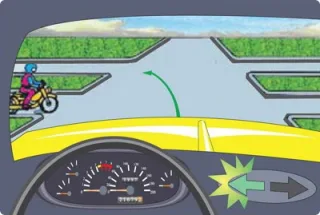
Answer help
16.12. At an intersection of equivalent roads, the driver of a non-rail vehicle must yield to vehicles approaching from the right.
Tram drivers must also be guided by this rule among themselves.
At any uncontrolled intersection, a tram, regardless of the direction of its further movement, has priority over non-rail vehicles approaching it on an equivalent road. -
Question #17 While driving straight, you suddenly hit a slippery section of the road. What should you do in this situation?
Topic: Organization and safety of traffic
-
Question #18 In which of the listed cases is further movement of vehicles prohibited?
Topic: Technical condition of vehicles and their equipment
Answer help
31.6. Further movement of vehicles is prohibited if:
c) during rain or snowfall, the windshield wiper on the side of the steering wheel is not working; -
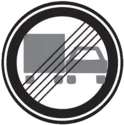
Question #19 On the section of the road behind this road sign:
Topic: Road signs (Appendix 1)
Answer help
3.28. "End of No Overtaking for Trucks". -
Question #20 When leaving an unpaved road onto an asphalt road, the driver must yield to:
Topic: Passing intersections
Answer help
16.11. At an intersection of unequal roads, the driver of a vehicle moving on a secondary road must yield to vehicles approaching this intersection of carriageways on the main road, regardless of the direction of their further movement.