
Practice: ticket #72
Answers are checked instantly. The hint — a rules excerpt — is under the question.
-
Question #1 According to the definition of the Traffic Rules, at what minimum distance do the conditions of 'insufficient visibility' occur in twilight, in conditions of fog, rain, snowfall, etc.?
Topic: General provisions

Answer help
insufficient visibility — visibility of the road in the direction of travel less than 300 m in twilight, in conditions of fog, rain, snowfall, etc.; -
Question #2 How should the driver of a motorcycle without a sidecar act if he heard a special sound signal and saw that a car with a blue flashing beacon is catching up with him?
Topic: Movement of vehicles with special signals
Answer help
3.2. In the event of approach of a vehicle with a blue flashing beacon and (or) special sound signal turned on, drivers of other vehicles that may create an obstacle to its movement must yield to it and ensure unobstructed passage of the specified vehicle (and vehicles accompanied by it).
On vehicles moving in an accompanied column, low beam headlights must be turned on.
If on such a vehicle flashing beacons of blue and red or only red are turned on, drivers of other vehicles must stop at the right edge of the roadway (on the right shoulder). On a road with a dividing strip, this requirement must be fulfilled by drivers of vehicles moving in the same direction. -
Question #3 What information is contained in this road sign?
Topic: Road signs (Appendix 1)
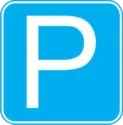
Answer help
5.38. "Parking area." -
Question #4 This road sign means:
Topic: Road signs (Appendix 1)
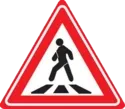
Answer help
1.32. "Pedestrian crossing." Approach to an uncontrolled pedestrian crossing marked with appropriate road signs or road markings. -
Question #5 What information is contained in this road sign?
Topic: Road signs (Appendix 1)
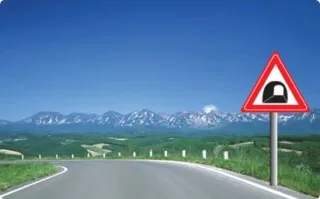
Answer help
1.9. "Tunnel." Approach to a structure that does not have artificial lighting, the visibility of the entrance portal of which is limited or the roadway is narrowed on the approach to it. -
Question #6 Is it allowed to cross a narrow solid white line of road marking indicating the edge of the carriageway adjacent to the shoulder?
Topic: Road markings (Appendix 2)
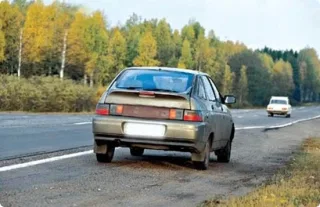
Answer help
1.1. (narrow solid line) — separates traffic flows of opposite directions and marks the boundaries of traffic lanes on roads; marks the boundaries of the carriageway, entry onto which is prohibited; marks the boundaries of parking places for vehicles and the edge of the carriageway of roads not classified by traffic conditions as motorways;
Lines 1.1 and 1.3 are prohibited to cross. If line 1.1 marks a parking place or the edge of the carriageway adjacent to the shoulder, crossing this line is permitted.
As an exception, provided that road safety is ensured, it is permitted to cross line 1.1 to bypass a stationary obstacle whose dimensions do not allow its safe bypass without crossing this line, as well as to overtake single vehicles moving at a speed of less than 30 km/h. -
Question #7 What information is contained in this road sign with a plate?
Topic: Road signs (Appendix 1)

Answer help
3.35. "Parking prohibited". Parking of all vehicles is prohibited.
7.2.1.—7.2.6. "Area of operation". They indicate: 7.2.1 — the length of the dangerous section marked by warning signs, or the area of operation of prohibition and information-indication signs;
7.2.2 — the area of operation of prohibition signs 3.34—3.37, as well as the length of one or more stopping places located one after another; 7.2.3 — the end of the area of operation of signs 3.34—3.37;
7.2.4 — that the vehicle is within the area of operation of signs 3.34—3.37; 7.2.5, 7.2.6 — the direction and area of operation of signs 3.34—3.37 in the case of prohibiting stopping or parking along one side of a square, building facade, etc. When used together with prohibition signs, the plates reduce the area of operation of the signs. -
Question #8 What should a driver be guided by when the requirements of temporary road signs and lane markings contradict each other?
Topic: Traffic regulation
Answer help
8.2. Road signs may be permanent, temporary, and with changing information. Temporary road signs are placed on portable devices or road equipment, or are attached to a shield with a yellow background and have priority over permanent road signs and road markings. -
Question #9 The driver must give signals with the direction indicators of the corresponding direction:
Topic: Warning signals
Answer help
9.2. The driver must give signals with direction indicator lights of the corresponding direction:
a) before starting to move and before stopping;
b) before changing lanes, turning, or making a U-turn. -
Question #10 How should the driver of a passenger car act in the shown situation?
Topic: Starting movement and changing its direction
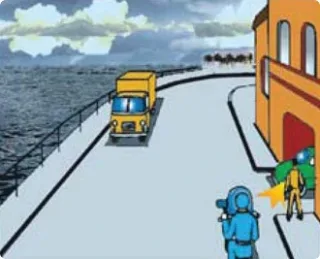
Answer help
10.2. When entering a road from a residential area, courtyards, parking places, petrol stations, and other adjacent territories, the driver must, before the carriageway or sidewalk, yield to pedestrians and vehicles moving along it, and when leaving the road — to cyclists and pedestrians whose direction of movement he is crossing. -
Question #11 A two-way road has three lanes for traffic in each direction. In which of the listed cases is the driver of a passenger car allowed to enter the far left lane?
Topic: Position of vehicles on the road
Answer help
11.5. On roads having two or more lanes for movement in one direction, driving onto the extreme left lane for movement in the same direction is permitted if the right lanes are occupied, as well as for turning left, making a U-turn, or for stopping or parking on the left side of a road with one-way traffic in populated areas, if this does not contradict the stopping (parking) rules. -
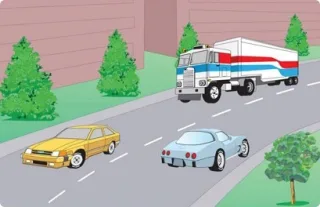
Question #12 At what maximum speed is it allowed for trucks to travel in populated areas?
Topic: Speed of movement
Answer help
12.4. In populated areas, the movement of vehicles is permitted at a speed of no more than 60 km/h. -
Question #13 How to transport a victim with an injury to the thoracic spine?
Topic: Fundamentals of providing medical assistance in case of a traffic accident
-
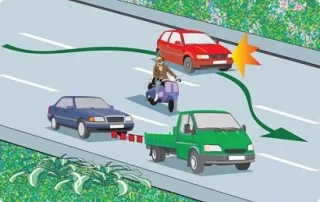
Question #14 Is overtaking allowed for the driver of the red car? A motorcyclist is performing a detour.
Topic: Overtaking
Answer help
14.6. Overtaking is prohibited:
ґ) of a vehicle that is overtaking or bypassing; -
Question #15 In which of the listed places is stopping vehicles prohibited?
Topic: Stopping and parking
Answer help
15.9. Stopping is prohibited:
в) on overpasses, bridges, viaducts, and under them, as well as in tunnels; -
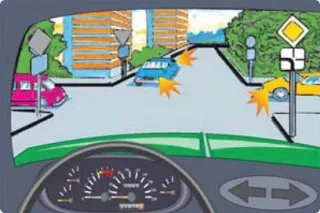
Question #16 The third to pass the intersection will be:
Topic: Passing intersections
Answer help
16.11. At an intersection of unequal roads, the driver of a vehicle moving on a secondary road must yield to vehicles approaching this crossing of carriageways on the main road, regardless of the direction of their further movement.
16.14. If the main road at an intersection changes direction, drivers of vehicles moving on it must be guided among themselves by the rules for passing through intersections of equal roads.
Drivers moving on secondary roads must also be guided by this rule among themselves. -
Question #17 When driving on a turn, the car is more stable if the movement is carried out:
Topic: Organization and safety of traffic
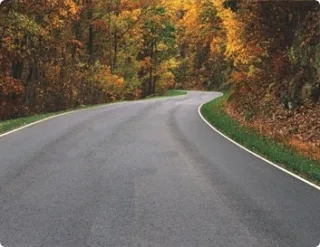
-
Question #18 The minimum permissible value of the residual tread pattern height of tires for trucks with a permitted maximum mass of more than 3.5 tons, according to the Road Traffic Rules, is:
Topic: Technical condition of vehicles and their equipment
Answer help
31.4.5. Wheels and tires:
а) tires of passenger cars and trucks with a permitted maximum mass of up to 3.5 t have a residual tread pattern height of less than 1.6 mm, trucks with -
Question #19 A searchlight headlight may be used only by drivers of operational vehicles:
Topic: Use of external lighting devices
Answer help
19.6. A spotlight and a searchlight may be used only by drivers of operational vehicles during the performance of official tasks, taking measures not to blind other road users. -
Question #20 The signal to stop a train is:
Topic: Movement through railway crossings
Answer help
20.9. The stop signal of a train (locomotive, railcar) is a circular movement of the hand (in daylight — with a piece of bright fabric or any clearly visible object, in the dark and in conditions of insufficient visibility — with a torch or lantern). The general alarm signal is a series of sound signals of a vehicle, consisting of one long and three short signals.