
Advertising
Practice: ticket #70
Answers are checked instantly. The hint — a rules excerpt — is under the question.
-
Question #1 Is it allowed to inspect things, hand luggage, or baggage during the absence of their owner (possessor)?
Topic: Fundamentals of law
-
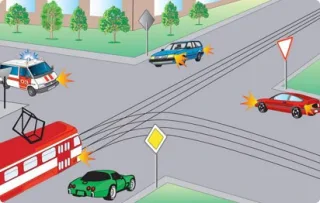
Question #2 The blue car will pass the intersection:
Topic: Passing intersections
Answer help
3.2. In the case of approach of a vehicle with a blue flashing beacon and (or) a special sound signal, drivers of other vehicles that may create an obstacle to its movement must give way to it and ensure unhindered passage of the specified vehicle (and vehicles accompanied by it).
On vehicles moving in an accompanied column, the low beam headlights must be turned on.
If on such a vehicle flashing beacons of blue and red or only red are turned on, drivers of other vehicles must stop at the right edge of the roadway (on the right roadside). On a road with a dividing strip, this requirement must be fulfilled by drivers of vehicles moving in the same direction.
16.11. At an intersection of unequal roads, the driver of a vehicle moving on a secondary road must give way to vehicles approaching this intersection of roadways on the main road, regardless of the direction of their further movement.
16.13. Before turning left and making a U-turn, the driver of a non-rail vehicle must give way to a tram of the same direction, as well as to vehicles moving on an equivalent road in the opposite direction straight or to the right.
Tram drivers must also be guided by this rule among themselves. -
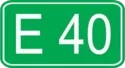
Question #3 What information is contained in this road sign?
Topic: Road signs (Appendix 1)
Answer help
5.61.1.—5.61.3. "Route number". Signs 5.61.1 — number assigned to the road (route); 5.61.2, 5.61.3 — number and direction of the road (route). -
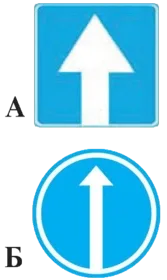
Question #4 How to determine a road with one-way traffic?
Topic: Road markings (Appendix 2)
Answer help
1.3. — separates traffic flows of opposite directions on roads having four or more lanes;
5.5. "Road with one-way traffic". A road or a separate roadway along which traffic of vehicles across the entire width is carried out only in one direction. -
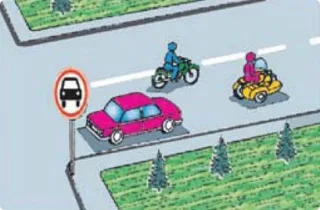
Question #5 Drivers of which vehicles, carrying out transit traffic, violated the requirement of this road sign?
Topic: Road signs (Appendix 1)
Answer help
3.2. "Several turns". A road section with two or more dangerous turns located one after another: 1.3.1 — with the first turn to the right, 1.3.2 — with the first turn to the left. -
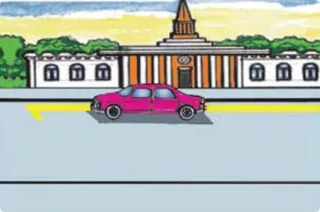
Question #6 Is stopping allowed in this place?
Topic: Road markings (Appendix 2)
Answer help
1.4. — indicates places where stopping and parking of vehicles are prohibited. It is used independently or in combination with sign 3.34 and is applied at the edge of the roadway or along the top of the curb; -
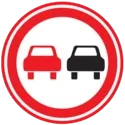
Question #7 Which vehicles does this road sign prohibit overtaking?
Topic: Road signs (Appendix 1)
Answer help
3.25. "Overtaking prohibited". Overtaking of all vehicles is prohibited (except single ones *, moving at a speed of less than 30 km/h).* Single vehicles are considered to be single vehicles, road trains, as well as a towing vehicle coupled with a towed one. -
Question #8 At the red signal of this traffic light, movement is prohibited:
Topic: Traffic regulation

Answer help
8.7.4. To regulate the movement of vehicles on streets, roads or along lanes of the roadway, the direction of movement on which may change to the opposite,
reversible traffic lights with a red X-shaped signal and a green signal in the form of an arrow pointing down are used. These signals prohibit or allow movement along the lane above which they are located.
The main signals of a reversible traffic light may be supplemented with a yellow signal in the form of an arrow inclined diagonally down to the right, the inclusion of which prohibits movement along the lane marked on both sides by road marking 1.9, and informs about the change of the reversible traffic light signal and the need to change to the right lane.
When the signals of the reversible traffic light located above the lane marked on both sides by road marking 1.9 are turned off, entry into this lane is prohibited. -
Question #9 At what distance before the vehicle is the emergency stop sign or flashing red light installed in daylight?
Topic: Warning signals
Answer help
9.10. Together with turning on the hazard warning lights, an emergency stop sign or a flashing red lantern should be installed at a distance ensuring road safety, but not closer than 20 m to the vehicle in populated areas and 40 m outside them, in case of:
a) a traffic accident;
b) a forced stop in places with limited visibility of the road in at least one direction less than 100 m. -
Question #10 In which of the listed cases is reversing allowed?
Topic: Starting movement and changing its direction
Answer help
10.10. Reversing of vehicles is prohibited on motorways, roads for cars, railway crossings, pedestrian crossings, intersections, bridges,
overpasses, elevated roads, in tunnels, at entrances and exits from them, as well as on road sections with limited visibility or insufficient visibility.
Reversing is allowed on roads with one-way traffic provided that the requirements of point 10.9 of these Rules are met and it is impossible to approach the object in another way. -
Question #11 When is it prohibited to drive onto the side of the road intended for oncoming traffic?
Topic: Position of vehicles on the road
Answer help
11.4. On roads with two-way traffic having at least two lanes for traffic in one direction, it is prohibited to enter the side of the road intended for oncoming traffic.
1.3. — separates traffic flows of opposite directions on roads having four or more lanes; -
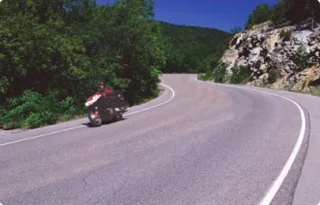
Question #12 Moving along the road at the maximum permitted speed, the driver saw an obstacle ahead. Road signs or markings regulating the order of movement are absent. According to the requirements of the Traffic Rules, he must:
Topic: Speed of movement
Answer help
12.3. In the event of a danger to traffic or an obstacle that the driver is objectively able to detect, he must immediately take measures to reduce speed up to stopping the vehicle or safely for other road users bypassing the obstacle. -
Question #13 If oncoming passing is difficult, the driver of which vehicle must give way?
Topic: Distance, interval, oncoming passing
Answer help
13.4. If oncoming passage is difficult, the driver on whose lane there is an obstacle or the dimensions of the vehicle he is driving interfere with oncoming traffic,
must give way. On road sections marked with signs 1.6 "Steep ascent" and 1.7 "Steep descent", in the presence of an obstacle, the driver of the vehicle moving downhill must give way. -
Question #14 Must the driver who has completed overtaking always return to the previously occupied lane?
Topic: Overtaking
Answer help
14.5. The driver of a vehicle performing overtaking may remain on the oncoming lane if after returning to the previously occupied lane he will have to start overtaking again, provided that he does not create danger to oncoming vehicles, and also will not interfere with vehicles moving behind him at a higher speed. -
Question #15 The driver may leave his place or leave the vehicle if:
Topic: Stopping and parking
Answer help
15.12. The driver must not leave the vehicle without taking all measures to prevent its spontaneous movement, penetration into it and (or) illegal seizure of it. -
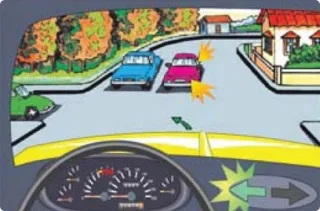
Question #16 The cars will pass the intersection in the following order:
Topic: Passing intersections
Answer help
16.12. At an intersection of equivalent roads, the driver of a non-rail vehicle must give way to vehicles approaching from the right.
Tram drivers must also be guided by this rule among themselves.
At any uncontrolled intersection, a tram, regardless of the direction of its further movement, has priority over non-rail vehicles approaching it on an equivalent road.
16.13. Before turning left and making a U-turn, the driver of a non-rail vehicle must give way to a tram of the same direction, as well as to vehicles moving on an equivalent road in the opposite direction straight or to the right.
Tram drivers must also be guided by this rule among themselves. -
Question #17 For road safety in conditions of heavy fog, the driver is recommended to:
Topic: Organization and safety of traffic
-
Question #18 Under what conditions is the operation of vehicles allowed?
Topic: Technical condition of vehicles and their equipment
Answer help
31.4.5. Wheels and tires:
a) tires of passenger cars and trucks with a permissible maximum mass up to 3.5 t have a residual tread pattern height of less than 1.6 mm, trucks with -
Question #19 It is allowed to use the searchlight headlight:
Topic: Use of external lighting devices
Answer help
19.6. High-beam headlights and searchlights may be used only by drivers of operational vehicles while performing official tasks, taking measures to avoid blinding other road users. -
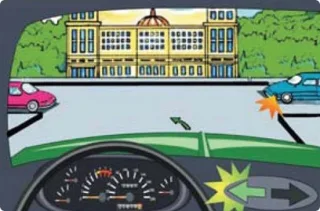
Question #20 The blue car will pass the intersection:
Topic: Passing intersections
Answer help
16.12. At an intersection of equivalent roads, the driver of a non-rail vehicle must yield to vehicles approaching from the right.
Tram drivers must also be guided by this rule among themselves.
At any uncontrolled intersection, a tram, regardless of the direction of its further movement, has priority over non-rail vehicles approaching it on an equivalent road.
16.13. Before turning left or making a U-turn, the driver of a non-rail vehicle must yield to a tram traveling in the same direction, as well as to vehicles moving on an equivalent road in the opposite direction straight or to the right.
Tram drivers must also be guided by this rule among themselves.