
Practice: ticket #69
Answers are checked instantly. The hint — a rules excerpt — is under the question.
-
Question #1 The police have the right to use physical force, special means, and firearms:
Topic: Fundamentals of law
-
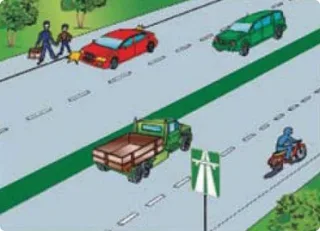
Question #2 Which road user violates the Rules?
Topic: Duties and rights of pedestrians
Answer help
4.14. Pedestrians are prohibited:
d) to move along a motorway or a road for cars, except for pedestrian paths, parking and rest areas.
6.7. Drivers of mopeds and bicycles are prohibited:
b) to move along motorways and roads for cars, as well as along the roadway if there is a bicycle path nearby;
27.2. On motorways and roads for cars, it is prohibited:
b) movement of freight vehicles with a permitted maximum mass over 3.5 t outside the first and second traffic lanes (except for turning left or making a U-turn on roads -
Question #3 This road sign warns that ahead:
Topic: Road signs (Appendix 1)

Answer help
1.29. "Single-track Railway". Designation of a crossing over a railway with one track not equipped with a barrier. -
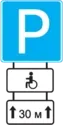
Question #4 This road sign with plates indicates:
Topic: Road signs (Appendix 1)
Answer help
5.38. "Parking Place".
7.2.1—7.2.6. "Area of Operation". They indicate: 7.2.1 — the length of the dangerous section indicated by warning signs, or the area of operation of prohibition and information-indicative signs;
7.2.2 — the area of operation of prohibition signs 3.34—3.37, as well as the length of one or several stopping areas located one after another; 7.2.3 — the end of the area of operation of signs 3.34—3.37;
7.2.4 — that the vehicle is within the area of operation of signs 3.34—3.37; 7.2.5, 7.2.6 — the direction and area of operation of signs 3.34—3.37 in case of prohibition of stopping or parking along one side of a square, building facade, etc. When used together with prohibition signs, the plates reduce the area of operation of the signs.
7.17. "Disabled Persons". Indicates that the effect of sign 5.38 applies only to motorized wheelchairs and cars on which the identification sign "Disabled Person" is installed in accordance with the requirements of these Rules. -
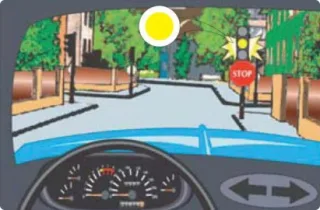
Question #5 The traffic light operates in flashing yellow signal mode. Are you allowed to pass the intersection without stopping before the 'Stop' sign?
Topic: Road signs (Appendix 1)
Answer help
2.2. "Proceeding Without Stopping is Prohibited". Proceeding without stopping before marking 1.12 (stop line) is prohibited, and if it is absent — before the sign.
16.1. An intersection where the order of passage is determined by traffic light signals or a traffic controller is considered controlled. At such an intersection, priority signs do not apply.
In the event of a traffic light being turned off or operating in flashing yellow signal mode and the absence of a traffic controller, the intersection is considered uncontrolled and drivers must be guided by the rules for passing through uncontrolled intersections and the priority signs installed at the intersection. -
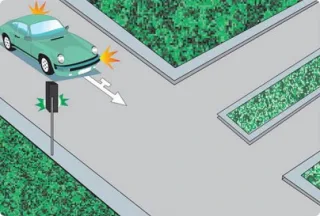
Question #6 This road marking allows:
Topic: Road markings (Appendix 2)
Answer help
1.18. — indicates the permitted directions of movement along lanes at an intersection. It is used independently or in combination with signs 5.16, 5.18; marking with the image of a dead end is applied to indicate that turning onto the nearest roadway is prohibited; marking that permits turning left from the extreme left lane also permits a U-turn; -
Question #7 This road sign:
Topic: Road signs (Appendix 1)
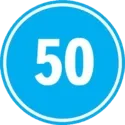
Answer help
4.16. "Minimum Speed Limit". Movement at a speed not less than indicated on the sign, but not more than provided for by points 12.4—12.7 of these Rules. -
Question #8 Movement is allowed
Topic: Traffic regulation
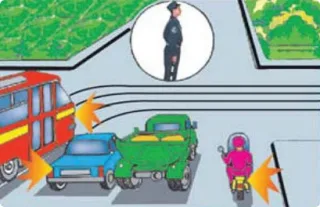
Answer help
8.8. Traffic Controller Signals. Traffic controller signals are the positions of his body, as well as hand gestures, including with a baton or a disc with a red reflector,
having the following meanings:
a) arms extended to the sides, lowered, or the right arm bent in front of the chest: from the left and right sides — tram movement is allowed straight, trackless vehicles — straight and -
Question #9 On a towed motor vehicle:
Topic: Warning signals
Answer help
9.9. Hazard warning lights must be turned on:
d) on a towed motor vehicle; -
Question #10 When entering the road from the acceleration lane in a passenger car, you:
Topic: Starting movement and changing its direction
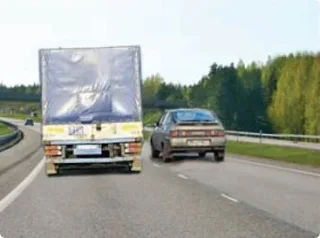
Answer help
10.8. If there is a deceleration lane at the place of leaving the road, the driver who intends to turn onto another road must change lanes to this lane in a timely manner and reduce speed only on it.
If there is an acceleration lane at the place of entering the road, the driver must move along it and merge into the traffic flow, yielding to vehicles moving on this road. -
Question #11 Which car is correctly parked?
Topic: Position of vehicles on the road
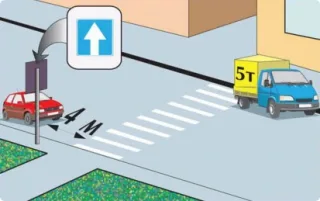
Answer help
11.6. On roads with three or more lanes for traffic in one direction, trucks with a permissible maximum mass exceeding 3.5 t, tractors, self-propelled machines and mechanisms are allowed to enter the extreme left lane only for turning left and making a U-turn, and in populated areas on roads with one-way traffic, in addition, for stopping on the left, in permitted cases, for the purpose of loading or unloading.
15.9. Stopping is prohibited:
g) at pedestrian crossings and closer than 10 m from them on both sides, except in cases of giving priority in traffic; -
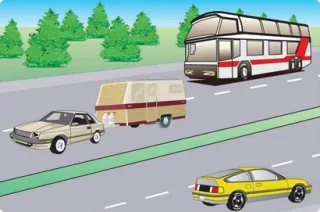
Question #12 What is the maximum speed allowed for passenger cars with trailers on highways?
Topic: Speed of movement
Answer help
12.6. Outside populated areas on all roads and on roads passing through populated areas, marked with sign 5.47, traffic is allowed at a speed of:
a) buses (minibuses) carrying organized groups of children, passenger cars with a trailer and motorcycles – no more than 80 km/h; -
Question #13 If oncoming passing on road sections marked with the 'Steep descent' sign is difficult, you must give way to:
Topic: Distance, interval, oncoming passing
Answer help
13.4. If oncoming passage is difficult, the driver on whose lane there is an obstacle or the dimensions of the vehicle he is driving interfere with oncoming traffic,
must give way. On road sections marked with signs 1.6 "Steep ascent" and 1.7 "Steep descent", in the presence of an obstacle, the driver of the vehicle moving downhill must give way. -
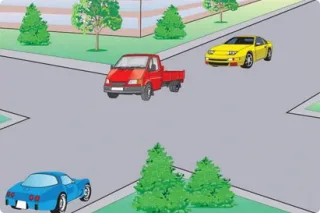
Question #14 Overtaking of non-rail vehicles is prohibited:
Topic: Overtaking
Answer help
14.6. Overtaking is prohibited:
a) at intersections; -
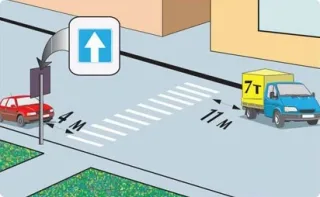
Question #15 Which of these cars stopped correctly?
Topic: Stopping and parking
Answer help
15.3. In populated areas, stopping and parking of vehicles are allowed on the left side of the road having one lane for traffic in each direction (without tram tracks in the middle) and not separated by marking 1.1, as well as on the left side of a road with one-way traffic.
If the road has a boulevard or a dividing strip, stopping and parking of vehicles near them is prohibited.
11.6. On roads with three or more lanes for traffic in one direction, trucks with a permissible maximum mass exceeding 3.5 t, tractors, self-propelled machines and mechanisms are allowed to enter the extreme left lane only for turning left and making a U-turn, and in populated areas on roads with one-way traffic, in addition, for stopping on the left, in permitted cases, for the purpose of loading or unloading. -
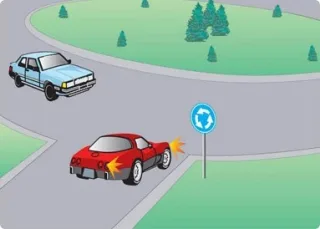
Question #16 Which vehicle has the right of way at the intersection with circular traffic?
Topic: Passing intersections
Answer help
16.12. At an intersection of equivalent roads, the driver of a non-rail vehicle must give way to vehicles approaching from the right.
Tram drivers must also be guided by this rule among themselves.
At any uncontrolled intersection, a tram, regardless of the direction of its further movement, has priority over non-rail vehicles approaching it on an equivalent road. -
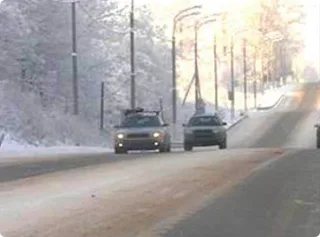
Question #17 You have pulled out to overtake and suddenly saw an oncoming vehicle. If you are not sure that you can complete the overtaking, you must:
Topic: Organization and safety of traffic
-
Question #18 Under which of the listed conditions is the operation of vehicles prohibited? Give a complete answer.
Topic: Technical condition of vehicles and their equipment
Answer help
31.4.4. Windshield wipers and windshield washers:
a) windshield wipers do not work;
b) windshield washers provided for by the vehicle design do not work; -
Question #19 On descents and ascents where the method of parking is not regulated by traffic control means, the driver of a bus must:
Topic: Movement on mountain roads and steep descents
Answer help
28.2. On mountain roads and steep descents, the driver of a truck whose permissible maximum mass exceeds 3.5 t, a tractor and a bus must:
b) during stopping or parking on ascents and descents, use wheel chocks.
15.7. On descents and ascents where the method of placement is not regulated by traffic control means, vehicles must be placed at an angle to the edge of the roadway so as not to create obstacles for other road users and to exclude the possibility of spontaneous movement of these means.
On such sections, it is allowed to place the vehicle along the edge of the roadway, turning the steered wheels in such a way as to exclude the possibility of spontaneous movement of the vehicle. -
Question #20 When approaching a railway crossing, as well as when starting to move after stopping before it, the driver must be guided by:
Topic: Movement through railway crossings
Answer help
20.2. Approaching the crossing, as well as starting to move after stopping in front of it, the driver must be guided by the instructions and signals of the crossing attendant, the position of the barrier, light and sound signaling, road signs and road markings, and also make sure that no train (locomotive, draisine) is approaching.