
Practice: ticket #66
Answers are checked instantly. The hint — a rules excerpt — is under the question.
-
Question #1 Administrative detention by internal affairs bodies is carried out:
Topic: Fundamentals of law
-
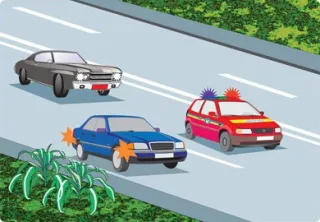
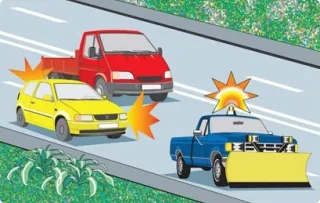
Question #2 How should the driver of a passenger car act in the situation shown in the figure, upon hearing a special sound signal and seeing a vehicle with blue and red flashing beacons?
Topic: Movement of vehicles with special signals
Answer help
3.2. In the event of approach of a vehicle with a blue flashing beacon and (or) special sound signal, drivers of other vehicles that may create an obstacle to its movement must yield to it and ensure unobstructed passage of the said vehicle (and vehicles accompanied by it).
On vehicles moving in an accompanied column, the low beam headlights must be turned on.
If on such a vehicle flashing beacons of blue and red or only red are turned on, drivers of other vehicles must stop at the right edge of the roadway (on the right shoulder). On a road with a dividing strip, this requirement must be fulfilled by drivers of vehicles moving in the same direction. -
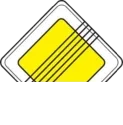
Question #3 What information is contained in this road sign?
Topic: Road signs (Appendix 1)
Answer help
2.4. "End of the main road." The right of priority passage of uncontrolled intersections is canceled. -
Question #4 Are there any road signs among these whose requirements begin immediately after the place on the road where they are installed?
Topic: Road signs (Appendix 1)
Answer help
3.20. "Movement of vehicles without observing the distance ...m is prohibited." Movement of vehicles with a distance between them less than indicated on the sign is prohibited.
3.31. "Zone of maximum speed limit." In the zone (settlement, microdistrict, recreation area, etc.) movement at a speed exceeding that indicated on the sign is prohibited.
3.33. "Sound signal is prohibited." The use of sound signals is prohibited, except when it is impossible to avoid a traffic accident without it.
7.2.1.—7.2.6. "Zone of action." Indicate: 7.2.1 — the length of the dangerous section marked with warning signs, or the zone of action of prohibition and information-indication signs;
7.2.2 — the zone of action of prohibition signs 3.34—3.37, as well as the length of one or several stopping areas located one after another; 7.2.3 — the end of the zone of action of signs 3.34—3.37;
7.2.4 — that the vehicle is in the zone of action of signs 3.34—3.37; 7.2.5, 7.2.6 — the direction and zone of action of signs 3.34—3.37 in case of prohibition of stopping or parking along one side of a square, building facade, etc. When used together with prohibition signs, the plates reduce the zone of action of the signs. -
Question #5 At what speed is it allowed to drive a passenger car in a built-up area indicated by this road sign?
Topic: Road signs (Appendix 1)

Answer help
5.47. "Beginning of a settlement." The name and beginning of the development of a settlement in which the requirements of these Rules determining the order of movement in settlements do not apply on this road.
12.6. Outside settlements on all roads and on roads passing through settlements marked with sign 5.47, movement is allowed at a speed:
g) for other vehicles: on a highway marked with road sign 5.1 – not more than 130 km/h, on a highway with separate roadways, -
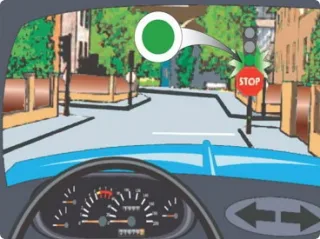
Question #6 Should the driver stop before the stop line in this case?
Topic: Road markings (Appendix 2)
Answer help
1.12. (stop line) — indicates the place where the driver must stop in the presence of sign 2.2 or at a traffic light or traffic controller signal prohibiting movement;
2.2. "Passing without stopping is prohibited." Passing without stopping is prohibited before marking 1.12 (stop line), and if it is absent — before the sign.
16.1. An intersection where the order of passage is determined by traffic light signals or a traffic controller is considered regulated. At such an intersection, priority signs do not apply.
In the case of turning off the traffic light or its operation in the mode of flashing yellow signal and the absence of a traffic controller, the intersection is considered unregulated and drivers must be guided by the rules for passing unregulated intersections and the priority signs installed at the intersection. -
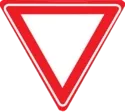
Question #7 This road sign:
Topic: Road signs (Appendix 1)
Answer help
2.1. "Yield." The driver must yield to vehicles approaching an uncontrolled intersection on the main road, and in the presence of plate 7.8 — to vehicles moving on the main road. -
Question #8 Which of the listed traffic rules requirements must be fulfilled when moving vehicles in columns?
Topic: Movement of vehicles in columns
Answer help
25.1. On each vehicle moving in a column, an identification sign "Column" is installed, provided for by subparagraph "є" of point 30.3 of these Rules, and the low beam headlights are turned on.
The identification sign may not be installed if the column is accompanied by operational vehicles with red, blue and red, green, or blue and green flashing beacons and (or) special sound signals. -
Question #9 In which cases must the driver give a warning signal before stopping using the turn indicators of the corresponding direction?
Topic: Warning signals
Answer help
9.2. The driver must give signals with light turn indicators of the corresponding direction:
a) before starting movement and stopping; -
Question #10 Which vehicle driver must yield when changing lanes?
Topic: Starting movement and changing its direction
Answer help
10.3. When changing lanes, the driver must yield to vehicles moving in the same direction on the lane to which he intends to change.
During simultaneous lane change of vehicles moving in the same direction, the driver who is on the left must yield to the vehicle on the right. -
Question #11 Is it allowed to transport passengers in the body of a truck when towing with a rigid or flexible coupling?
Topic: Towing and operation of vehicle combinations
Answer help
23.9. During towing on a rigid or flexible coupling, it is prohibited to carry passengers in the towed vehicle (except a passenger car) and in the body of the towing truck, and in the case of towing by partial loading of this vehicle onto a platform or special support device — in all vehicles (except the cab of the towing vehicle). -
Question #12 On which lane of a motorway or road for cars is it allowed for trucks with a permissible maximum mass of more than 3.5 t to drive?
Topic: Movement on highways and roads for cars
Answer help
27.2. On highways and roads for cars it is prohibited:
b) movement of freight vehicles with a permitted maximum mass over 3.5 t outside the first and second lanes (except for turning left or making a U-turn on roads -
Question #13 How to provide first medical aid for a thermal burn on the way?
Topic: Fundamentals of providing medical assistance in case of a traffic accident
-
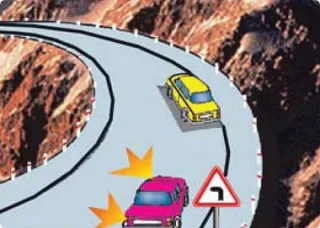
Question #14 Is overtaking allowed in this place?
Topic: Overtaking
Answer help
14.6. Overtaking is prohibited:
g) at the end of an ascent, on bridges, overpasses, viaducts, sharp turns and other road sections with limited visibility or in conditions of insufficient visibility; -
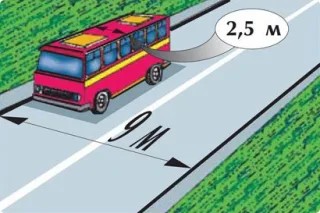
Question #15 Is the bus driver allowed to stop in this place to let passengers out?
Topic: Stopping and parking
Answer help
15.9. Stopping is prohibited:
d) in places where the distance between the solid marking line, dividing strip or the opposite edge of the carriageway and the stopped vehicle is less than 3 m; -
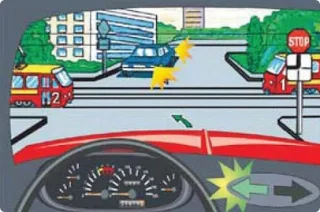
Question #16 In what order will vehicles pass the intersection?
Topic: Passing intersections
Answer help
16.11. At an intersection of unequal roads, the driver of a vehicle moving on a secondary road must give way to vehicles approaching this intersection of carriageways on the main road, regardless of the direction of their further movement.
16.14. If the main road changes direction at an intersection, drivers of vehicles moving on it must be guided among themselves by the rules for passing through intersections of equal roads.
Drivers moving on secondary roads must also be guided by this rule among themselves. -
Question #17 Which wheels of a rear-wheel drive passenger car are most prone to locking 'skid'?
Topic: Organization and safety of traffic
-
Question #18 Where should the medical first aid kit be stored in the car?
Topic: Technical condition of vehicles and their equipment
Answer help
31.4.7. Other structural elements:
e) absent: a medical first-aid kit with information printed on it about the type of vehicle for which it is intended — on a motorcycle with a sidecar, passenger car,
1. GENERAL PROVISIONS
1.1. These Rules, in accordance with the Law of Ukraine "On Road Traffic", establish a uniform procedure for road traffic throughout the territory of Ukraine. Other regulatory acts relating to the specifics of road traffic (transportation of special cargo, operation of certain types of vehicles, movement on a closed territory, etc.) must be based on the requirements of these Rules. # -
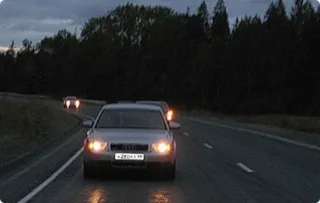
Question #19 What lighting should be turned on in the car when passing oncoming traffic on unlit sections of the road?
Topic: Use of external lighting devices
Answer help
19.2. High beam should be switched to low beam no less than 250 m before an oncoming vehicle, and also when it can blind other drivers, in particular those moving in the same direction.
The light must be switched even at a greater distance if the driver of the oncoming vehicle indicates the need for this by periodically switching the headlights. -
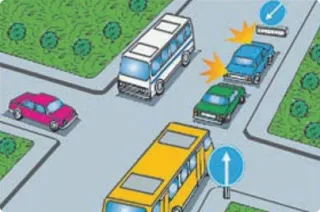
Question #20 Is the driver of the yellow bus allowed to enter the intersection?
Topic: Passing intersections
Answer help
16.4. It is prohibited to enter any intersection, including when the traffic light signal permits movement, if a traffic jam has formed that will force the driver to stop at the intersection, which will create an obstacle for the movement of other vehicles and pedestrians.