
Practice: ticket #65
Answers are checked instantly. The hint — a rules excerpt — is under the question.
-
Question #1 What should the driver consider when determining the maximum width of the traffic lane for a road train?
Topic: Position of vehicles on the road
Answer help
11.1. The number of lanes on the carriageway for the movement of non-rail vehicles is determined by road markings or road signs 5.16, 5.17.1, 5.17.2, and in their absence — by the drivers themselves, taking into account the width of the carriageway of the corresponding direction of movement, the dimensions of vehicles and safe intervals between them.
Traffic lane — a longitudinal lane on the carriageway with a width of at least 2.75 m, marked or not marked by road markings and intended for the movement of non-rail vehicles; -
Question #2 How can it be determined that the driver of an operational vehicle is performing an urgent official task?
Topic: Movement of vehicles with special signals
Answer help
3.1. Drivers of operational vehicles, performing an urgent official task, may deviate from the requirements of sections 8 (except for traffic controller signals), 10—18, 26, 27 and point 28.1 of these Rules, provided that a flashing beacon of blue or red color and a special sound signal are turned on and road safety is ensured. If there is no need for additional attraction of attention of road users, the special sound signal may be turned off. -
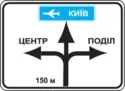
Question #3 What does the insert on a blue background with the name of a populated area on it mean?
Topic: Road signs (Appendix 1)
Answer help
5.51. "Preliminary direction indicator". Direction of movement to the populated areas and other objects indicated on the sign. The signs may have images of signs 3.2—3.8, 3.11—3.20, 3.29, 3.31, 5.1, 5.3, 5.28.1—5.30, 5.61.1, 6.1—6.24, airport symbols, sports and other pictograms, etc. In the lower part of sign 5.51, the distance from the place of installation of the sign to the intersection or the beginning of the deceleration lane is indicated.
Sign 5.51 is also used to indicate a detour of road sections on which one of the prohibiting signs 3.15—3.19 is installed.
Signs 5.51—5.54 installed outside a populated area have a green or blue background if they are installed respectively on a motorway or another road. An insert on a blue or green background means that movement to the indicated populated area or object is carried out respectively along a road other than a motorway, or along a motorway. Signs 5.51—5.54 installed in a populated area must have a white background. Inserts on a blue or green background mean that movement to the indicated populated area or object is carried out respectively along a road other than a motorway, or along a motorway. -
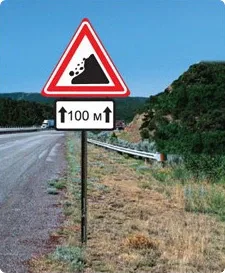
Question #4 What information is contained in this road sign with a plate?
Topic: Road signs (Appendix 1)
Answer help
1.16. "Falling stones". A section of road on which there may be falling stones, rockfalls, landslides.
7.2.1.—7.2.6. "Area of operation". They indicate: 7.2.1 — the length of the dangerous section marked with warning signs, or the area of operation of prohibiting and information-indicative signs; 7.2.2 — the area of operation of prohibiting signs 3.34—3.37, as well as the length of one or more stopping areas located one after another; 7.2.3 — the end of the area of operation of signs 3.34—3.37; 7.2.4 — that the vehicle is in the area of operation of signs 3.34—3.37; 7.2.5, 7.2.6 — the direction and area of operation of signs 3.34—3.37 in case of prohibition of stopping or parking along one side of a square, building facade, etc. When used together with prohibiting signs, the plates reduce the area of operation of the signs. -
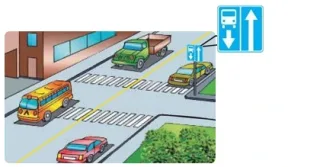
Question #5 While driving, the drivers of which vehicles violate the Traffic Rules.
Topic: Road signs (Appendix 1)
Answer help
5.8. "Road with a lane for route vehicles". A road on which the movement of vehicles is carried out along an established route on a specially designated lane towards the general flow of vehicles.
17.1. and 5.17.2. "Direction of movement along lanes". -
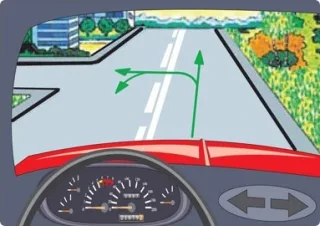
Question #6 In which of the directions indicated by arrows is movement allowed?
Topic: Road markings (Appendix 2)
Answer help
1.11. — separates traffic flows of opposite or same directions on road sections where lane changing is allowed only from one lane; marks places intended for turning around, entering and exiting parking areas, etc., where movement is allowed only in one direction;
Line 1.11 may be crossed only from the side of its broken part, and from the side of the solid part — only upon completion of overtaking or bypassing an obstacle. -
Question #7 Where should the driver stop when entering an intersection if this road sign is installed in front of him and there is no 'stop line' marking?
Topic: Road signs (Appendix 1)
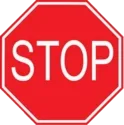
Answer help
2.2. "Passing without stopping is prohibited." Passing without stopping is prohibited before marking 1.12 (stop line), and if it is absent — before the sign. -
Question #8 The driver of which vehicle is given the right of way at an intersection of equal roads with circular traffic?
Topic: Passing intersections
Answer help
16.12. At an intersection of equivalent roads, the driver of a non-rail vehicle must yield to vehicles approaching from the right.
Tram drivers must also be guided by this rule among themselves.
At any uncontrolled intersection, a tram, regardless of the direction of its further movement, has priority over non-rail vehicles approaching it on an equivalent road. -
Question #9 When turning left at an uncontrolled equal intersection, the driver of a non-rail vehicle:
Topic: Passing intersections
Answer help
16.12. At an intersection of equivalent roads, the driver of a non-rail vehicle must yield to vehicles approaching from the right.
Tram drivers must also be guided by this rule among themselves.
At any uncontrolled intersection, a tram, regardless of the direction of its further movement, has priority over non-rail vehicles approaching it on an equivalent road.
16.13. Before turning left and making a U-turn, the driver of a non-rail vehicle must yield to a tram of the same direction, as well as to vehicles moving on an equivalent road in the opposite direction straight or to the right.
Tram drivers must also be guided by this rule among themselves. -
Question #10 From which lane is it allowed to go straight?
Topic: Starting movement and changing its direction
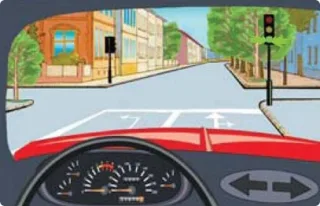
Answer help
10.4. Before turning right, left, or making a U-turn, the driver must take in advance the appropriate extreme position on the roadway intended for movement in that direction, except when making a turn when entering an intersection where circular traffic is organized, the direction of movement is determined by road signs or road markings, or movement is possible only in one direction established by the configuration of the roadway, road signs, or markings.
A driver making a left turn or U-turn outside an intersection from the appropriate extreme position on the roadway of this direction must yield to oncoming vehicles, and when performing these maneuvers not from the extreme left position on the roadway — also to vehicles moving in the same direction.
If there is a tram track in the middle of the roadway, the driver of a non-rail vehicle making a left turn or U-turn outside an intersection must yield to the tram. -
Question #11 In what way is it allowed to tow a vehicle with a faulty steering system?
Topic: Towing and operation of vehicle combinations
Answer help
23.4. When towing a mechanical vehicle on a flexible coupling, the towed vehicle must have functioning and serviceable service brake system and steering, and on a rigid coupling — steering. -
Question #12 The vehicle has an identification sign 'Maximum speed limit'. Is it allowed to exceed the speed indicated on the sign?
Topic: Speed of movement
Answer help
12.9. The driver is prohibited from:
b) exceeding the maximum speed specified in points 12.4—12.7 on a road section where road signs 3.29, 3.31 are installed, or on a vehicle on which is installed -
Question #13 An oncoming vehicle is approaching a narrow section of the road. What should you do?
Topic: Distance, interval, oncoming passing
Answer help
13.4. If oncoming passage is difficult, the driver on whose lane there is an obstacle or the dimensions of the vehicle he controls interfere with oncoming traffic must yield. On road sections marked with signs 1.6 "Steep ascent" and 1.7 "Steep descent", in the presence of an obstacle, the driver of the vehicle moving downhill must yield. -
Question #14 According to the requirements of the Traffic Rules, how should the driver of a car act when being overtaken by another vehicle?
Topic: Overtaking
Answer help
14.3. The driver of the overtaken vehicle is prohibited from hindering overtaking by increasing speed or by other actions. -
Question #15 Is it allowed for the driver to park a truck with a permissible maximum mass of more than 3.5 tons on a road section with this road sign and plate?
Topic: Stopping and parking
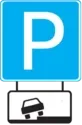
Answer help
15.6. Parking of all vehicles in places marked with road signs 5.38, 5.39, installed with plate 7.6.1, is allowed on the roadway along the sidewalk, and installed with one of the plates 7.6.2—7.6.5 — for passenger cars and motorcycles only as shown on the plate. -
Question #16 The driver of which vehicle must yield the right of way?
Topic: Passing intersections
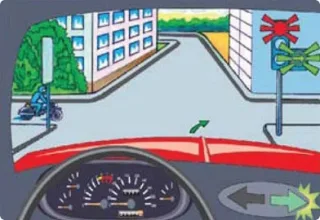
Answer help
16.9. When moving in the direction of the arrow included in the additional section simultaneously with the yellow or red traffic light signal, the driver must yield to vehicles moving from other directions.
When moving in the direction of the green arrow on a plate installed at the level of the red traffic light signal with vertical arrangement of signals, the driver must take the extreme right (left) lane and yield to vehicles and pedestrians moving from other directions. -
Question #17 How does 'skid' braking affect the braking distance on a dry road?
Topic: Organization and safety of traffic
-
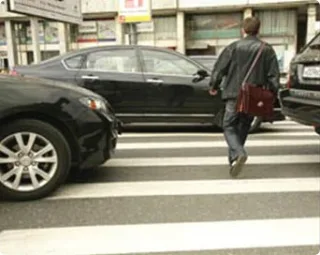
Question #18 If a traffic jam has formed behind a pedestrian crossing, which will force the driver to stop at the pedestrian crossing, the driver must:
Topic: Passing pedestrian crossings and stops of vehicles
Answer help
18.6. It is prohibited to enter a pedestrian crossing if a traffic jam has formed behind it that will force the driver to stop on this crossing. -
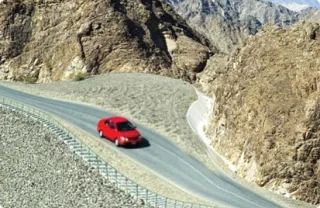
Question #19 Is it allowed to drive on steep descents of mountain roads with the engine not running and the clutch or gear disengaged?
Topic: Movement on mountain roads and steep descents
Answer help
28.3. On mountain roads it is prohibited:
a) to move with the engine not running and with the clutch or gear disengaged; -
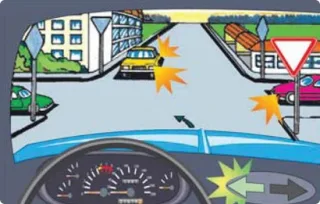
Question #20 The second vehicle will cross the intersection:
Topic: Passing intersections
Answer help
16.11. At an intersection of unequal roads, the driver of a vehicle moving on a secondary road must yield to vehicles approaching this intersection of roadways on the main road, regardless of the direction of their further movement.
16.13. Before turning left and making a U-turn, the driver of a non-rail vehicle must yield to a tram of the same direction, as well as to vehicles moving on an equivalent road in the opposite direction straight or to the right.
Tram drivers must also be guided by this rule among themselves.