
Practice: ticket #63
Answers are checked instantly. The hint — a rules excerpt — is under the question.
-
Question #1 What is called the 'braking distance'?
Topic: General provisions
Answer help
braking distance — the distance that a vehicle travels during emergency braking from the beginning of the impact on the brake system control (pedal, handle) to the place of its stop; -
Question #2 Should you stop the car in front of a pedestrian crossing where there are pedestrians?
Topic: Duties and rights of pedestrians
Answer help
4.9. In places where traffic is regulated, pedestrians must be guided by the signals of the traffic controller or traffic light. In such places, pedestrians who have not managed to finish crossing the carriageway of one direction must be on a safety island or a line dividing traffic flows of opposite directions, and in their absence — in the middle of the carriageway and may continue crossing only when it is allowed by the corresponding signal of the traffic light or traffic controller and they are convinced of the safety of further movement. 8.7.3. Traffic light signals have the following meanings: e) a red signal, including flashing, or two red flashing signals prohibit movement. A signal in the form of a green arrow (arrows) in an additional (additional) section -
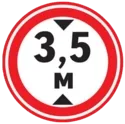
Question #3 If the height of the vehicle (with or without cargo) is greater than that indicated on this road sign, the driver must:
Topic: Movement of vehicles with special signals
Answer help
3.18. "Movement of vehicles whose height exceeds ... m is prohibited". The movement of vehicles whose overall height (with or without cargo) is greater than indicated on the sign is prohibited. -
Question #4 Which road sign indicates the direction of movement at a T-junction?
Topic: Road signs (Appendix 1)
-
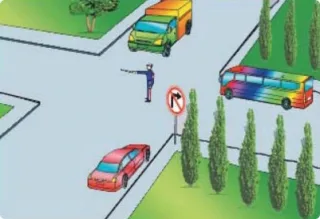
Question #5 On this signal of the traffic controller, the driver of a passenger car is allowed to move:
Topic: Traffic regulation
Answer help
3.22. "Right turn prohibited". 8.8. Traffic controller signals. The signals of the traffic controller are the positions of his body, as well as hand gestures, including with a baton or a disk with a red reflector, having the following meanings: b) the right arm is extended forward: from the left side — tram movement to the left is allowed, non-rail vehicles — in all directions; pedestrians are allowed to cross -
Question #6 The 'stop line' marking indicates the place where the driver must:
Topic: Road markings (Appendix 2)
Answer help
1.12. (stop line) — indicates the place where the driver must stop in the presence of sign 2.2 or at a traffic light or traffic controller signal prohibiting movement; -
Question #7 A U-turn is allowed:
Topic: Road signs (Appendix 1)
Answer help
3.23. "Left turn prohibited". Turning left of vehicles is prohibited. In this case, a U-turn is allowed. 5.8. "Road with a lane for route vehicles". A road on which the movement of vehicles is carried out along the established route on a specially designated lane towards the general flow of vehicles. -
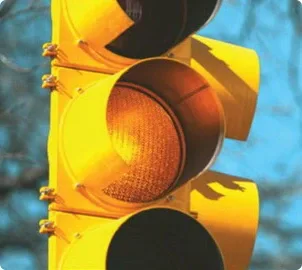
Question #8 A yellow flashing traffic light signal:
Topic: Traffic regulation
Answer help
8.7.3. Traffic light signals have the following meanings: e) a yellow flashing signal or two yellow flashing signals allow movement and inform about the presence of a dangerous uncontrolled intersection or pedestrian crossing; -
Question #9 Should the driver always give signals with turn indicators when changing the direction of his movement?
Topic: Warning signals
Answer help
9.2. The driver must give signals with light turn indicators of the corresponding direction: a) before starting movement and stopping; b) before changing lanes, turning or making a U-turn. 9.4. It is necessary to give a signal with turn indicators or by hand in advance before the start of the maneuver (taking into account the speed of movement), but not less than 50–100 m in populated areas and 150–200 m outside them, and stop immediately after its completion (the hand signal should be finished immediately before the start of the maneuver). The signal is prohibited from being given if it may be unclear to other road users. Giving a warning signal does not give the driver an advantage and does not release him from taking precautions. -
Question #10 How should the driver of a vehicle leaving a parking place act?
Topic: Starting movement and changing its direction
Answer help
10.2. When leaving the road from a residential area, courtyards, parking places, gas stations and other adjacent territories, the driver must give way to pedestrians and vehicles moving along it before the carriageway or sidewalk, and when leaving the road — to cyclists and pedestrians whose direction of movement he crosses. -
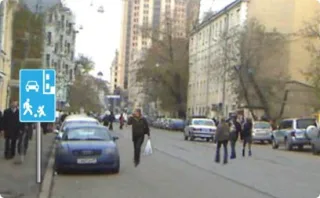
Question #11 Is it allowed for pedestrians to move in a residential area along the roadway?
Topic: Movement in residential and pedestrian zones
Answer help
26.1. Pedestrians are allowed to move in a residential and pedestrian zone both on sidewalks and on the carriageway. Pedestrians have priority over vehicles, but must not create unreasonable obstacles for their movement. -
Question #12 Is it allowed to enter technological gaps in the dividing strip on highways?
Topic: Movement on highways and roads for cars
Answer help
27.2. On motorways and roads for cars, it is prohibited: d) making a U-turn and entering technological gaps of the dividing strip; -
Question #13 The vehicle's medical first-aid kit contains 'Hydrogen peroxide'. It is used for:
Topic: Fundamentals of providing medical assistance in case of a traffic accident
-
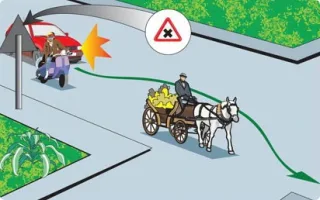
Question #14 Is it allowed for the driver of a car to overtake?
Topic: Overtaking
Answer help
14.6. Overtaking is prohibited: a) at an intersection; -
Question #15 In which places is it allowed to park a vehicle at an angle to the edge of the roadway?
Topic: Stopping and parking
Answer help
15.5. Placing vehicles at an angle to the edge of the carriageway is allowed in places where this will not impede the movement of other vehicles. Near sidewalks or other places with pedestrian traffic, placing vehicles at an angle is allowed only with the front part, and on ascents — only with the rear part. -
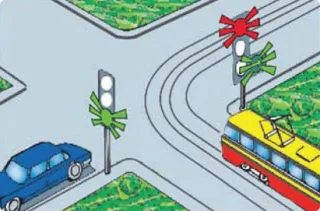
Question #16 Which vehicle's driver must yield the right of way?
Topic: Passing intersections
Answer help
16.9. When moving in the direction of the arrow included in the additional section simultaneously with a yellow or red traffic light signal, the driver must give way to vehicles moving from other directions. When moving in the direction of the green arrow on a plate installed at the level of the red traffic light signal with vertical arrangement of signals, the driver must take the extreme right (left) lane and give way to vehicles and pedestrians moving from other directions. -
Question #17 In which case does the centrifugal force acting on a car on road curves increase?
Topic: Organization and safety of traffic
-
Question #18 Under which of the listed conditions is the operation of vehicles prohibited? Give a complete answer.
Topic: Technical condition of vehicles and their equipment
Answer help
31.4.5. Wheels and tires: b) tires have local damage (cuts, tears, etc.) exposing the cord, as well as delamination of the carcass, separation of the tread and sidewall; -
Question #19 Is it allowed to use high beam headlights on roads in populated areas?
Topic: Use of external lighting devices
Answer help
19.1. At night and in conditions of insufficient visibility, regardless of the degree of road lighting, as well as in tunnels, the following lighting devices must be switched on on a moving vehicle:
a) on all mechanical vehicles — low beam (high beam) headlights;
b) on mopeds (bicycles) and horse-drawn carts (sledges) — headlights or lanterns;
c) on trailers and towed vehicles — clearance lights.
Note.
In conditions of insufficient visibility, on mechanical vehicles it is allowed to switch on fog lights instead of low beam (high beam) headlights. -
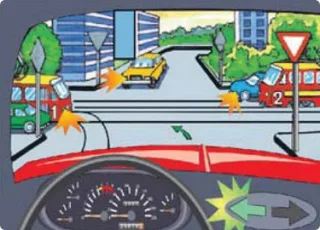
Question #20 Vehicles will pass the intersection in the following order:
Topic: Passing intersections
Answer help
16.11. At an intersection of unequal roads, the driver of a vehicle moving on a secondary road must give way to vehicles approaching this intersection of carriageways on the main road, regardless of the direction of their further movement.
16.13. Before turning left and making a U-turn, the driver of a non-rail vehicle must give way to a tram of the same direction, as well as to vehicles moving on an equivalent road in the opposite direction straight or to the right.
Tram drivers must also be guided by this rule among themselves.