
Practice: ticket #61
Answers are checked instantly. The hint — a rules excerpt — is under the question.
-
Question #1 Is it allowed to operate a vehicle that has been converted to another type of fuel?
Topic: Individual traffic rules issues requiring coordination with the State Automobile Inspection
Answer help
32.1. The following are coordinated with the State Automobile Inspection bodies:
є) conversion of vehicles.
31.3. Operation of vehicles is prohibited in accordance with the legislation:
а) in the event of their manufacture or conversion in violation of the requirements of standards, rules and regulations concerning road safety; -
Question #2 Is it allowed for pedestrians to cross the road if there is no crossing or intersection in sight?
Topic: Duties and rights of pedestrians
Answer help
4.8. If there is no pedestrian crossing or intersection within visibility range, and the road has no more than three lanes for traffic in both directions, it is permitted to cross it at a right angle to the edge of the carriageway in places where the road is clearly visible in both directions, and only after the pedestrian has made sure that there is no danger. -
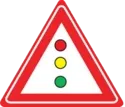
Question #3 A driver is approaching a section of road outside a built-up area, before which this road sign is installed. What information is contained in this road sign?
Topic: Road signs (Appendix 1)
Answer help
1.24. "Traffic light control". An intersection, pedestrian crossing, or section of road where traffic is regulated by a traffic light. -
Question #4 Which of the listed road signs require drivers to stop before a railway crossing?
Topic: Road signs (Appendix 1)
Answer help
2.2. "No passing without stopping". It is prohibited to pass without stopping before marking 1.12 (stop line), and if it is absent — before the sign.
If sign 2.2 is installed before an unguarded railway crossing that is not equipped with traffic light signaling, the driver must stop before the stop line, and if it is absent — before this sign. -
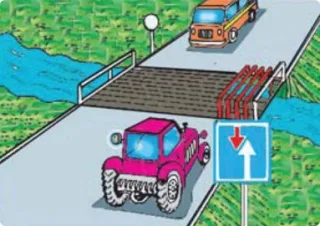
Question #5 Which vehicle driver must yield the right of way?
Topic: Road signs (Appendix 1)
Answer help
2.6. "Advantage over oncoming traffic". A narrow section of road where, while driving along it, the driver has an advantage over oncoming vehicles. -
Question #6 What does a wide yellow solid line of road marking indicate?
Topic: Road markings (Appendix 2)
Answer help
1.2. (wide solid line) — marks the edge of the carriageway on motorways or the boundaries of the lane for route vehicles. In places where entry into the lane for route vehicles is allowed for other vehicles, this line may be broken; -
Question #7 This road sign:
Topic: Road signs (Appendix 1)

Answer help
4.11. "Movement of passenger cars". It is permitted to move only passenger cars, buses, motorcycles, route vehicles, and trucks whose permissible maximum mass does not exceed 3.5 t. -
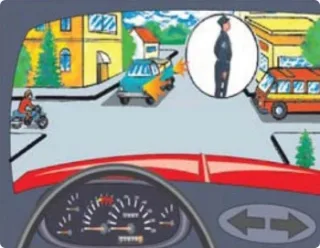
Question #8 In which answer are vehicles that are prohibited from moving listed?
Topic: Traffic regulation
Answer help
8.8. Traffic controller signals. Traffic controller signals are the positions of his body, as well as hand gestures, including with a baton or a disk with a red reflector,
having the following meanings:
a) arms extended to the sides, lowered, or the right arm bent in front of the chest: from the left and right sides — tram movement straight is allowed, trackless vehicles — straight and -
Question #9 When transporting passengers, drivers of route vehicles are prohibited from:
Topic: Transportation of passengers
Answer help
21.2. Drivers of route vehicles are prohibited, while transporting passengers, from talking to them, eating, drinking, smoking, as well as transporting passengers and cargo in the cab,
if it is separated from the passenger compartment. -
Question #10 What is the minimum age allowed to learn to drive a motorcycle?
Topic: Training driving
Answer help
24.2. Persons learning to drive a car must be at least 16 years old, and a motorcycle — 14 years old. Such persons must have with them a document confirming their age. -
Question #11 Which vehicles must drive as close as possible to the right edge of the roadway, except in cases provided for by the traffic rules?
Topic: Position of vehicles on the road
Answer help
11.7. Vehicles whose speed must not exceed 40 km/h or which for technical reasons cannot develop such speed must move as close as possible to the right edge of the carriageway, except when overtaking, bypassing, or changing lanes before turning left or making a U-turn. -
Question #12 Is it allowed for a driver of an intercity bus outside built-up areas to exceed the speed of 70 km/h?
Topic: Speed of movement
Answer help
12.6. Outside built-up areas on all roads and on roads passing through built-up areas marked with sign 5.47, movement is allowed at a speed:
d) buses (except minibuses) — no more than 90 km/h; -
Question #13 In the absence of breathing in a victim, it is necessary to:
Topic: Fundamentals of providing medical assistance in case of a traffic accident
-
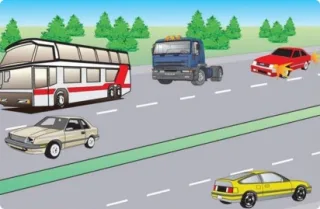
Question #14 On roads with two or more lanes for traffic in one direction, exiting from the right lanes:
Topic: Overtaking
Answer help
14.6. Overtaking is prohibited:
e) on roads having two or more lanes for traffic in one direction;
11.5. On roads having two or more lanes for traffic in one direction, entering the far left lane for traffic in the same direction is allowed if the right lanes are occupied, as well as for turning left, making a U-turn, or for stopping or parking on the left side of a road with one-way traffic in built-up areas, if this does not contradict the stopping (parking) rules. -
Question #15 Is parking prohibited in all the listed places?
Topic: Stopping and parking
Answer help
15.10. Parking is prohibited:
a) in places where stopping is prohibited; -
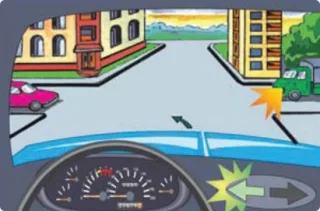
Question #16 The first to pass the intersection will be:
Topic: Passing intersections
Answer help
16.12. At an intersection of equivalent roads, the driver of a trackless vehicle must give way to vehicles approaching from the right.
This rule must also be followed by tram drivers among themselves.
At any uncontrolled intersection, a tram, regardless of the direction of its further movement, has an advantage over trackless vehicles approaching it on an equivalent road.
16.13. Before turning left and making a U-turn, the driver of a trackless vehicle must give way to a tram traveling in the same direction, as well as to vehicles moving on an equivalent road in the opposite direction straight or to the right.
This rule must also be followed by tram drivers among themselves. -
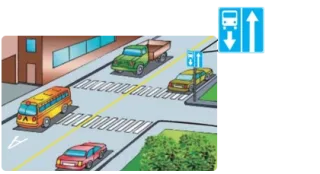
Question #17 During movement, which vehicle drivers violate the traffic rules? No one violates. Everyone violates.
Topic: Advantages of route vehicles
Answer help
17.1. On a road with a lane for route vehicles marked by road sign 5.8 or 5.11, the movement and stopping of other vehicles on this lane are prohibited.
5.8. "Road with a lane for route vehicles". A road where vehicle movement is carried out along an established route on a specially designated lane against the general flow of vehicles. -
Question #18 Is it allowed to install tires restored according to the second class of repair on passenger cars?
Topic: Technical condition of vehicles and their equipment
Answer help
31.4.5. Wheels and tires:
e) — diagonal; -
Question #19 A spotlight is allowed to be used:
Topic: Use of external lighting devices
Answer help
19.6. A spotlight and a searchlight may be used only by drivers of operational vehicles while performing official tasks, taking measures not to blind other road users. -
Question #20 The general alarm signal at a railway crossing is a series of:
Topic: Movement through railway crossings
Answer help
20.9. The stop signal of a train (locomotive, railcar) is a circular movement of the hand (in daylight — with a piece of bright fabric or any clearly visible object, in the dark and in conditions of insufficient visibility — with a torch or lantern). The general alarm signal is a series of sound signals of a vehicle consisting of one long and three short signals.