
Practice: ticket #60
Answers are checked instantly. The hint — a rules excerpt — is under the question.
-
Question #1 Who is allowed to conduct a personal inspection of the driver's belongings?
Topic: Fundamentals of law
-
Question #2 When a vehicle with a blue flashing beacon approaches, drivers of other vehicles must:
Topic: Movement of vehicles with special signals
Answer help
3.2. In the event of approach of a vehicle with a blue flashing beacon and (or) a special sound signal, drivers of other vehicles that may create an obstacle to its movement must give way to it and ensure unimpeded passage of the specified vehicle (and vehicles accompanied by it).
Vehicles moving in an accompanied column must have their low-beam headlights on.
If on such a vehicle flashing beacons of blue and red or only red are turned on, drivers of other vehicles must stop at the right edge of the carriageway (on the right shoulder). On a road with a dividing strip, this requirement must be fulfilled by drivers of vehicles moving in the same direction. -
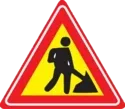
Question #3 What information is contained in this road sign?
Topic: Road signs (Appendix 1)
Answer help
1.37. "Road works". A section of road on which works are being carried out. -
Question #4 Do the requirements of these road signs differ?
Topic: Road signs (Appendix 1)

Answer help
5.45. "Beginning of a populated area". The name and beginning of the built-up area of a populated area in which the requirements of these Rules apply, determining the traffic order in populated areas.
5.47. "Beginning of a populated area". The name and beginning of the built-up area of a populated area in which the requirements of these Rules determining the traffic order in populated areas do not apply on this road. -
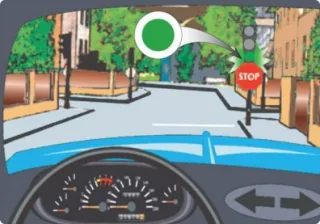
Question #5 Must the driver stop before the stop line in this case?
Topic: Road signs (Appendix 1)
Answer help
2.2. "No passing without stopping". Passing without stopping before marking 1.12 (stop line) is prohibited, and if it is absent — before the sign.
1.12. (stop line) — indicates the place where the driver must stop when there is a sign 2.2 or at a traffic light or traffic controller signal prohibiting movement;
16.1. An intersection where the order of passage is determined by traffic light or traffic controller signals is considered controlled. At such an intersection, priority signs do not apply.
In the event of a traffic light being switched off or operating in the flashing yellow signal mode and the absence of a traffic controller, the intersection is considered uncontrolled and drivers must be guided by the rules for passing through uncontrolled intersections and the priority signs installed at the intersection. -
Question #6 In what place must the driver stop the vehicle when there is a 'stop line' marking?
Topic: Road markings (Appendix 2)
Answer help
1.12. (stop line) — indicates the place where the driver must stop when there is a sign 2.2 or at a traffic light or traffic controller signal prohibiting movement; -
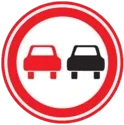
Question #7 Which vehicles does this road sign prohibit overtaking?
Topic: Road signs (Appendix 1)
Answer help
3.25. "Overtaking prohibited". Overtaking of all vehicles is prohibited (except for single *, moving at a speed of less than 30 km/h).
* Single vehicles are considered to be individual vehicles, road trains, as well as a towing vehicle coupled with a towed one. -
Question #8 This traffic light is used to regulate traffic:
Topic: Traffic regulation

Answer help
8.7.4. To regulate the movement of vehicles on streets, roads or along carriageway lanes, the direction of movement on which may change to the opposite,
reversible traffic lights with a red X-shaped signal and a green signal in the form of an arrow pointing down are used. These signals prohibit or permit movement along the lane above which they are located.
The main signals of a reversible traffic light may be supplemented by a yellow signal in the form of an arrow inclined diagonally down to the right, the activation of which prohibits movement along the lane marked on both sides by road marking 1.9, and informs about the change of the reversible traffic light signal and the need to change to the lane on the right.
When the signals of the reversible traffic light located above the lane marked on both sides by road marking 1.9 are switched off, entry into this lane is prohibited. -
Question #9 What lights must be turned on on a route vehicle when driving on a specially allocated lane against the general flow of traffic in daylight?
Topic: Warning signals
Answer help
9.8. During the movement of mechanical vehicles in daylight hours, in order to indicate a moving vehicle, the low-beam headlights must be turned on:
б) on route vehicles moving along a lane marked by road sign 5.8, towards the general flow of vehicles; -
Question #10 A U-turn is prohibited:
Topic: Starting movement and changing its direction
Answer help
10.7. U-turn is prohibited:
а) at railway crossings; -
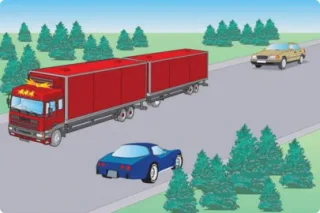
Question #11 What is the maximum total length of coupled vehicles, except route vehicles, allowed by the Road Traffic Rules?
Topic: Towing and operation of vehicle combinations
Answer help
23.10. Towing is prohibited:
в) if the total length of the coupled vehicles exceeds 22 m (route vehicles — 30 m); -
Question #12 Sudden braking while driving:
Topic: Speed of movement
Answer help
12.9. The driver is prohibited from:
г) braking sharply (except in cases when it is impossible to prevent a traffic accident without this). -
Question #13 For what maximum period can a hemostatic tourniquet be applied in summer?
Topic: Fundamentals of providing medical assistance in case of a traffic accident
-
Question #14 What identification sign marks a vehicle when transporting organized groups of children?
Topic: Number plates, identification signs, inscriptions and markings
Answer help
30.3. The following identification signs are installed on the corresponding vehicles (Appendix 4):
в) "Children" — a yellow square with a red border and a black image of the symbol of road sign 1.33 (side of the square — at least 250 mm, border — 1/10 of this side). The sign -
Question #15 Tram tracks are located at the right edge of the roadway. In what place must the driver stop the vehicle to let passengers out?
Topic: Stopping and parking
Answer help
15.8. On a tram track of the same direction, located on the left at the same level as the carriageway for the movement of non-rail vehicles, stopping is allowed only to comply with the requirements of these Rules, and on those located at the right edge of the carriageway — only for boarding (alighting) of passengers or to comply with the requirements of these Rules.
In these cases, no obstacles must be created for the movement of trams. -
Question #16 How should the driver of the red car act in the situation shown in the picture?
Topic: Passing intersections
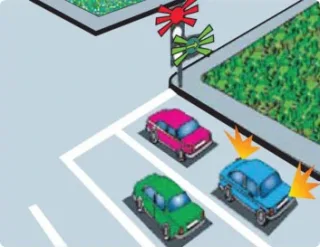
Answer help
16.10. At an intersection where traffic is regulated by a traffic light with an additional section, the driver located on the lane from which the turn is made must continue moving in the direction indicated by the arrow turned on in the additional section, if his stop at the prohibiting traffic light signal will create obstacles for vehicles moving behind him on the same lane. -
Question #17 Sudden braking of a vehicle in heavy traffic:
Topic: Organization and safety of traffic
-
Question #18 The total play in the steering of a truck with a permissible maximum mass over 3.5 tons must not exceed:
Topic: Technical condition of vehicles and their equipment
Answer help
31.4.2. Steering control:
а) the total play in the steering control exceeds the following limit values: -
Question #19 In which of the listed cases is it allowed to use fog lights?
Topic: Use of external lighting devices
Answer help
19.5. Fog lights can be used in conditions of insufficient visibility both separately and with low-beam or high-beam headlights, and in the dark on unlit sections of roads — only together with low-beam or high-beam headlights. -
Question #20 The first to cross the intersection will be:
Topic: Passing intersections
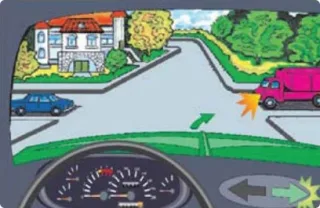
Answer help
16.12. At an intersection of equivalent roads, the driver of a non-rail vehicle must give way to vehicles approaching from the right.
This rule must also be followed by tram drivers among themselves.
At any uncontrolled intersection, a tram, regardless of the direction of its further movement, has priority over non-rail vehicles approaching it on an equivalent road.
16.13. Before turning left and making a U-turn, the driver of a non-rail vehicle must give way to a tram of the same direction, as well as to vehicles moving on an equivalent road in the opposite direction straight or to the right.
This rule must also be followed by tram drivers among themselves.