
Practice: ticket #59
Answers are checked instantly. The hint — a rules excerpt — is under the question.
-
Question #1 What does the term 'give way' mean? Give a full answer.
Topic: General provisions
-
Question #2 The car is equipped with seat belts. In which cases is it allowed not to fasten them?
Topic: Duties and rights of drivers of mechanical vehicles
Answer help
2.3. To ensure road safety, the driver is obliged to:
c) on cars equipped with passive safety devices (head restraints, seat belts), use them and not transport passengers not wearing seat belts -
Question #3 What information is contained in this road sign with a plate?
Topic: Road signs (Appendix 1)
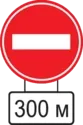
Answer help
3.21. "Entry prohibited". Entry of all vehicles is prohibited.
7.1.1.—7.1.4. "Distance to object". Indicate: 7.1.1 — distance from the sign to the beginning of the dangerous section, the place of introduction of the corresponding restriction or a certain object (place),
located ahead in the direction of travel; 7.1.2 — distance from sign 2.1 to the intersection in the case that sign 2.2 is installed directly before the intersection; 7.1.3 and 7.1.4 —
distance to an object located to the side of the road. -
Question #4 Do the requirements for installing these road signs differ?
Topic: Road signs (Appendix 1)

Answer help
Signs 5.51—5.54 installed outside a built-up area have a green or blue background if they are installed respectively on a motorway or another road. An insert on a blue or green background means that movement to the indicated populated area or object is carried out respectively along a road other than a motorway, or along a motorway. Signs 5.51—5.54
installed in a built-up area must have a white background. Inserts on a blue or green background mean that movement to the indicated populated area or object is carried out respectively along a road other than a motorway, or along a motorway. -
Question #5 In the house in the courtyard on the left lives the owner of this car. Which of the indicated routes is the driver allowed to take to get to his courtyard?
Topic: Road signs (Appendix 1)
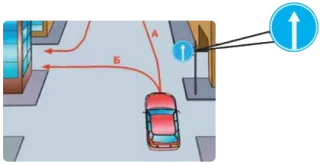
Answer help
4.1. "Go straight".
Signs 4.3, 4.5 and 4.6 also allow U-turns of vehicles. The effect of signs 4.1—4.6 does not apply to vehicles moving along established routes.
The effect of signs 4.1—4.6 applies to the intersection of carriageways in front of which they are installed. The effect of sign 4.1 installed at the beginning of a road or after an intersection
applies to the section of road up to the nearest intersection. The sign does not prohibit turning right into courtyards and other territories adjacent to the road. -
Question #6 If a broken dividing line is marked on the road:
Topic: Road markings (Appendix 2)
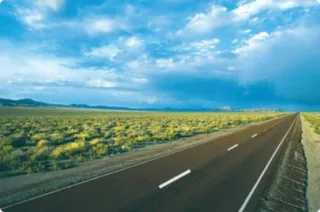
Answer help
1.5. — separates traffic flows of opposite directions on roads having two or three lanes; marks the boundaries of traffic lanes when there are two or more lanes
intended for movement in one direction; -
Question #7 At the intersection, there is a traffic light and a mandatory road sign 'Go straight'. In which direction is movement allowed?
Topic: Road signs (Appendix 1)
Answer help
4.1. "Go straight".
Signs 4.3, 4.5 and 4.6 also allow U-turns of vehicles. The effect of signs 4.1—4.6 does not apply to vehicles moving along established routes.
The effect of signs 4.1—4.6 applies to the intersection of carriageways in front of which they are installed. The effect of sign 4.1 installed at the beginning of a road or after an intersection
applies to the section of road up to the nearest intersection. The sign does not prohibit turning right into courtyards and other territories adjacent to the road. -
Question #8 If two signals are simultaneously turned on in the traffic light - red and yellow, then the driver of a non-rail vehicle must:
Topic: Traffic regulation
Answer help
8.7.3. Traffic light signals have the following meanings:
e) the combination of red and yellow signals prohibits movement and informs about the upcoming activation of the green signal; -
Question #9 In which of the listed cases is a warning triangle and a flashing red light installed?
Topic: Warning signals
Answer help
9.10. Together with turning on the hazard warning lights, a warning triangle or a flashing red lamp should be installed at a distance ensuring road safety, but not closer than 20 m to the vehicle in built-up areas and 40 m outside them, in the case of:
b) forced stopping in places with limited visibility of the road in at least one direction of less than 100 m. -
Question #10 Is it allowed to reverse in this place?
Topic: Starting movement and changing its direction
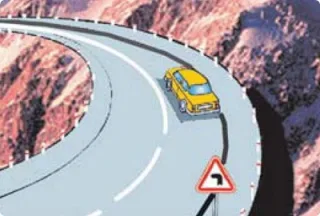
Answer help
10.10. The movement of vehicles in reverse is prohibited on motorways, roads for cars, railway crossings, pedestrian crossings, intersections, bridges,
overpasses, elevated roads, in tunnels, at entrances and exits from them, as well as on sections of roads with limited visibility or insufficient visibility.
Reverse movement is allowed on roads with one-way traffic, provided that the requirements of paragraph 10.9 of these Rules are met and it is impossible to approach the object in any other way. -
Question #11 Is it allowed to tow motorcycles?
Topic: Towing and operation of vehicle combinations
Answer help
23.10. Towing is prohibited:
g) by motorcycles without a sidecar, as well as such motorcycles, mopeds or bicycles; -
Question #12 Is towing allowed on a motorway?
Topic: Movement on highways and roads for cars
Answer help
27.3. On motorways, except in specially designated areas, the movement of mechanical vehicles whose speed, according to their technical characteristics or condition, is less than 40 km/h is prohibited, as well as the driving and grazing of animals in the road right-of-way.
12.7. During towing, the speed must not exceed 50 km/h. -
Question #13 In case of a penetrating chest wound, it is necessary to:
Topic: Fundamentals of providing medical assistance in case of a traffic accident
-
Question #14 How are the extreme outer parts of cargo protruding beyond the vehicle's dimensions by a distance greater than provided by the Traffic Rules marked in the dark and in conditions of insufficient visibility?
Topic: Number plates, identification signs, inscriptions and markings
Answer help
30.3. The following identification signs are installed on the corresponding vehicles (Appendix 4):
з) "Oversized load" — signal plates or flags measuring 400 x 400 mm with alternating red and white stripes applied diagonally (width — 50 mm), and in the dark -
Question #15 Which driver violates the stopping rules if the truck driver stopped for loading cargo, and the bus driver stopped for rest?
Topic: Stopping and parking
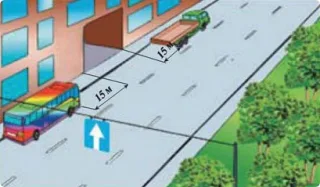
Answer help
15.9. Stopping is prohibited:
и) closer than 10 m from exits from adjacent territories and directly at the exit point.
11.6. On roads with three or more lanes for traffic in one direction, trucks with a permissible maximum mass exceeding 3.5 t, tractors, self-propelled machines and mechanisms are allowed to enter the far left lane only for turning left and making a U-turn, and in populated areas on roads with one-way traffic, in addition, for stopping on the left, in permitted cases, for loading or unloading. -
Question #16 The last vehicle to cross the intersection will be:
Topic: Passing intersections
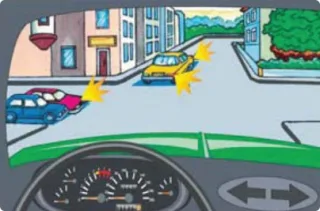
Answer help
16.12. At an intersection of equivalent roads, the driver of a non-rail vehicle must give way to vehicles approaching from the right.
This rule must also be followed by tram drivers among themselves.
At any uncontrolled intersection, a tram, regardless of the direction of its further movement, has priority over non-rail vehicles approaching it on an equivalent road. -
Question #17 What dangerous consequences can a sudden start from a standstill cause?
Topic: Organization and safety of traffic
-
Question #18 You are approaching an uncontrolled pedestrian crossing. What should you do in this situation?
Topic: Passing pedestrian crossings and stops of vehicles
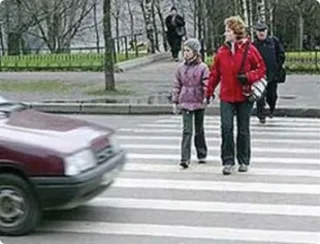
Answer help
18.1. The driver of a vehicle approaching an uncontrolled pedestrian crossing where pedestrians are present must reduce speed, and if necessary stop, to give way to pedestrians for whom an obstacle or danger may be created. -
Question #19 Under which of the listed conditions is the operation of vehicles prohibited? Give a complete answer.
Topic: Technical condition of vehicles and their equipment
Answer help
31.4.7. Other structural elements:
ї) the headlights and rear position lights of a vehicle transporting oversized, heavy or dangerous cargo, as well as flashing beacons, are absent or faulty, -
Question #20 The blue car will cross the intersection:
Topic: Passing intersections
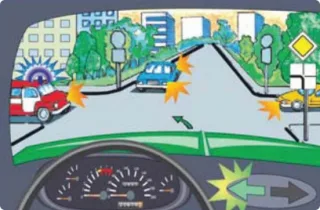
Answer help
16.11. At an intersection of unequal roads, the driver of a vehicle moving on a secondary road must give way to vehicles approaching this intersection of carriageways on the main road, regardless of the direction of their further movement.
16.14. If the main road at an intersection changes direction, drivers of vehicles moving on it must be guided among themselves by the rules for passing through intersections of equivalent roads.
This rule must also be followed by drivers moving on secondary roads.
3.2. In the event of approach of a vehicle with a blue flashing beacon and (or) a special sound signal, drivers of other vehicles that may create an obstacle to its movement must give way to it and ensure unimpeded passage of the specified vehicle (and vehicles accompanied by it).
Vehicles moving in an accompanied column must have their low-beam headlights on.
If on such a vehicle flashing beacons of blue and red or only red are turned on, drivers of other vehicles must stop at the right edge of the carriageway (on the right shoulder). On a road with a dividing strip, this requirement must be fulfilled by drivers of vehicles moving in the same direction.