
Practice: ticket #57
Answers are checked instantly. The hint — a rules excerpt — is under the question.
-
Question #1 Driving through a prohibiting traffic light signal or traffic controller gesture entails:
Topic: Fundamentals of law
-
Question #2 Can pedestrians move on bicycle paths in the absence of a sidewalk or pedestrian path?
Topic: Duties and rights of pedestrians
Answer help
4.1. Pedestrians must move along sidewalks and pedestrian paths, keeping to the right side. If there are no sidewalks, pedestrian paths, or it is impossible to move along them, pedestrians may move along bicycle paths, keeping to the right side and not hindering the movement of bicycles and mopeds, or in a single row along the roadside, keeping as far to the right as possible, and in the absence of a roadside or the impossibility of moving along it — along the edge of the carriageway towards the movement of vehicles. In this case, one must be careful and not interfere with other road users. -
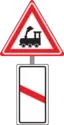
Question #3 What information is contained in these road signs?
Topic: Road signs (Appendix 1)
Answer help
1.28. "Railway crossing without a barrier." 1.31.1—1.31.6. "Approaching a railway crossing." Additional warning about approaching a railway crossing outside built-up areas. Warning signs, except for signs 1.4.1—1.4.3, 1.29—1.31.6, are installed outside built-up areas at a distance of 150—300 m, in built-up areas — at a distance of 50—100 m before the beginning of the dangerous section. If necessary, signs are also installed at a different distance, which is indicated on plate 7.1.1 -
Question #4 Is there among these road signs one that would not extend its effect to route vehicles?
Topic: Road signs (Appendix 1)
Answer help
3.1. "Movement prohibited." The movement of all vehicles is prohibited. 3.2. "Several turns." A section of road with two or more dangerous turns located one after another: 1.3.1 — with the first turn to the right, 1.3.2 — with the first turn to the left. 3.34. "Stopping prohibited." Stopping and parking of vehicles is prohibited, except for taxis carrying out boarding or disembarkation of passengers (unloading or loading of cargo). 4.1. "Go straight." The effect of the signs does not apply: 3.1, 3.2, 3.21—3.24, 3.34 — to vehicles moving along established routes; 3.1, 3.2, 3.35—3.38, as well as sign 3.34 if there is plate 7.18 under it — to drivers with disabilities driving a motorized wheelchair or a car marked with the "Disabled" identification sign; 3.1—3.8, 3.11 — to vehicles serving citizens or belonging to citizens who live or work in this zone, as well as to vehicles serving enterprises located in the designated zone. In such cases, vehicles must enter the designated zone and leave it at the nearest intersection to the destination; 3.3 — to trucks that have an inclined white stripe on the outer side surface or carry groups of people; 3.35—3.38 — to taxis with the taximeter turned on. -
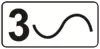
Question #5 What information is contained in this plate?
Topic: Road signs (Appendix 1)
Answer help
7.10. "Number of turns." Used with signs 1.3.1 and 1.3.2 if there are three or more turns. The number of turns may also be directly indicated on signs 1.3.1 and 1.3.2 -
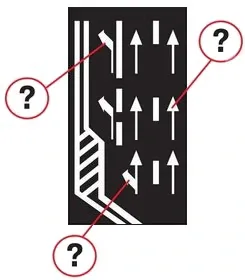
Question #6 What does this road marking mean?
Topic: Road markings (Appendix 2)
Answer help
1.18. — indicates the permitted directions of movement along lanes at an intersection. Used independently or in combination with signs 5.16, 5.18; marking with the image of a dead end is applied to indicate that turning onto the nearest carriageway is prohibited; marking that permits turning left from the extreme left lane also permits a U-turn; -
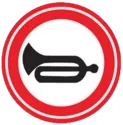
Question #7 What information is contained in this road sign?
Topic: Road signs (Appendix 1)
Answer help
3.33. "Sound signal prohibited." The use of sound signals is prohibited, except in cases where it is impossible to avoid a traffic accident without it. -
Question #8 Is it mandatory to comply with the requirements of horizontal road markings?
Topic: Traffic regulation
Answer help
8.5.1. Horizontal road marking establishes a certain regime and order of movement. It is applied on the carriageway or on the top of the curb in the form of lines, arrows, inscriptions, symbols, etc., with paint or other materials of the appropriate color according to paragraph 1 of section 34 of these Rules. -
Question #9 How should a towed motor vehicle be marked if its hazard warning lights are faulty or absent?
Topic: Warning signals
Answer help
9.9. Hazard warning lights must be turned on: d) on a towed motor vehicle; 9.11. If the vehicle is not equipped with hazard warning lights or they are faulty, it is necessary to install a warning triangle or a flashing red lantern: a) at the rear of the vehicle specified in paragraph 9.9 ("c", "d", "e") of these Rules; -
Question #10 What is the acceleration lane for?
Topic: Starting movement and changing its direction
Answer help
10.8. If there is a deceleration lane at the place of leaving the road, the driver who intends to turn onto another road must change lanes to this lane in a timely manner and reduce speed only on it. If there is an acceleration lane at the place of entering the road, the driver must move along it and merge into the traffic flow, giving way to vehicles moving along this road. -
Question #11 Where can passengers be during towing of cars by partial loading?
Topic: Towing and operation of vehicle combinations
Answer help
23.9. During towing with a rigid or flexible coupling, it is prohibited to carry passengers in the towed vehicle (except for a passenger car) and in the body of the towing truck, and in the case of towing by partial loading of this vehicle onto a platform or a special support device — in all vehicles (except for the cab of the towing vehicle). -
Question #12 Is it allowed for trucks to drive on highways and roads for cars beyond the second lane?
Topic: Movement on highways and roads for cars
Answer help
27.2. On motorways and roads for cars, it is prohibited: b) the movement of freight vehicles with a permissible maximum mass exceeding 3.5 t outside the first and second traffic lanes (except for turning left or making a U-turn on roads -
Question #13 In which figure is the position of the victim shown, in which it is recommended to transport him in case of spinal injury in an unconscious state.
Topic: Fundamentals of providing medical assistance in case of a traffic accident
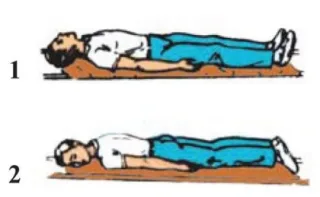
-
Question #14 In which of the listed cases is overtaking prohibited?
Topic: Overtaking
Answer help
14.6. Overtaking is prohibited: d) at the end of an ascent, on bridges, overpasses, viaducts, sharp turns, and other sections of roads with limited visibility or in conditions of insufficient visibility; -
Question #15 At what distance from railway crossings is stopping of vehicles prohibited?
Topic: Stopping and parking
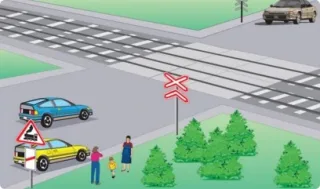
Answer help
15.10. Parking is prohibited: d) closer than 50 m from railway crossings; -
Question #16 Cars will pass the intersection in the following order:
Topic: Passing intersections
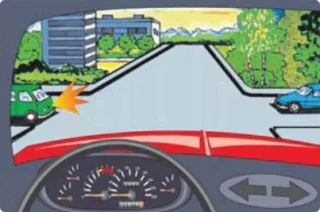
Answer help
16.12. At an intersection of equivalent roads, the driver of a non-rail vehicle must give way to vehicles approaching from the right. This rule must also be followed by tram drivers among themselves. At any uncontrolled intersection, a tram, regardless of the direction of its further movement, has priority over non-rail vehicles approaching it on an equivalent road. -
Question #17 Is the driver of a tourist bus allowed to enter lane 'A' in this situation to turn right?
Topic: Advantages of route vehicles
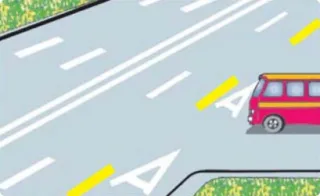
Answer help
17.2. A driver who turns right on a road with a lane for route vehicles separated by a broken line of road marking may make the turn from this lane. In such places, it is also allowed to enter it when leaving the road and for boarding or disembarking passengers at the right edge of the carriageway. -
Question #18 Under which of the listed conditions is the operation of vehicles prohibited? Give a complete answer.
Topic: Technical condition of vehicles and their equipment
Answer help
31.4.5. Wheels and tires: e) on the front axle of a bus performing intercity transportation, tires with a restored tread are installed, and on other axles — tires restored according to the second class -
Question #19 In which of the listed cases is it allowed to use rear fog lights?
Topic: Use of external lighting devices
Answer help
19.9. The rear fog light may be used in conditions of insufficient visibility both in daylight and in the dark. -
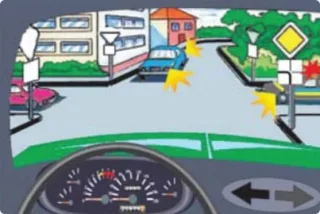
Question #20 The blue car will pass the intersection:
Topic: Passing intersections
Answer help
16.11. At an intersection of unequal roads, the driver of a vehicle moving along a secondary road must give way to vehicles approaching this intersection of carriageways along the main road, regardless of the direction of their further movement. 16.14. If the main road changes direction at an intersection, drivers of vehicles moving along it must be guided among themselves by the rules for passing intersections of equivalent roads. This rule must also be followed by drivers moving along secondary roads. 3.2. In the case of approaching a vehicle with a blue flashing beacon and (or) a special sound signal, drivers of other vehicles that may create an obstacle for its movement must give way to it and ensure unhindered passage of the specified vehicle (and vehicles accompanied by it). On vehicles moving in an accompanied column, the low beam headlights must be turned on. If on such a vehicle flashing beacons of blue and red or only red are turned on, drivers of other vehicles must stop at the right edge of the carriageway (on the right roadside). On a road with a dividing strip, this requirement must be fulfilled by drivers of vehicles moving in the same direction.