
Practice: ticket #54
Answers are checked instantly. The hint — a rules excerpt — is under the question.
-
Question #1 What is called the 'braking distance'?
Topic: General provisions
Answer help
braking distance — the distance that a vehicle travels during emergency braking from the beginning of the impact on the brake system control (pedal, handle) to the place of its stop; -
Question #2 A vehicle must be temporarily registered with the State Automobile Inspectorate if it is in international traffic on the territory of Ukraine for more than:
Topic: International movement
Answer help
29.2. A vehicle in international traffic on the territory of Ukraine for more than two months must be temporarily registered with the State Automobile Inspectorate, except for vehicles belonging to foreign citizens and stateless persons who are in Ukraine on vacation or treatment according to relevant vouchers or other documents for a period determined by the State Customs Service authorities. -
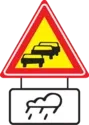
Question #3 What information is contained in this road sign with a plate?
Topic: Road signs (Appendix 1)
Answer help
1.38. "Traffic congestion." A section of road where narrowing of the carriageway causes traffic congestion due to road works or other reasons.
7.13. "Wet pavement." Indicates that the sign's effect applies to the period when the carriageway pavement is damp or wet.
Plates 7.12 and 7.13 are used with signs 1.13, 1.38, 1.39, 3.1—3.4, 3.6—3.14, 3.25, 3.27, 3.29, 3.31 -
Question #4 Which of these road signs prohibits the movement of a fully loaded road train whose permissible maximum mass is 8 tons?
Topic: Road signs (Appendix 1)
Answer help
3.15. "Movement of vehicles whose mass exceeds ...t is prohibited." The movement of vehicles, including their combinations, whose total actual mass exceeds that indicated on the sign is prohibited. -
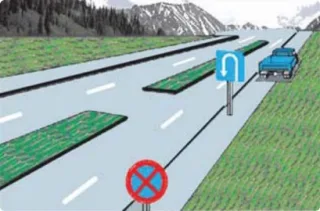
Question #5 Does the prohibitory road sign apply to the section of road where the driver has stopped?
Topic: Road signs (Appendix 1)
Answer help
3.34. "Stopping prohibited." Stopping and parking of vehicles are prohibited, except for taxis carrying out boarding or alighting of passengers (unloading or loading of cargo).
The effect of signs 3.9, 3.10, 3.34—3.37 extends only to the side of the road on which they are installed. -
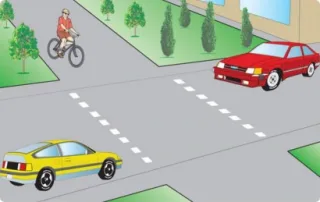
Question #6 If a bicycle path crosses the road outside an intersection, drivers of mopeds and bicycles:
Topic: Requirements for drivers of mopeds and bicycles
Answer help
6.6. If a bicycle path crosses a road outside an intersection, drivers of mopeds and bicycles must give way to other vehicles moving along the road. -
Question #7 At what distance before the beginning of a dangerous section are warning road signs placed outside populated areas?
Topic: Road signs (Appendix 1)
Answer help
Warning signs, except for signs 1.4.1—1.4.3, 1.29—1.31.6, are installed outside populated areas at a distance of 150—300 m, in populated areas — at a distance of 50—100 m before the beginning of the dangerous section. If necessary, signs are installed at a different distance, which is indicated on plate 7.1.1.
On signs 1.23.1—1.23.4, the depiction of junctions corresponds to the actual configuration of the intersection.
Signs 1.23.3 and 1.23.4 are installed when the distance between junctions of secondary roads is less than 50 m in populated areas and 100 m outside them. -
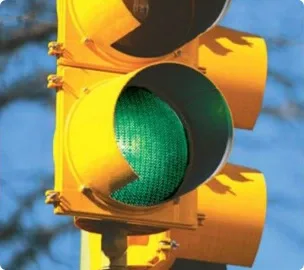
Question #8 What does the green flashing traffic light signal mean?
Topic: Traffic regulation
Answer help
8.7.3. Traffic light signals have the following meanings:
c) green flashing permits movement but informs that a signal prohibiting movement will soon be turned on. -
Question #9 Must the driver always give signals with direction indicators when changing the direction of his movement?
Topic: Warning signals
Answer help
9.2. The driver must give signals with direction indicators of the corresponding direction:
a) before starting to move and stopping;
b) before changing lanes, turning, or making a U-turn.
9.4. It is necessary to give a signal with direction indicators or by hand in advance before the start of the maneuver (taking into account the speed of movement), but not less than 50—100 m in populated areas and 150—200 m outside them, and stop immediately after its completion (the hand signal should be finished immediately before the start of the maneuver). The signal is prohibited from being given if it may be unclear to other road users.
Giving a warning signal does not give the driver an advantage and does not relieve him from taking precautionary measures. -
Question #10 In which of the listed cases must the driver of a vehicle give way?
Topic: Starting movement and changing its direction
Answer help
10.2. When entering a road from a residential area, courtyards, parking areas, filling stations, and other adjacent territories, the driver must before the carriageway or sidewalk give way to pedestrians and vehicles moving along it, and when leaving the road — to cyclists and pedestrians whose direction of movement he is crossing. -
Question #11 Is towing by a vehicle with a trailer permitted?
Topic: Towing and operation of vehicle combinations
Answer help
23.10. Towing is prohibited:
g) more than one vehicle or by a vehicle with a trailer; -
Question #12 What does this road sign mean?
Topic: Duties and rights of pedestrians
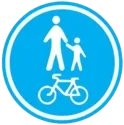
Answer help
4.14. "Path for pedestrians and cyclists." Movement of pedestrians and cyclists. -
Question #13 How to correctly choose the place for applying a hemostatic tourniquet to a limb?
Topic: Fundamentals of providing medical assistance in case of a traffic accident
-
Question #14 This identification sign marks cars:
Topic: Number plates, identification signs, inscriptions and markings

Answer help
30.3. The following identification signs are installed on the relevant vehicles (annex 4):
b) "Deaf driver" — a yellow circle with a diameter of 160 mm with three black circles of 40 mm diameter drawn inside, located at the corners of an imaginary equilateral -
Question #15 Stopping is prohibited:
Topic: Stopping and parking
Answer help
15.9. Stopping is prohibited:
c) on overpasses, bridges, viaducts, and under them, as well as in tunnels; -
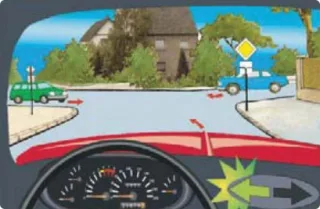
Question #16 The cars will pass through the intersection in the following order:
Topic: Passing intersections
Answer help
16.11. At an intersection of unequal roads, the driver of a vehicle moving along a secondary road must give way to vehicles approaching this crossing of carriageways along the main road, regardless of the direction of their further movement.
16.14. If the main road changes direction at an intersection, drivers of vehicles moving along it must be guided among themselves by the rules for passing through intersections of equal roads.
Drivers moving along secondary roads must also be guided among themselves by this rule. -
Question #17 If, while starting to move, you sharply press the accelerator pedal, what consequences could this lead to?
Topic: Organization and safety of traffic
-
Question #18 Under which of the listed conditions is the operation of vehicles prohibited? Give a complete answer.
Topic: Technical condition of vehicles and their equipment
Answer help
31.4.7. Other structural elements:
g) the main leaf or center bolt of the spring is broken;
d) the towing coupling or support coupling device of the tractor and trailer link in the composition of a road train, as well as the safety ropes (chains) provided by their design, are faulty. There are -
Question #19 What information is contained in this road sign?
Topic: Road signs (Appendix 1)
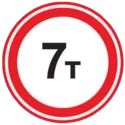
Answer help
3.15. "Movement of vehicles whose mass exceeds ...t is prohibited." The movement of vehicles, including their combinations, whose total actual mass exceeds that indicated on the sign is prohibited. -
Question #20 This road marking:
Topic: Road markings (Appendix 2)

Answer help
1.18. — indicates the permitted directions of movement along lanes at an intersection. It is used independently or in combination with signs 5.16, 5.18; marking with the image of a dead end is applied to indicate that turning onto the nearest carriageway is prohibited; marking that permits turning left from the extreme left lane also permits a U-turn;