
Practice: ticket #53
Answers are checked instantly. The hint — a rules excerpt — is under the question.
-
Question #1 'Safe distance' is the distance:
Topic: General provisions
Answer help
safe distance — the distance to the vehicle moving ahead in the same lane, which, in the event of its sudden braking or stopping, will allow the driver of the vehicle moving behind to avoid a collision without performing any maneuver; -
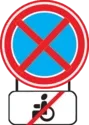
Question #2 These road sign and plate, according to the Traffic Rules, prohibit stopping of vehicles:
Topic: Road signs (Appendix 1)
Answer help
2.8. A disabled driver driving a motorized wheelchair or a car marked with the identification sign "Disabled" may deviate from the requirements of road signs 3.1, 3.2 and 3.35—3.38,
as well as sign 3.34 if there is a plate 7.18 under it
3.34. "Stopping prohibited". Stopping and parking of vehicles are prohibited, except for a taxi carrying out boarding or alighting of passengers (loading or unloading of cargo).
7.18. "Except for disabled persons". Indicates that the effect of the sign does not apply to motorized wheelchairs and cars on which the identification sign "Disabled" is installed in accordance with the requirements of these Rules. Used with signs 3.1, 3.34—3.38 -
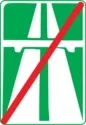
Question #3 What information is contained in this road sign?
Topic: Road signs (Appendix 1)
Answer help
5.2. "End of motorway". -
Question #4 Which of these road signs warns of approaching a dangerous turn?
Topic: Road signs (Appendix 1)
Answer help
1.1. "Dangerous right turn".
Signs 1.1 and 1.2 warn of a road curve with a radius of less than 500 m outside built-up areas and less than 150 m in built-up areas, or of a curve with limited visibility. -
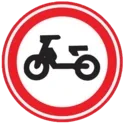
Question #5 The moped driver is approaching a section of road in front of which this road sign is installed. Is he allowed to move on this section?
Topic: Road signs (Appendix 1)
Answer help
3.7. "Moped movement prohibited". The movement of mopeds and bicycles with an auxiliary engine is prohibited. -
Question #6 What does this road marking mean?
Topic: Road markings (Appendix 2)

Answer help
1.20. — warns of approaching marking 1.13; -
Question #7 Where does the zone of action of the road sign 'No Overtaking' begin and end in a populated area? Give a complete answer.
Topic: Road signs (Appendix 1)
Answer help
3.25. "Overtaking prohibited". Overtaking of all vehicles is prohibited (except for single *, moving at a speed of less than 30 km/h).
* Single vehicles are considered to be single vehicles, road trains, as well as a towing vehicle coupled with a towed one.
3.26. "End of overtaking prohibition". -
Question #8 Two alternately flashing red signals have the following meaning:
Topic: Traffic regulation

Answer help
8.7.3. Traffic light signals have the following meanings:
e) a red signal, including a flashing one, or two red flashing signals prohibit movement. A signal in the form of a green arrow (arrows) in an additional (additional) section -
Question #9 Is it allowed to transport children under 12 years of age in the front seat of a passenger car?
Topic: Transportation of passengers
Answer help
21.11. It is prohibited to transport:
b) children whose height is less than 145 cm or who have not reached the age of 12, in vehicles equipped with seat belts, without the use of special means, -
Question #10 Training driving on motorways and on roads for cars:
Topic: Training driving
Answer help
24.9. It is prohibited to teach driving vehicles in a residential area, on roads for cars and on motorways. The list of roads on which driving instruction is allowed is agreed with the State Automobile Inspectorate. -
Question #11 Under what conditions is it permitted to operate combinations of vehicles consisting of a car, tractor, or other towing vehicle and a trailer?
Topic: Towing and operation of vehicle combinations
Answer help
23.11. Operation of vehicle combinations consisting of a car, tractor or other towing vehicle and a trailer is allowed only if the trailer matches the towing vehicle and the requirements for their operation are met. -
Question #12 Is it permitted for vehicles whose technical speed is less than 40 km/h to drive on motorways?
Topic: Movement on highways and roads for cars
Answer help
27.3. On motorways, except for specially equipped places, the movement of mechanical vehicles whose speed according to their technical characteristics or their condition is less than 40 km/h is prohibited, as well as the driving and grazing of animals in the right-of-way of the road. -
Question #13 Which vehicle's driver must give way when meeting on sections of roads marked with the 'Steep descent' sign?
Topic: Distance, interval, oncoming passing
Answer help
13.4. If oncoming passing is difficult, the driver on whose lane there is an obstacle or the dimensions of the vehicle he is driving interfere with oncoming traffic,
must give way. On road sections marked with signs 1.6 "Steep ascent" and 1.7 "Steep descent", in the presence of an obstacle, the driver of the vehicle moving downhill must give way. -
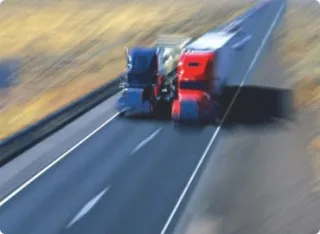
Question #14 The driver of the overtaken vehicle must:
Topic: Overtaking
Answer help
14.3. The driver of the overtaken vehicle is prohibited from preventing overtaking by increasing the speed of movement or by other actions. -
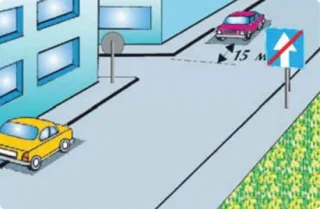
Question #15 Which car's driver did not violate parking rules?
Topic: Stopping and parking
Answer help
15.3. In built-up areas, stopping and parking of vehicles are allowed on the left side of the road that has one lane for traffic in each direction (without tram tracks in the middle) and is not divided by marking 1.1, as well as on the left side of a road with one-way traffic.
If the road has a boulevard or a dividing strip, stopping and parking of vehicles near them is prohibited.
15.9. Stopping is prohibited:
g) at intersections and closer than 10 m from the edge of the intersecting carriageway in the absence of a pedestrian crossing on them, except for stopping to give priority in traffic -
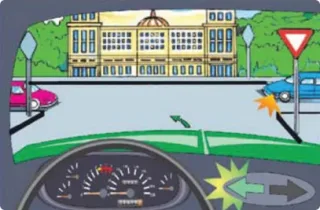
Question #16 The cars will pass the intersection in the following order:
Topic: Passing intersections
Answer help
16.11. At an intersection of unequal roads, the driver of a vehicle moving on a secondary road must give way to vehicles approaching this intersection of carriageways on the main road, regardless of the direction of their further movement.
16.13. Before turning left and making a U-turn, the driver of a non-rail vehicle must give way to a tram of the same direction, as well as to vehicles moving on an equivalent road in the opposite direction straight or to the right.
This rule should also be followed by tram drivers among themselves. -
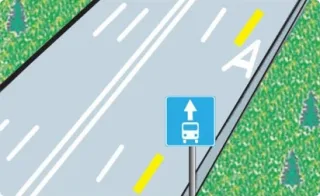
Question #17 Is it permitted for the driver of a passenger car to stop to let passengers out on the lane marked by this road sign?
Topic: Advantages of route vehicles
Answer help
17.2. A driver turning right on a road with a lane for route vehicles, separated by a broken line of road marking, may make the turn from this lane. In such places, it is also allowed to enter it when entering the road and for boarding or alighting passengers at the right edge of the carriageway. -
Question #18 Under which of the listed conditions is the operation of vehicles prohibited? Give a complete answer.
Topic: Technical condition of vehicles and their equipment
Answer help
31.4.6. Engine:
a) the content of harmful substances in exhaust gases or their smoke exceed the standards established by standards; -
Question #19 If the braking efficiency of the service braking system of vehicles does not meet the requirements of the Road Traffic Rules, you must:
Topic: Technical condition of vehicles and their equipment
Answer help
31.5. In the event of malfunctions specified in paragraph 31.4 of these Rules occurring on the road, the driver must take measures to eliminate them, and if this is impossible, move as short a way as possible to the place of parking or repair, observing precautions and fulfilling the requirements of paragraphs 9.9 and 9.11 of these Rules.
In the event of malfunctions specified in paragraph 31.4.7 ("i"; "d" — as part of a road train) occurring on the road, further movement is prohibited until they are eliminated. The driver of the faulty vehicle must take measures to remove it beyond the carriageway of the road. -
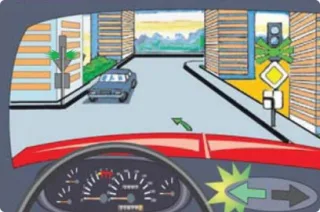
Question #20 The blue car will pass the intersection:
Topic: Passing intersections
Answer help
16.6. When turning left or making a U-turn on a green signal of the main traffic light, the driver of a non-rail vehicle must give way to a tram of the same direction, as well as to vehicles moving in the opposite direction straight or turning right.
This rule should also be followed by tram drivers among themselves.
8.3. Traffic controller signals have priority over traffic light signals and the requirements of priority road signs and are mandatory for execution.
Traffic light signals, except for a yellow flashing one, have priority over priority road signs.
Drivers and pedestrians must comply with additional requirements of the traffic controller, even if they contradict traffic light signals, the requirements of road signs and markings.