
Practice: ticket #50
Answers are checked instantly. The hint — a rules excerpt — is under the question.
-
Question #1 Are police officers allowed to inspect vehicles, things, hand luggage, and baggage?
Topic: Fundamentals of law
-
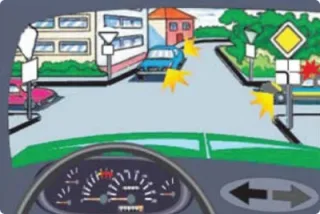
Question #2 The blue car will pass the intersection:
Topic: Movement of vehicles with special signals
Answer help
3.2. When a vehicle with a blue flashing beacon and/or special sound signal approaches, drivers of other vehicles that may create an obstacle to its movement must yield to it and ensure unimpeded passage of the specified vehicle (and vehicles accompanied by it).
Vehicles moving in the accompanied column must have low beam headlights on.
If such a vehicle has blue and red or only red flashing beacons turned on, drivers of other vehicles must stop at the right edge of the carriageway (on the right shoulder). On a road with a dividing strip, this requirement must be fulfilled by drivers of vehicles moving in the same direction.
16.11. At an intersection of unequal roads, the driver of a vehicle moving on a secondary road must yield to vehicles approaching this intersection of carriageways on the main road, regardless of the direction of their further movement.
16.14. If the main road changes direction at an intersection, drivers of vehicles moving on it must be guided among themselves by the rules for passing intersections of equal roads.
Drivers moving on secondary roads must also be guided by this rule among themselves. -
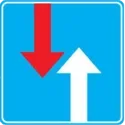
Question #3 If this road sign is installed, which drivers have the right of way?
Topic: Road signs (Appendix 1)
Answer help
2.6. "Priority over oncoming traffic." A narrow section of road during which the driver has priority over oncoming vehicles. -
Question #4 The effect of which road sign does not apply to route vehicles?
Topic: Road signs (Appendix 1)
Answer help
3.23. "No Left Turn". Turning left is prohibited for vehicles. However, a U-turn is permitted. -
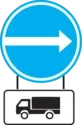
Question #5 Is the motorcycle driver allowed to turn right at the intersection before which this road sign and plate are installed?
Topic: Road signs (Appendix 1)
Answer help
4.2. "Turn Right".
7.5.1.—7.5.8. "Type of Vehicle". Indicate the type of vehicle to which the sign applies. Plate 7.5.1 extends the sign's effect to trucks (including those with trailers) with a permissible maximum mass exceeding 3.5 t; 7.5.3 — to passenger cars, as well as trucks with a permissible maximum mass up to 3.5 t. -
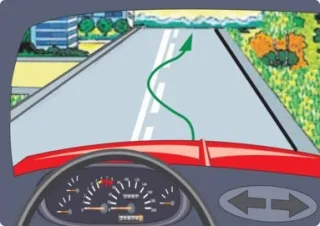
Question #6 Is the car driver allowed to cross the solid line of this road marking?
Topic: Road markings (Appendix 2)
Answer help
1.11. — separates traffic flows of opposite or same directions on road sections where lane changing is permitted only from one lane; marks places intended for U-turns, entry and exit from parking areas, etc., where traffic is permitted only in one direction;
Line 1.11 may be crossed only from its broken side, and from the solid side — only upon completion of overtaking or avoiding an obstacle. -
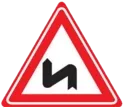
Question #7 What information is contained in this road sign?
Topic: Road signs (Appendix 1)
Answer help
1.3.1-1.3.2. "Multiple Turns". A road section with two or more dangerous turns located one after another: 1.3.1 — with the first turn to the right, 1.3.2 — with the first turn to the left. -
Question #8 Traffic controller signals:
Topic: Traffic regulation
Answer help
8.3. Traffic controller signals have priority over traffic light signals and requirements of priority road signs and are mandatory for execution.
Traffic light signals, except for the yellow flashing one, have priority over priority road signs.
Drivers and pedestrians must comply with additional requirements of the traffic controller, even if they contradict traffic light signals, requirements of road signs and markings. -
Question #9 The signal by turn indicators or by hand is stopped:
Topic: Warning signals
Answer help
9.4. It is necessary to give a signal with turn indicators or by hand in advance before starting the maneuver (taking into account the speed of movement), but not less than 50—100 m in built-up areas and 150—200 m outside them, and stop immediately after its completion (the hand signal should be finished immediately before starting the maneuver). The signal is prohibited if it may be unclear to other road users.
Giving a warning signal does not give the driver an advantage and does not relieve him from taking precautionary measures. -
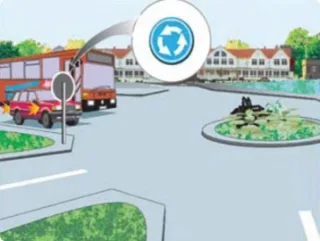
Question #10 Which vehicle driver correctly enters the intersection with circular traffic?
Topic: Starting movement and changing its direction
Answer help
10.4. Before turning right, left, or making a U-turn, the driver must take the appropriate extreme position on the carriageway intended for movement in that direction in advance, except when turning when entering an intersection where circular traffic is organized, the direction of movement is determined by road signs or road markings, or movement is possible only in one direction established by the configuration of the carriageway, road signs, or markings.
A driver making a left turn or U-turn outside an intersection from the corresponding extreme position on the carriageway of this direction must give way to oncoming vehicles, and when performing these maneuvers not from the extreme left position on the carriageway — also to vehicles moving in the same direction.
If there is a tram track in the middle of the carriageway, the driver of a non-rail vehicle making a left turn or U-turn outside an intersection must give way to the tram. -
Question #11 Entry into the pedestrian zone is allowed:
Topic: Movement in residential and pedestrian zones
Answer help
26.3. Entry into a pedestrian zone is permitted only for vehicles serving citizens and enterprises located in the specified zone, as well as vehicles belonging to citizens who live or work in this zone, or cars (motorized wheelchairs) marked with the identification sign "Disabled" driven by disabled drivers. If there are other entrances to objects located on this territory, drivers must use only them. -
Question #12 Is it allowed to drive on highways vehicles whose speed according to technical characteristics or their condition is less than 40 km/h?
Topic: Movement on highways and roads for cars
Answer help
27.3. On motorways, except for specially equipped places, the movement of mechanical vehicles whose speed according to their technical characteristics or their condition is less than 40 km/h is prohibited, as well as driving and grazing animals in the road right-of-way. -
Question #13 How to provide first aid for a bruised abdomen?
Topic: Fundamentals of providing medical assistance in case of a traffic accident
-
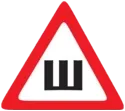
Question #14 What does this identification sign mean?
Topic: Number plates, identification signs, inscriptions and markings
Answer help
30.3. The following identification signs are installed on the corresponding vehicles (Appendix 4):
l) "Spikes" — an equilateral triangle of white color with the apex upward and a red border, in which the letter "Ш" of black color is inscribed (side of the triangle — not less than 200 mm, -
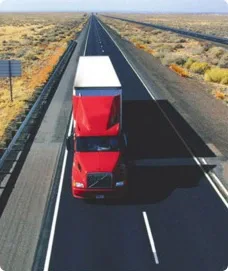
Question #15 Where should the driver stop the vehicle on the road?
Topic: Stopping and parking
Answer help
15.1. Stopping and parking of vehicles on the road must be carried out in specially designated places or on the roadside. -
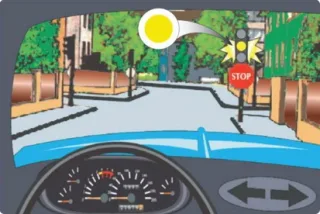
Question #16 The traffic light operates in the mode of flashing yellow signal. Are you allowed to pass the intersection without stopping before the sign "Moving without stopping is prohibited"?
Topic: Passing intersections
Answer help
16.1. An intersection where the order of passage is determined by traffic light signals or a traffic controller is considered regulated. At such an intersection, priority signs do not apply.
In the event of a traffic light being switched off or operating in the mode of flashing yellow signal and the absence of a traffic controller, the intersection is considered unregulated and drivers must be guided by the rules for passing unregulated intersections and the priority signs installed at the intersection.
2.2. "No Passing Without Stopping". Passing without stopping before marking 1.12 (stop line) is prohibited, and if it is absent — before the sign. -
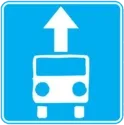
Question #17 Is the bus driver allowed to drive along the lane marked with this road sign, if this lane is separated by a solid yellow line of road marking?
Topic: Advantages of route vehicles
Answer help
17.1. On a road with a lane for route vehicles, marked by road sign 5.8 or 5.11, the movement and stopping of other vehicles on this lane are prohibited.
5.11. "Lane for Route Vehicles". The lane is intended only for vehicles moving along established routes in the same direction as the general traffic flow.
The effect of the sign extends to the traffic lane above which it is installed. The effect of the sign installed to the right of the road extends to the right traffic lane. -
Question #18 Under which of the listed conditions is the operation of vehicles prohibited? Give a complete answer.
Topic: Technical condition of vehicles and their equipment
Answer help
31.4.5. Wheels and tires:
e) there is no mounting bolt (nut) or there are cracks in the disc and wheel rims; -
Question #19 Under which of the listed conditions is the operation of vehicles prohibited? Give a complete answer.
Topic: Technical condition of vehicles and their equipment
Answer help
31.4.7. Other structural elements:
h) seat belts are not in working condition or have visible tears on the straps;
i) on motorcycles and mopeds there are no footrests provided by the design, on the seat — no transverse handles for the passenger; -
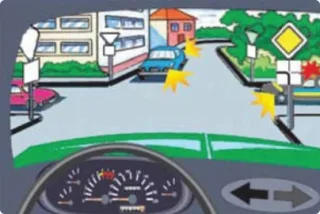
Question #20 The green car will pass the intersection:
Topic: Passing intersections
Answer help
16.11. At an intersection of unequal roads, the driver of a vehicle moving on a secondary road must give way to vehicles approaching this crossing of carriageways on the main road, regardless of the direction of their further movement.
16.14. If the main road at an intersection changes direction, drivers of vehicles moving on it must be guided among themselves by the rules for passing intersections of equal roads.
This rule must also be followed among themselves by drivers moving on secondary roads.
3.2. In the event of approach of a vehicle with a blue flashing beacon and (or) special sound signal, drivers of other vehicles that may create an obstacle to its movement must give way to it and ensure unhindered passage of the specified vehicle (and vehicles accompanied by it).
On vehicles moving in an accompanied column, low beam headlights must be turned on.
If on such a vehicle flashing beacons of blue and red or only red are turned on, drivers of other vehicles must stop at the right edge of the carriageway (on the right roadside). On a road with a dividing strip, this requirement must be fulfilled by drivers of vehicles moving in the same direction.