
Practice: ticket #49
Answers are checked instantly. The hint — a rules excerpt — is under the question.
-
Question #1 Should a warning precede before a police officer decides to use force, special means, or firearms?
Topic: Fundamentals of law
-
Question #2 How should a car driver act if, approaching an intersection, he hears a special sound signal and sees that a car with a red flashing beacon is catching up with him?
Topic: Movement of vehicles with special signals
Answer help
3.2. When a vehicle with a blue flashing beacon and/or special sound signal approaches, drivers of other vehicles that may create an obstacle to its movement must yield to it and ensure unimpeded passage of the specified vehicle (and vehicles accompanied by it).
Vehicles moving in the accompanied column must have low beam headlights on.
If such a vehicle has blue and red or only red flashing beacons turned on, drivers of other vehicles must stop at the right edge of the carriageway (on the right shoulder). On a road with a dividing strip, this requirement must be fulfilled by drivers of vehicles moving in the same direction. -
Question #3 What information is contained in this road sign?
Topic: General provisions
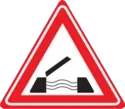
Answer help
1.25. "Drawbridge." Approach to a drawbridge. -
Question #4 What is the difference between the road signs 'Yield' and 'Stop'?
Topic: Road signs (Appendix 1)
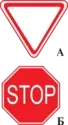
Answer help
2.1. "Yield." The driver must yield to vehicles approaching an uncontrolled intersection on the main road, and if there is a sign 7.8, to vehicles moving on the main road.
2.2. "No stopping without stopping." Stopping without stopping before marking 1.12 (stop line) is prohibited, and if it is absent, before the sign. -
Question #5 This road sign:
Topic: Road signs (Appendix 1)
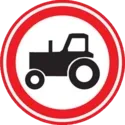
Answer help
3.5. "Movement of tractors is prohibited." The movement of tractors, self-propelled machines and mechanisms is prohibited. -
Question #6 What does this road marking warn about?
Topic: Road signs (Appendix 1)

Answer help
1.21. (inscription "STOP") - warns of approaching marking 1.12, if it is used in combination with sign 2.2; -
Question #7 In front of which road sections is this road sign installed?
Topic: Road signs (Appendix 1)
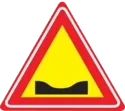
Answer help
1.12. "Pothole." A section of road with potholes or subsidence of the road surface on the carriageway. -
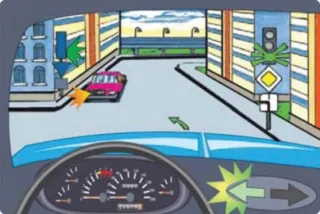
Question #8 The red car will cross the intersection
Topic: Traffic regulation
Answer help
8.3. Traffic controller signals have priority over traffic light signals and requirements of priority road signs and are mandatory for execution.
Traffic light signals, except yellow flashing, have priority over priority road signs.
Drivers and pedestrians must comply with additional requirements of the traffic controller, even if they contradict traffic light signals, requirements of road signs and markings.
16.6. When turning left or making a U-turn on a green signal of the main traffic light, the driver of a non-rail vehicle must yield to a tram traveling in the same direction, as well as to vehicles moving in the opposite direction straight or turning right.
Tram drivers must also be guided by this rule among themselves. -
Question #9 Which external lights must be turned on on a towed motor vehicle during towing?
Topic: Warning signals
Answer help
9.9. Hazard warning lights must be turned on:
d) on a towed motor vehicle; -
Question #10 What is the purpose of the deceleration lane?
Topic: Starting movement and changing its direction
Answer help
10.8. If there is a deceleration lane at the place of leaving the road, the driver who intends to turn onto another road must change lanes to this lane in a timely manner and reduce speed only on it.
If there is an acceleration lane at the place of entering the road, the driver must move along it and merge into the traffic flow, yielding to vehicles moving on this road. -
Question #11 When there is a tram track in the middle of the roadway, a left turn or U-turn must be made:
Topic: Position of vehicles on the road
Answer help
11.8. On a tram track of the same direction located at the same level as the carriageway for non-rail vehicles, movement is allowed provided that this is not prohibited by road signs or road markings, as well as during overtaking, bypassing, when the width of the carriageway is insufficient to perform a bypass without entering the tram track.
At an intersection, it is allowed to enter the tram track of the same direction in the same cases, but provided that there are no road signs 5.16-5.19 before the intersection.
Turning left or making a U-turn must be performed from the tram track of the same direction located at the same level as the carriageway for non-rail vehicles, if a different traffic order is not provided by road signs 5.16, 5.18 or marking 1.18.
In all cases, obstacles must not be created for tram movement. -
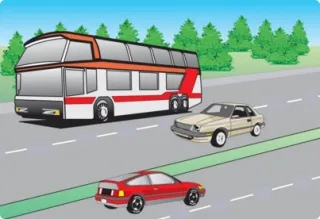
Question #12 What is the maximum speed allowed for intercity buses on motorways?
Topic: Speed of movement
Answer help
12.6. Outside built-up areas on all roads and on roads passing through built-up areas marked with sign 5.47, movement is allowed at a speed of:
d) buses (except minibuses) - no more than 90 km/h; -
Question #13 What are the first signs of exhaust gas poisoning?
Topic: Fundamentals of providing medical assistance in case of a traffic accident
-
Question #14 In which of the listed cases is overtaking prohibited?
Topic: Overtaking
Answer help
14.6. Overtaking is prohibited:
e) in tunnels;
e) columns of vehicles behind which a vehicle with a flashing beacon (except orange) is moving. -
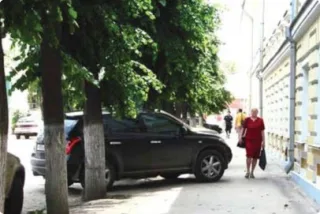
Question #15 Is parking allowed on the edge of a sidewalk adjacent directly to the edge of the roadway?
Topic: Stopping and parking
Answer help
15.10. Stopping is prohibited:
b) on sidewalks (except places marked with appropriate road signs installed with plates); -
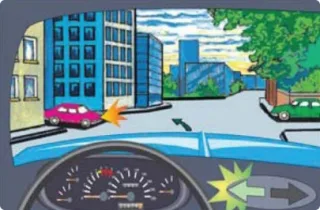
Question #16 The cars will pass the intersection in the following order:
Topic: Passing intersections
Answer help
16.12. At an intersection of equal roads, the driver of a non-rail vehicle must yield to vehicles approaching from the right.
Tram drivers must also be guided by this rule among themselves.
At any uncontrolled intersection, a tram, regardless of the direction of its further movement, has priority over non-rail vehicles approaching it on an equal road.
16.13. Before turning left and making a U-turn, the driver of a non-rail vehicle must yield to a tram traveling in the same direction, as well as to vehicles moving on an equal road in the opposite direction straight or to the right.
Tram drivers must also be guided by this rule among themselves. -
Question #17 Engine braking on a slippery road for a rear-wheel drive vehicle:
Topic: Organization and safety of traffic
-
Question #18 What should you do when turning right in the shown situation?
Topic: Passing pedestrian crossings and stops of vehicles
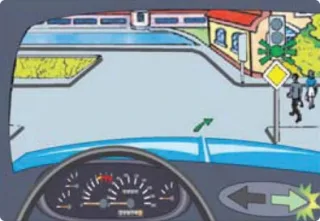
Answer help
18.2. At controlled pedestrian crossings and intersections, when a traffic light or traffic controller signal allows movement of vehicles, the driver must yield to pedestrians who are finishing crossing the carriageway of the corresponding direction of movement and for whom an obstacle or danger may be created. -
Question #19 What information is contained in this road sign?
Topic: Road signs (Appendix 1)
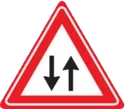
Answer help
1.26. "Two-way traffic." Beginning of a road section (carriageway) with oncoming traffic after one-way. -
Question #20 The second vehicle to pass the intersection will be:
Topic: Passing intersections
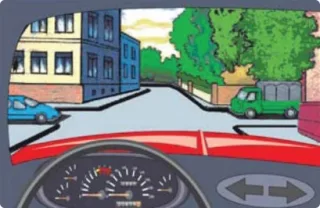
Answer help
16.12. At an intersection of equal roads, the driver of a non-rail vehicle must yield to vehicles approaching from the right.
Tram drivers must also be guided by this rule among themselves.
At any uncontrolled intersection, a tram, regardless of the direction of its further movement, has priority over non-rail vehicles approaching it on an equal road.