
Practice: ticket #48
Answers are checked instantly. The hint — a rules excerpt — is under the question.
-
Question #1 According to the definition of the Traffic Rules, 'permissible maximum mass of a road train' is:
Topic: General provisions
Answer help
permitted maximum mass — the mass of the equipped vehicle with cargo, driver, and passengers, which is established by the technical characteristics of the vehicle as the maximum permissible. The permitted maximum mass of a road train is the sum of the permitted maximum permissible mass of each vehicle included in the road train; -
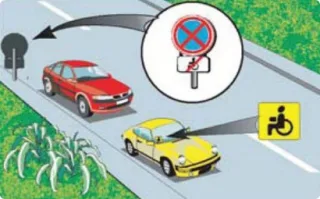
Question #2 The driver of which car is allowed to stop in the area of this road sign with a plate?
Topic: Duties and rights of drivers of mechanical vehicles
Answer help
2.8. A disabled driver driving a motorized wheelchair or a car marked with the identification sign "Disabled" may deviate from the requirements of road signs 3.1, 3.2, and 3.35—3.38, as well as sign 3.34 if there is a plate 7.18 under it -
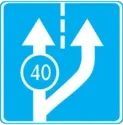
Question #3 How should the driver act if his vehicle cannot continue moving uphill at a speed of 40 km/h or more?
Topic: Road signs (Appendix 1)
Answer help
5.20.1.—5.20.3. "Beginning of an additional lane". The beginning of an additional lane on an incline or a deceleration lane.
If a sign 4.16 is depicted on the sign installed before the additional lane, the driver of a vehicle that cannot continue moving along the main lane at the indicated or higher speed must change to the additional lane.
Sign 5.20.3 indicates the beginning of an additional lane on the left or the beginning of a deceleration lane before an intersection for turning left or making a U-turn. -
Question #4 Which road sign prohibits the movement of vehicles whose overall length is greater than indicated on the sign?
Topic: Road signs (Appendix 1)
Answer help
3.19. "Movement of vehicles whose length exceeds ...m is prohibited". The movement of vehicles whose overall length (with or without cargo) is greater than that indicated on the sign is prohibited. -
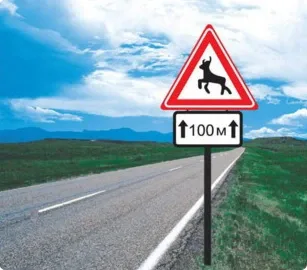
Question #5 This road sign with a plate warns the driver that:
Topic: Road signs (Appendix 1)
Answer help
1.36. "Wild animals". A road section where wild animals may appear.
7.2.1.—7.2.6. "Area of operation". They indicate: 7.2.1 — the length of the dangerous section marked with warning signs, or the area of operation of prohibition and information-indication signs;
7.2.2 — the area of operation of prohibition signs 3.34—3.37, as well as the length of one or more stopping areas located one after another; 7.2.3 — the end of the area of operation of signs 3.34—3.37;
7.2.4 — that the vehicle is in the area of operation of signs 3.34—3.37; 7.2.5, 7.2.6 — the direction and area of operation of signs 3.34—3.37 in the case of prohibiting stopping or parking along one side of a square, building facade, etc. When used together with prohibition signs, the plates reduce the area of operation of the signs. -
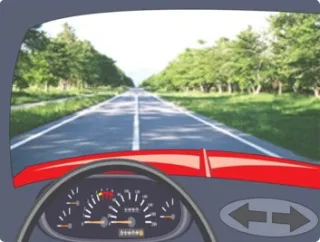
Question #6 In front of you are two solid marking lines and on the right. Is it allowed to cross them?
Topic: Road markings (Appendix 2)
Answer help
1.1. (narrow solid line) — separates traffic flows of opposite directions and marks the boundaries of traffic lanes on roads; marks the boundaries of the roadway onto which entry is prohibited; marks the boundaries of vehicle parking areas and the edge of the roadway of roads not classified as motorways according to traffic conditions;
Lines 1.1 and 1.3 are prohibited to cross. If line 1.1 marks a parking area or the edge of the roadway adjacent to the shoulder, crossing this line is permitted.
As an exception, provided that road safety is ensured, it is permitted to cross line 1.1 to bypass a stationary obstacle whose dimensions do not allow safe bypass without crossing this line, as well as to overtake single vehicles moving at a speed of less than 30 km/h. -
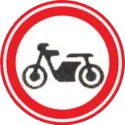
Question #7 What information is contained in this road sign?
Topic: Road signs (Appendix 1)
Answer help
3.6. "Motorcycle movement is prohibited".
motorcycle — a two-wheeled mechanical vehicle with or without a sidecar, having an engine with a working volume of 50 cubic cm or more. Motor scooters, motorized wheelchairs, three-wheeled and other mechanical vehicles whose permitted maximum mass does not exceed 400 kg are equated to motorcycles; -
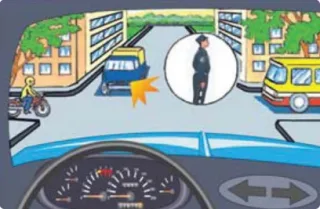
Question #8 In which answer are the vehicles that are allowed to move named?
Topic: Traffic regulation
Answer help
8.8. Traffic controller signals. The signals of the traffic controller are the positions of his body, as well as hand gestures, including with a baton or a disk with a red reflector,
having the following meanings:
a) arms extended to the sides, lowered, or the right arm bent in front of the chest: from the left and right sides — the movement of a tram straight is allowed, non-rail vehicles — straight and -
Question #9 At what distance from pedestrian crossings are stopping and parking of vehicles prohibited?
Topic: Stopping and parking
Answer help
15.9. Stopping is prohibited:
d) at pedestrian crossings and closer than 10 m from them on both sides, except in cases of giving priority in traffic; -
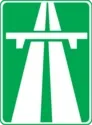
Question #10 Is training driving allowed on road sections marked with this road sign?
Topic: Training driving
Answer help
24.9. It is prohibited to teach driving vehicles in residential areas, on roads for cars, and on motorways. The list of roads on which teaching driving vehicles is permitted is agreed with the State Automobile Inspectorate. -
Question #11 When is a vehicle whose speed does not exceed 40 km/h allowed to enter the far left lane of the roadway for travel in the same direction?
Topic: Position of vehicles on the road
Answer help
11.7. Vehicles whose speed must not exceed 40 km/h or which for technical reasons cannot develop such speed must move as close as possible to the right edge of the roadway, except in cases of overtaking, bypassing, or changing lanes before turning left or making a U-turn. -
Question #12 What is the maximum speed allowed for vehicles driven by drivers with less than two years of experience on motorways?
Topic: Speed of movement
Answer help
12.6. Outside populated areas on all roads and on roads passing through populated areas marked with sign 5.47, movement is allowed at a speed of:
b) vehicles driven by drivers with up to 2 years of experience — no more than 70 km/h; -
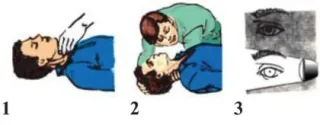
Question #13 In which figure is the method for determining whether a victim is alive or dead correctly shown?
Topic: Fundamentals of providing medical assistance in case of a traffic accident
-
Question #14 In which cases are vehicles re-registered with the State Automobile Inspection (GAI)?
Topic: Number plates, identification signs, inscriptions and markings
Answer help
30.1. Owners of mechanical vehicles and trailers to them must register (re-register) them with the State Automobile Inspectorate regardless of their technical condition within 10 days from the moment of acquisition (receipt), customs clearance, or conversion or repair, if it is necessary to make changes to the registration documents. -
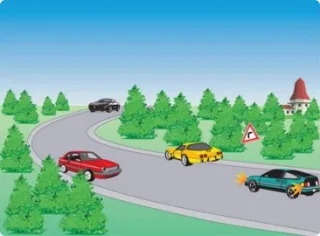
Question #15 Is parking allowed outside populated areas where visibility or view of the road is less than 100 m in only one direction?
Topic: Stopping and parking
Answer help
15.10. Stopping is prohibited:
g) outside built-up areas in zones of dangerous curves and convex breaks in the longitudinal profile of the road with visibility or view less than 100 m in at least one direction of travel; -
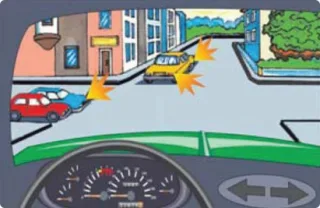
Question #16 The red car will cross the intersection:
Topic: Passing intersections
Answer help
16.2. At controlled and uncontrolled intersections, a driver turning right or left must yield to pedestrians crossing the carriageway onto which he is turning, as well as to cyclists moving straight in the same direction. -
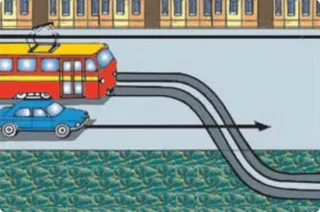
Question #17 Which vehicle's driver must yield?
Topic: Advantages of route vehicles
Answer help
17.3. Outside intersections where tram tracks cross the lane of non-rail vehicles, priority is given to the tram (except when the tram is leaving the depot). -
Question #18 Is it allowed to operate a car if one bolt (nut) of the wheel mounting is missing?
Topic: Technical condition of vehicles and their equipment
Answer help
31.4.5. Wheels and tires:
e) there is no mounting bolt (nut) or there are cracks in the disc and rims of the wheels; -
Question #19 Which vehicle's driver has the right of way on mountain roads and steep descents marked with appropriate road signs when passing oncoming traffic is difficult?
Topic: Movement on mountain roads and steep descents
Answer help
28.1. On mountain roads and steep descents where passing oncoming traffic is difficult, the driver of a vehicle moving downhill must yield to vehicles moving uphill. -
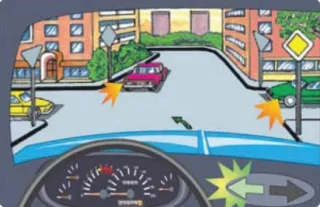
Question #20 The last to cross the intersection will be:
Topic: Passing intersections
Answer help
16.11. At an intersection of unequal roads, the driver of a vehicle moving on a secondary road must yield to vehicles approaching this intersection of carriageways on the main road, regardless of the direction of their further movement.
16.13. Before turning left and making a U-turn, the driver of a non-rail vehicle must yield to a tram traveling in the same direction, as well as to vehicles moving on an equal road in the opposite direction straight or to the right.
Tram drivers must also be guided by this rule among themselves.