
Practice: ticket #44
Answers are checked instantly. The hint — a rules excerpt — is under the question.
-
Question #1 Driving vehicles by persons in a state of intoxication entails:
Topic: Fundamentals of law
-
Question #2 Is it allowed to board (alight) passengers from the side of the roadway?
Topic: Duties and rights of passengers
Answer help
5.1. Passengers may board (alight) after the vehicle has stopped only from the boarding area, and in the absence of such an area — from the sidewalk or roadside, and if this is impossible, then from the extreme lane of the carriageway (but not from the side of the adjacent lane for movement), provided that it is safe and does not create obstacles for other road users. -
Question #3 Approaching a railway crossing, before which this road sign is installed, the driver of a non-rail vehicle must:
Topic: Road signs (Appendix 1)

Answer help
2.2. "Passing without stopping is prohibited." It is prohibited to pass without stopping before road marking 1.12 (stop line), and if it is absent, before the sign.
If sign 2.2 is installed before a railway crossing that is not guarded and is not equipped with traffic light signaling, the driver must stop before the stop line, and if it is absent, before this sign.
20.2. Approaching the crossing, as well as starting to move after stopping before it, the driver must be guided by the instructions and signals of the crossing attendant, the position of the barrier, light and sound signaling, road signs and road markings, and also make sure that no train (locomotive, draisine) is approaching. -
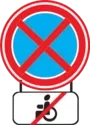
Question #4 Is it allowed for a disabled driver, driving a car marked with the 'Disabled' identification sign, to stop in the zone of this road sign with a plate?
Topic: Road signs (Appendix 1)
Answer help
3.34. "Stopping prohibited". Stopping and parking of vehicles is prohibited, except for taxis carrying out boarding or alighting of passengers (unloading or loading of cargo).
7.18. "Except for the disabled". Indicates that the effect of the sign does not apply to motorized wheelchairs and cars on which the identification sign "Disabled" is installed in accordance with the requirements of these Rules. It is used with signs 3.1, 3.34—3.38
2.8. A disabled driver driving a motorized wheelchair or a car marked with the identification sign "Disabled" may deviate from the requirements of road signs 3.1, 3.2 and 3.35—3.38, as well as sign 3.34 if there is a plate 7.18 under it -
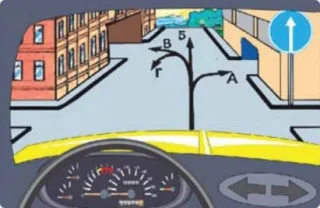
Question #5 In which directions is movement allowed? (Directions A and B are entrances to courtyards).
Topic: Road signs (Appendix 1)
Answer help
4.1. "Go straight".
Signs 4.3, 4.5 and 4.6 also allow U-turns of vehicles. The effect of signs 4.1—4.6 does not apply to vehicles moving on established routes.
The effect of signs 4.1—4.6 applies to the intersection of carriageways before which they are installed. The effect of sign 4.1, installed at the beginning of the road or after the intersection, applies to the section of the road up to the nearest intersection. The sign does not prohibit turning right into courtyards and other territories adjacent to the road. -
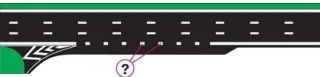
Question #6 What information is contained in this road marking?
Topic: Road markings (Appendix 2)
Answer help
1.8. (wide broken line) — indicates the boundary between the acceleration or deceleration lane and the main lane of the carriageway (at intersections, road junctions at different levels, in the area of bus stops, etc.); -
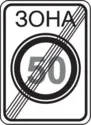
Question #7 What information is contained in this road sign?
Topic: Road signs (Appendix 1)
Answer help
3.32. "End of the maximum speed limit zone". -
Question #8 Is the 'Column' identification sign always installed on vehicles moving in a column?
Topic: Movement of vehicles in columns
Answer help
25.1. On each vehicle moving as part of a column, the identification sign "Column" is installed, provided for in subparagraph "e" of paragraph 30.3 of these Rules, and the low beam headlights are switched on.
The identification sign may not be installed if the column is accompanied by operational vehicles with red, blue and red, green or blue and green flashing beacons and (or) special sound signals turned on. -
Question #9 What is the maximum number of passengers allowed to be carried in the body of a truck?
Topic: Transportation of passengers
Answer help
21.7. The number of passengers carried in the body of a truck must not exceed the number of seats equipped for sitting. -
Question #10 Training driving on roads is allowed:
Topic: Training driving
Answer help
24.5. Driving instruction on roads is allowed only in the presence of a driving instructor (teaching person) and with sufficient initial driving skills of the student. -
Question #11 Is it allowed to carry passengers in a towed vehicle when towing with a flexible or rigid coupling?
Topic: Towing and operation of vehicle combinations
Answer help
23.9. During towing with a rigid or flexible coupling, it is prohibited to carry passengers in the towed vehicle (except for a passenger car) and in the body of the towing truck, and in the case of towing by partial loading of this vehicle onto a platform or special support device — in all vehicles (except for the cab of the towing vehicle). -
Question #12 Is stopping allowed on motorways and roads for cars?
Topic: Movement on highways and roads for cars
Answer help
27.2. On motorways and roads for cars, it is prohibited:
c) stopping outside special parking areas marked with road signs 5.38 or 6.15; -
Question #13 What distance on roads outside populated areas must drivers of vehicles whose speed does not exceed 40 km/h observe?
Topic: Distance, interval, oncoming passing
-
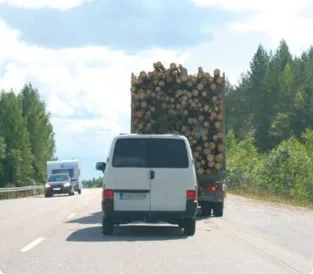
Question #14 According to the Traffic Rules, what must the driver be sure of before starting to overtake a road train?
Topic: Overtaking
Answer help
14.2. Before starting to overtake, the driver must make sure that:
b) the driver of the vehicle moving ahead in the same lane has not given a signal of intention to turn (change lanes) left; -
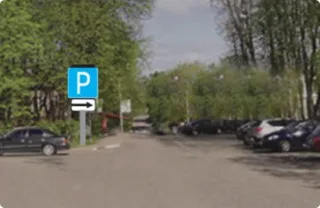
Question #15 In conditions of insufficient visibility, parking outside a populated area is allowed:
Topic: Stopping and parking
Answer help
15.11. At night and in conditions of insufficient visibility, parking outside populated areas is allowed only on parking areas or outside the road. -
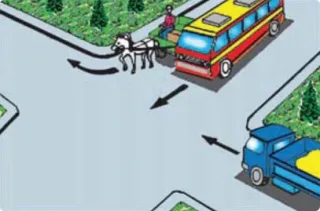
Question #16 Indicate the order of passage through the intersection:
Topic: Passing intersections
Answer help
16.12. At an intersection of equal roads, the driver of a non-rail vehicle must give way to vehicles approaching from the right.
Tram drivers must also be guided by this rule among themselves.
At any uncontrolled intersection, a tram, regardless of the direction of its further movement, has priority over non-rail vehicles approaching it on an equal road. -
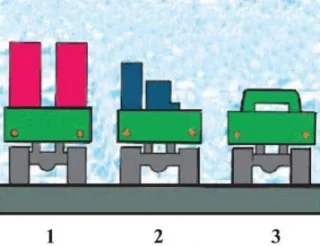
Question #17 In which case does the vehicle's stability against overturning increase?
Topic: Organization and safety of traffic
-
Question #18 In which of the listed cases is the driver obliged to reduce speed or stop before a pedestrian crossing?
Topic: Passing pedestrian crossings and stops of vehicles
Answer help
18.1. The driver of a vehicle approaching an uncontrolled pedestrian crossing where pedestrians are present must reduce speed, and if necessary, stop to give way to pedestrians for whom an obstacle or danger may be created.
18.2. At controlled pedestrian crossings and intersections, when the traffic light or traffic controller signal permits vehicle movement, the driver must give way to pedestrians who are finishing crossing the carriageway of the corresponding direction and for whom an obstacle or danger may be created. -
Question #19 This road sign prohibits the movement of:
Topic: Road signs (Appendix 1)
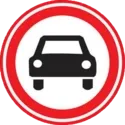
Answer help
3.2. "Several turns". A section of road with two or more dangerous turns located one after another: 1.3.1 — with the first turn to the right, 1.3.2 — with the first turn to the left.
The effect of the signs does not apply:
3.1, 3.2, 3.21—3.24, 3.34 — to vehicles moving along established routes;
3.1, 3.2, 3.35—3.38, as well as sign 3.34 if there is plate 7.18 under it — to disabled drivers driving a motorized wheelchair or a car marked with the identification sign "Disabled";
3.1—3.8, 3.11 — to vehicles serving citizens or belonging to citizens who live or work in this zone, as well as to vehicles serving enterprises located in the designated zone. In such cases, vehicles must enter the designated zone and leave it at the nearest intersection to the destination;
3.3 — to trucks that have an inclined white stripe on the outer side surface or carry groups of people;
3.35—3.38 — to taxis with the taximeter turned on. -
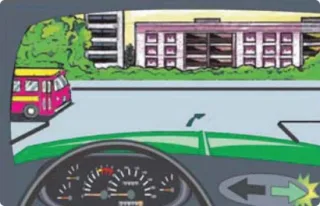
Question #20 You are in the green car:
Topic: Passing intersections
Answer help
16.12. At an intersection of equal roads, the driver of a non-rail vehicle must give way to vehicles approaching from the right.
Tram drivers must also be guided by this rule among themselves.
At any uncontrolled intersection, a tram, regardless of the direction of its further movement, has priority over non-rail vehicles approaching it on an equal road.