
Practice: ticket #43
Answers are checked instantly. The hint — a rules excerpt — is under the question.
-
Question #1 Is it allowed to install special sound signals on vehicles?
Topic: Individual traffic rules issues requiring coordination with the State Automobile Inspection
Answer help
32.1. The following are agreed with the State Automobile Inspection bodies:
e) technical requirements, design, and installation on vehicles of special sound and light signaling devices (such as "Siren", flashing beacon, etc.), light -
Question #2 In which place are pedestrians allowed to cross the roadway in the absence of a pedestrian crossing?
Topic: Duties and rights of pedestrians
Answer help
4.7. Pedestrians must cross the carriageway at pedestrian crossings, including underground and overhead ones, and in their absence — at intersections along the lines of sidewalks or roadsides.
4.8. If there is no crossing or intersection in the visibility zone, and the road has no more than three lanes for both directions, it is allowed to cross it at a right angle to the edge of the carriageway in places where the road is clearly visible in both directions, and only after the pedestrian is convinced that there is no danger. -
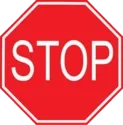
Question #3 What should the driver do if this road sign is installed before an uncontrolled intersection?
Topic: Road signs (Appendix 1)
Answer help
2.2. "Passing without stopping is prohibited." It is prohibited to pass without stopping before road marking 1.12 (stop line), and if it is absent, before the sign. -
Question #4 Which road sign gives the driver priority over oncoming vehicles?
Topic: Road signs (Appendix 1)
Answer help
2.6. "Advantage over oncoming traffic." A narrow section of road, while driving along which the driver has an advantage over oncoming vehicles. -
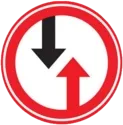
Question #5 What information is contained in this road sign?
Topic: Road signs (Appendix 1)
Answer help
2.5. "Advantage of oncoming traffic." It is prohibited to enter a narrow section of road if this may impede oncoming traffic. The driver must give way to oncoming vehicles located on the narrow section. -
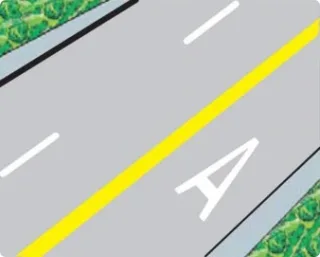
Question #6 Which vehicles are allowed to drive in the right lane of the roadway?
Topic: Road markings (Appendix 2)
Answer help
1.23. — indicates a lane intended for the movement of only route vehicles. -
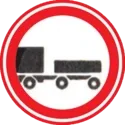
Question #7 Is towing of mechanical vehicles allowed if this road sign is installed on the road?
Topic: Road signs (Appendix 1)
Answer help
3.4. "Junction with a secondary road." Sign 1.23.1 — junction on the right side, 1.23.2 — on the left, 1.23.3 — on the right and left, 1.23.4 — on the left and right side. -
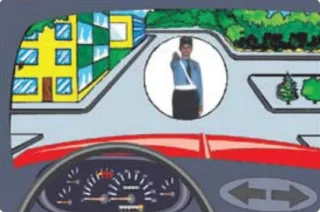
Question #8 Movement is allowed:
Topic: Traffic regulation
Answer help
8.8. Traffic controller signals. Traffic controller signals are the positions of his body, as well as hand gestures, including with a baton or a disc with a red reflector, having the following meanings:
b) the right arm extended forward: from the left side — the movement of the tram to the left is allowed, non-rail vehicles — in all directions; pedestrians are allowed to cross -
Question #9 The hazard warning lights on a towed mechanical vehicle must be switched on:
Topic: Warning signals
Answer help
9.9. The hazard warning lights must be switched on:
d) on a towed motor vehicle; -
Question #10 What is the purpose of the deceleration lane?
Topic: Starting movement and changing its direction
Answer help
10.8. If there is a deceleration lane at the place of leaving the road, the driver who intends to turn onto another road must change lanes to this lane in a timely manner and reduce speed only on it.
If there is an acceleration lane at the place of entering the road, the driver must drive along it and merge into the traffic flow, giving way to vehicles moving along this road. -
Question #11 Is it allowed for passengers to be in a towed vehicle during towing?
Topic: Towing and operation of vehicle combinations
Answer help
23.9. During towing on a rigid or flexible coupling, it is prohibited to carry passengers in the towed vehicle (except for a passenger car) and in the body of the towing truck, and in the case of towing by partial loading of this vehicle onto a platform or a special support device — in all vehicles (except for the cab of the towing vehicle). -
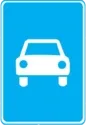
Question #12 Are stopping and parking allowed on roads marked with this road sign?
Topic: Movement on highways and roads for cars
Answer help
27.2. On motorways and roads for cars, it is prohibited:
c) stopping outside special parking places marked with road signs 5.38 or 6.15; -
Question #13 How to provide first aid if gasoline is ingested?
Topic: Fundamentals of providing medical assistance in case of a traffic accident
-
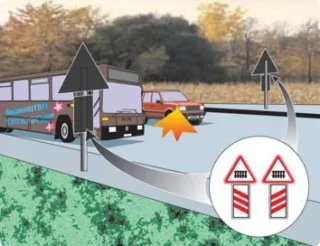
Question #14 Is it allowed to overtake a bus on this section of road?
Topic: Overtaking
Answer help
14.6. Overtaking is prohibited:
b) at railway crossings and closer than 100 m before them;
1.27. "Railway crossing with a barrier".
1.31.1—1.31.6. "Approaching a railway crossing". Additional warning of approaching a railway crossing outside built-up areas. -
Question #15 Is parking of vehicles on the sidewalk allowed?
Topic: Stopping and parking
Answer help
15.10. Parking is prohibited:
c) on sidewalks, except for passenger cars and motorcycles, which may be placed at the edge of sidewalks, where at least 2 m remains for pedestrian movement; -
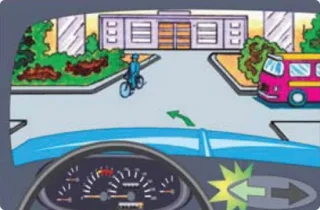
Question #16 The cyclist will cross the intersection:
Topic: Passing intersections
Answer help
16.12. At an intersection of equivalent roads, the driver of a non-rail vehicle must give way to vehicles approaching from the right.
Tram drivers must also be guided by this rule among themselves.
At any uncontrolled intersection, a tram, regardless of the direction of its further movement, has an advantage over non-rail vehicles approaching it on an equivalent road.
16.13. Before turning left and making a U-turn, the driver of a non-rail vehicle must give way to a tram in the same direction, as well as to vehicles moving on an equivalent road in the opposite direction straight or to the right.
Tram drivers must also be guided by this rule among themselves. -
Question #17 How should one drive out of a deep rut in winter in a rear-wheel-drive vehicle?
Topic: Organization and safety of traffic
-
Question #18 Bus tires must have a residual tread pattern height of at least:
Topic: Technical condition of vehicles and their equipment
Answer help
31.4.5. Wheels and tires:
a) tires of passenger cars and trucks with a permitted maximum mass of up to 3.5 t have a residual tread pattern height of less than 1.6 mm, trucks with -
Question #19 The total play in the steering of a bus with a permitted maximum mass over 5 tons must not exceed:
Topic: Technical condition of vehicles and their equipment
Answer help
31.4.2. Steering:
a) the total play in the steering exceeds the following limit values: -
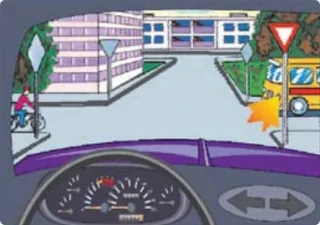
Question #20 Vehicles will cross the intersection in the following order:
Topic: Passing intersections
Answer help
16.11. At an intersection of unequal roads, the driver of a vehicle moving on a secondary road must give way to vehicles approaching this intersection of carriageways on the main road, regardless of the direction of their further movement.
16.13. Before turning left and making a U-turn, the driver of a non-rail vehicle must give way to a tram in the same direction, as well as to vehicles moving on an equivalent road in the opposite direction straight or to the right.
Tram drivers must also be guided by this rule among themselves.