
Practice: ticket #42
Answers are checked instantly. The hint — a rules excerpt — is under the question.
-
Question #1 Is an exit onto the road from a gas station considered an intersection?
Topic: General provisions
Answer help
intersection — a place of crossing, joining, or branching of roads at the same level, the boundary of which is imaginary lines between the beginnings of the curves of the edges of the carriageway of each of the roads. The place where an exit from an adjacent territory joins the road is not considered an intersection; -
Question #2 What vehicles is a driver allowed to drive who has more than three years of driving experience and a driver's license of category 'C'?
Topic: Duties and rights of drivers of mechanical vehicles
Answer help
2.13. The right to drive vehicles is granted:
a) motor vehicles and motorized wheelchairs — from 16 years of age;
b) cars of all types and categories (except buses and trucks equipped for transporting more than eight passengers), trams and trolleybuses — from 18 years of age;
c) buses and trucks equipped for transporting more than eight passengers — from 19 years of age. -
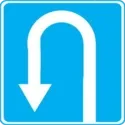
Question #3 On the section of road where this road sign is installed:
Topic: Road signs (Appendix 1)
Answer help
5.26. "Turning place". Indicates a place for turning vehicles around. Turning left is prohibited. -
Question #4 Which of these road signs allows transit traffic for motorcycles?
Topic: Road signs (Appendix 1)
Answer help
4.11. "Movement of passenger cars". Only passenger cars, buses, motorcycles, route vehicles, and trucks whose permissible maximum mass does not exceed 3.5 tons are allowed to move. -
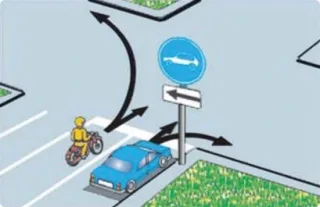
Question #5 Drivers of which vehicles are allowed to move?
Topic: Road signs (Appendix 1)
Answer help
4.11. "Movement of passenger cars". Only passenger cars, buses, motorcycles, route vehicles, and trucks whose permissible maximum mass does not exceed 3.5 tons are allowed to move.
7.3.1.—7.3.3. "Direction of action". Show the directions of action of signs located before an intersection, or the directions of movement to designated objects located directly near the road. -
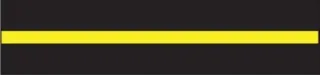
Question #6 What does a solid yellow line of horizontal road marking indicate?
Topic: Road markings (Appendix 2)
Answer help
1.4. — indicates places where stopping and parking of vehicles are prohibited. It is used independently or in combination with sign 3.34 and is applied at the edge of the carriageway or along the top of the curb; -
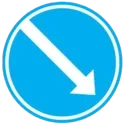
Question #7 What information is contained in this road sign?
Topic: Road signs (Appendix 1)
Answer help
4.7. "Bypassing an obstacle on the right side". -
Question #8 Do additional requirements of a traffic controller take precedence over traffic light signals?
Topic: Traffic regulation
Answer help
8.3. Traffic controller signals have priority over traffic light signals and requirements of priority road signs and are mandatory for execution.
Traffic light signals, except for the yellow flashing one, have priority over priority road signs.
Drivers and pedestrians must comply with additional requirements of the traffic controller, even if they contradict traffic light signals, requirements of road signs, and markings. -
Question #9 At any uncontrolled intersection, a tram, regardless of the direction of its further movement:
Topic: Passing intersections
Answer help
16.12. At an intersection of equivalent roads, the driver of a non-rail vehicle must give way to vehicles approaching from the right.
Tram drivers must also be guided by this rule among themselves.
At any uncontrolled intersection, a tram, regardless of the direction of its further movement, has priority over non-rail vehicles approaching it on an equivalent road. -
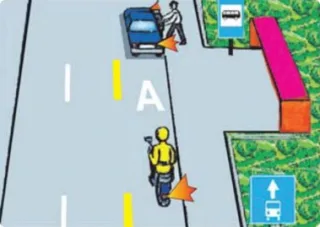
Question #10 The driver of which vehicle did not violate the stopping rules?
Topic: Stopping and parking
Answer help
15.9. Stopping is prohibited:
e) closer than 30 m from boarding areas for stopping route vehicles, and if there are none — closer than 30 m from the road sign of such a stop on both sides;
17.2. A driver who turns right on a road with a lane for route vehicles, separated by a broken line of road marking, may make the turn from this lane. In such places, it is also allowed to enter it when leaving the road and for boarding or alighting passengers at the right edge of the carriageway. -
Question #11 Is towing allowed on icy roads?
Topic: Towing and operation of vehicle combinations
Answer help
23.10. Towing is prohibited:
b) on a flexible coupling during icy conditions; -
Question #12 In which places is stopping of vehicles allowed on motorways?
Topic: Movement on highways and roads for cars
Answer help
27.2. On highways and roads for cars, it is prohibited:
c) stopping outside special parking places marked by road signs 5.38 or 6.15; -
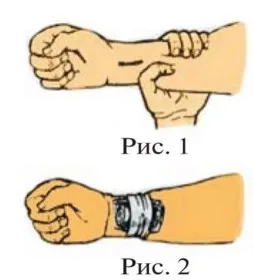
Question #13 Which figure most correctly shows the method of stopping bleeding from a wound?
Topic: Fundamentals of providing medical assistance in case of a traffic accident
-
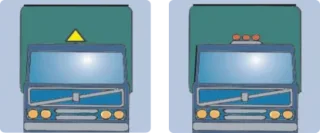
Question #14 Which of these identification signs is installed to indicate a road train?
Topic: Number plates, identification signs, inscriptions and markings
Answer help
30.3. The following identification signs are installed on the corresponding vehicles (appendix 4):
a) "Road train" — three orange lights located horizontally above the front part of the cab (body) with gaps between the lights from 150 to 300 mm — on trucks -
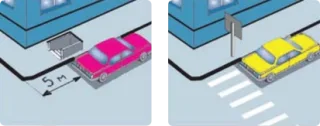
Question #15 In which figure did the driver incorrectly stop his car to let passengers out?
Topic: Stopping and parking
Answer help
15.9. Stopping is prohibited:
d) at pedestrian crossings and closer than 10 m from them on both sides, except for cases of giving priority in movement;
e) at intersections and closer than 10 m from the edge of the crossed carriageway in the absence of a pedestrian crossing on them, except for stopping to give priority in movement -
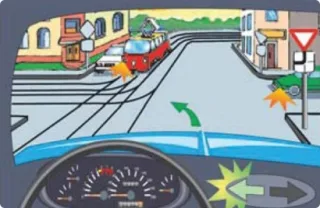
Question #16 Vehicles will pass the intersection in the following order:
Topic: Passing intersections
Answer help
16.11. At an intersection of unequal roads, the driver of a vehicle moving on a secondary road must give way to vehicles approaching this crossing of carriageways on the main road, regardless of the direction of their further movement.
16.14. If the main road changes direction at an intersection, drivers of vehicles moving on it must be guided among themselves by the rules for passing intersections of equivalent roads.
Drivers moving on secondary roads must also be guided by this rule among themselves. -
Question #17 Is it allowed for vehicles to drive in the lane intended for route vehicles?
Topic: Advantages of route vehicles
Answer help
17.1. On a road with a lane for route vehicles, marked by road sign 5.8 or 5.11, the movement and stopping of other vehicles on this lane are prohibited. -
Question #18 Under which of the listed conditions is the operation of vehicles prohibited? Give a complete answer.
Topic: Technical condition of vehicles and their equipment
Answer help
31.4.5. Wheels and tires:
d) on one axle of the vehicle, diagonal tires are installed together with radial, studded and unstudded, frost-resistant and non-frost-resistant, tires of different
31.4.7. Other structural elements:
d) the door locks of the body or cab, the locks of the sides of the cargo platform, the locks of the necks of tanks and fuel tanks, the adjustment mechanism provided by the design do not work -
Question #19 What should you do if, at night, the driver of an oncoming car does not switch from high beam to low beam and thereby blinds you?
Topic: Use of external lighting devices
Answer help
19.3. In case of deterioration of visibility in the direction of movement caused by the light of headlights of oncoming vehicles, the driver must reduce the speed to one that would not exceed the safe speed under the conditions of actual visibility of the road in the direction of movement, and in case of blinding — turn on the hazard warning lights and, without changing the lane,
stop. Resumption of movement is allowed only after the negative consequences of blinding have passed. -
Question #20 In which of the listed cases should you stop before a railway crossing?
Topic: Movement through railway crossings
Answer help
20.5. Movement through the crossing is prohibited if:
d) a traffic jam has formed behind the crossing, which will force the driver to stop at the crossing;