
Practice: ticket #40
Answers are checked instantly. The hint — a rules excerpt — is under the question.
-
Question #1 Drivers who drive vehicles and for whom there are sufficient grounds to believe that they are intoxicated:
Topic: Fundamentals of law
-
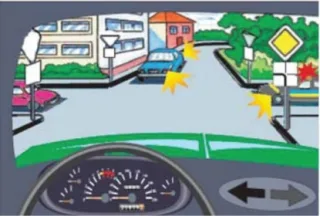
Question #2 The green car will pass the intersection:
Topic: Passing intersections
Answer help
3.2. When a vehicle with a blue flashing beacon and (or) special sound signal approaches, drivers of other vehicles that may create an obstacle to its movement must give way to it and ensure unimpeded passage of the specified vehicle (and vehicles accompanied by it).
Vehicles moving in an accompanied column must have their low beam headlights on.
If such a vehicle has blue and red or only red flashing beacons on, drivers of other vehicles must stop at the right edge of the carriageway (on the right shoulder). On a road with a dividing strip, this requirement must be fulfilled by drivers of vehicles moving in the same direction.
16.11. At an intersection of unequal roads, the driver of a vehicle moving on a secondary road must give way to vehicles approaching this intersection of carriageways on the main road, regardless of the direction of their further movement.
16.14. If the main road changes direction at an intersection, drivers of vehicles moving on it must be guided among themselves by the rules for passing intersections of equal roads.
Drivers moving on secondary roads must also be guided by this rule among themselves. -
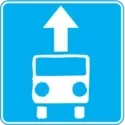
Question #3 Is it allowed for drivers of ordinary vehicles to stop for boarding or alighting passengers on the lane marked with this road sign?
Topic: Advantages of route vehicles
Answer help
17.2. A driver turning right on a road with a lane for route vehicles separated by a broken line of road marking may make the turn from this lane. In such places, it is also allowed to enter it when leaving the road and for boarding or alighting passengers at the right edge of the carriageway.
5.11. "Lane for route vehicles". The lane is intended only for vehicles moving on established routes in the same direction as the general traffic flow.
The effect of the sign extends to the lane above which it is installed. The effect of the sign installed to the right of the road extends to the right lane. -
Question #4 Which of these road signs indicates the direction of movement for returning to the roadway on the right?
Topic: Road signs (Appendix 1)
Answer help
5.24.1. and 5.24.2. "Change of direction of movement on a road with a dividing strip". Shows the direction of detour of a section of the carriageway closed to traffic on a road with a dividing strip or the direction of movement to return to the carriageway on the right. -
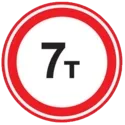
Question #5 What does the number indicated on this road sign mean?
Topic: Road signs (Appendix 1)
Answer help
3.15. "Movement of vehicles with a mass exceeding ...t prohibited". The movement of vehicles, including their combinations, whose total actual mass exceeds that indicated on the sign is prohibited. -
Question #6 This road marking indicates:
Topic: Road markings (Appendix 2)

Answer help
2.5. — side surfaces of road barriers on curves of small radius, steep descents, other dangerous sections; -
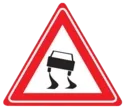
Question #7 What information is contained in this road sign?
Topic: Road signs (Appendix 1)
Answer help
1.13. "Slippery road". A road section with increased slipperiness of the carriageway. -
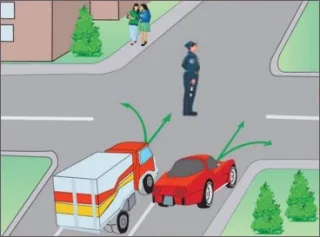
Question #8 Movement is prohibited
Topic: Traffic regulation
Answer help
8.8. Traffic controller signals. Traffic controller signals are the positions of his body, as well as hand gestures, including with a baton or disc with a red reflector,
having the following meanings:
a) arms extended to the sides, lowered, or the right arm bent in front of the chest: from the left and right sides — tram movement straight is allowed, non-rail vehicles — straight and -
Question #9 The flashing red light emitted by a lantern, which is used in accordance with the requirements of the Road Traffic Rules, must be clearly visible:
Topic: Warning signals
Answer help
9.12. The flashing red light emitted by a lamp, which is used in accordance with the requirements of paragraphs 9.10 and 9.11 of these Rules, must be clearly visible both during the day in sunny weather and in conditions of insufficient visibility. -
Question #10 In the case when the trajectories of vehicles intersect, and the order of passage is not specified by the Road Traffic Rules, the driver must yield the road:
Topic: Starting movement and changing its direction
Answer help
10.11. If the trajectories of vehicles intersect, and the order of passage is not determined by these Rules, the driver to whom the vehicle approaches from the right side must give way. -
Question #11 Transportation of passengers is prohibited when towing on a rigid or flexible coupling:
Topic: Towing and operation of vehicle combinations
Answer help
23.9. During towing on a rigid or flexible coupling, it is prohibited to carry passengers in the towed vehicle (except for a passenger car) and in the body of the towing truck, and in the case of towing by partial loading of this vehicle onto a platform or special support device — in all vehicles (except for the cab of the towing vehicle). -
Question #12 In what places is intentional stopping of vehicles allowed on motorways?
Topic: Movement on highways and roads for cars
Answer help
27.2. On motorways and roads for cars, it is prohibited:
c) stopping outside special parking places marked with road signs 5.38 or 6.15; -
Question #13 The driver of a bus performing international transportation, moving downhill on a section of road marked with the road sign 'Steep descent' - must he yield the road to the driver of an oncoming passenger car, on whose lane there is an obstacle?
Topic: Distance, interval, oncoming passing
Answer help
13.4. If oncoming passage is difficult, the driver on whose lane there is an obstacle or the dimensions of the vehicle he controls interfere with oncoming traffic,
must give way. On road sections marked with signs 1.6 "Steep ascent" and 1.7 "Steep descent", in the presence of an obstacle, the driver of the vehicle moving downhill must give way. -
Question #14 Is overtaking vehicles allowed at an intersection on a road that is the main one in relation to the one being crossed?
Topic: Overtaking
Answer help
14.6. Overtaking is prohibited:
a) at an intersection; -
Question #15 Parking is prohibited:
Topic: Stopping and parking
Answer help
15.10. Stopping is prohibited:
d) closer than 50 m from railway crossings; -
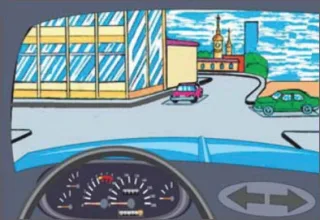
Question #16 The second to pass the intersection will be:
Topic: Passing intersections
Answer help
16.12. At an intersection of equivalent roads, the driver of a non-rail vehicle must give way to vehicles approaching from the right.
Tram drivers must also be guided by this rule among themselves.
At any uncontrolled intersection, a tram, regardless of the direction of its further movement, has priority over non-rail vehicles approaching it on an equivalent road. -
Question #17 You have stopped on an incline waiting for a permissive traffic light signal. In this case, it is best to hold the car in place:
Topic: Organization and safety of traffic
-
Question #18 Under what conditions, according to the Road Traffic Rules, is further movement of vehicles prohibited even to the place of repair?
Topic: Technical condition of vehicles and their equipment
Answer help
31.6. Further movement of vehicles is prohibited if:
a) the service brake system or steering does not allow the driver to stop the vehicle or perform a maneuver while driving at minimum speed;
b) at night or in conditions of insufficient visibility, the lamps of headlights or rear position lights are not lit;
c) during rain or snowfall, the windshield wiper on the side of the steering wheel does not work;
d) the towing coupling device of the road train is damaged. -
Question #19 Under what conditions is the operation of vehicles prohibited?
Topic: Technical condition of vehicles and their equipment
Answer help
31.4.3. External lighting devices:
a) the number, type, color, placement and mode of operation of external lighting devices do not meet the requirements of the vehicle design;
b) the headlight adjustment is violated;
c) the lamp of the left headlight in the low beam mode does not light;
d) there are no diffusers on the lighting devices or diffusers and lamps are used that do not correspond to the type of this lighting device;
e) tinting or coating is applied to the diffusers of lighting devices, which reduces their transparency or light transmission.
Notes:
1. Motorcycles (mopeds) may be additionally equipped with one fog lamp, other mechanical vehicles — with two. Fog lamps must be placed at a height of at least 250 mm from the road surface (but not higher than low beam headlights) symmetrically relative to the longitudinal axis of the vehicle and no further than 400 mm from the outer dimension in width. -
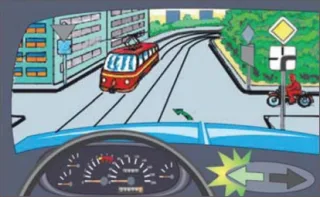
Question #20 Does the driver of a motorcycle have priority in movement over the driver of a tram?
Topic: Passing intersections
Answer help
16.11. At an intersection of unequal roads, the driver of a vehicle moving on a secondary road must give way to vehicles approaching this intersection of carriageways on the main road, regardless of the direction of their further movement.
16.14. If the main road at an intersection changes direction, drivers of vehicles moving on it must be guided among themselves by the rules for passing intersections of equivalent roads.
Drivers moving on secondary roads must also be guided by this rule among themselves.