
Practice: ticket #35
Answers are checked instantly. The hint — a rules excerpt — is under the question.
-
Question #1 Violation of overtaking and oncoming traffic rules entail:
Topic: Fundamentals of law
-
Question #2 Where should a pedestrian move if there is no sidewalk or pedestrian path on the road?
Topic: Duties and rights of pedestrians
Answer help
4.1. Pedestrians must move along sidewalks and pedestrian paths, keeping to the right side.
If there are no sidewalks, pedestrian paths, or it is impossible to move along them, pedestrians may move along bicycle paths, keeping to the right side and not obstructing the movement of bicycles and mopeds, or in a single row along the roadside, keeping as far to the right as possible, and in its absence or impossibility to move along it — along the edge of the roadway towards the movement of vehicles. In this case, one must be careful and not interfere with other road users. -
Question #3 This road sign:
Topic: Road signs (Appendix 1)
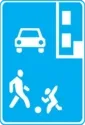
Answer help
5.31. "Residential zone." Informs about entering an area where special traffic conditions provided for by these Rules apply. -
Question #4 Which road sign indicates a hotel or motel?
Topic: Road signs (Appendix 1)
Answer help
6.16. "Hotel or motel." -
Question #5 In which direction is it allowed for a passenger car to move?
Topic: Road signs (Appendix 1)
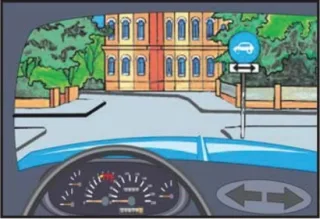
Answer help
4.11. "Movement of passenger cars." Only passenger cars, buses, motorcycles, route vehicles, and trucks whose permissible maximum mass does not exceed 3.5 tons are allowed to move.
7.3.1.—7.3.3. "Direction of action." Indicate the directions of action of signs located before an intersection, or the directions of movement to designated objects located directly near the road. -
Question #6 Which vehicle drivers stopped incorrectly for passenger disembarkation?
Topic: Road markings (Appendix 2)
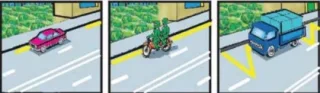
Answer help
1.10. — indicates places where parking is prohibited. It is used independently or in combination with sign 3.35 and is applied at the edge of the roadway or along the top of the curb; -
Question #7 How to determine a road or carriageway with one-way traffic?
Topic: Road signs (Appendix 1)
Answer help
5.5. "Road with one-way traffic." A road or separated roadway along which vehicles move in only one direction across its entire width. -
Question #8 What do two simultaneously lit traffic light signals - red and yellow - mean?
Topic: Traffic regulation
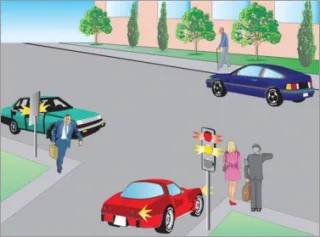
Answer help
8.7.3. Traffic light signals have the following meanings:
e) the combination of red and yellow signals prohibits movement and informs about the upcoming activation of the green signal; -
Question #9 If the bus doors are open, the driver:
Topic: Transportation of passengers
Answer help
21.4. The driver is prohibited from starting to move until the doors are fully closed and from opening them until the vehicle has stopped. -
Question #10 From what minimum age is it allowed to learn to drive a passenger car belonging to an individual?
Topic: Training driving
Answer help
24.2. Persons learning to drive a car must be at least 16 years old, and a motorcycle — 14 years old. Such persons must have a document confirming their age. -
Question #11 Cycling on the carriageway is allowed only in one row along the rightmost lane as far to the right as possible. In which cases is it allowed to leave this lane?
Topic: Position of vehicles on the road
Answer help
11.14. Movement along the roadway on bicycles, mopeds, horse-drawn carts (sleds), and riders is allowed only in a single row along the rightmost lane as far to the right as possible, except when overtaking. Turning left and making a U-turn are allowed on roads with one lane for movement in each direction and without a tram track in the middle.
Movement along the roadside is allowed if it does not create obstacles for pedestrians. -
Question #12 At what speed is it allowed for a passenger car to move in a populated area indicated by this road sign?
Topic: Speed of movement

Answer help
12.6. Outside populated areas on all roads and on roads passing through populated areas marked with sign 5.47, movement is allowed at a speed:
g) for other vehicles: on a highway marked with road sign 5.1 – no more than 130 km/h, on a highway with separate roadways,
5.47. "Beginning of a populated area." The name and beginning of the development of a populated area in which the requirements of these Rules determining the order of movement in populated areas do not apply on this road. -
Question #13 How to provide first aid for a dislocated shoulder joint?
Topic: Fundamentals of providing medical assistance in case of a traffic accident
-
Question #14 How is the maximum mass of transported cargo and the load distribution on the vehicle's axles regulated?
Topic: Transportation of cargo
Answer help
22.1. The mass of the cargo being transported and the distribution of load on the axles must not exceed the values determined by the technical characteristics of this vehicle. -
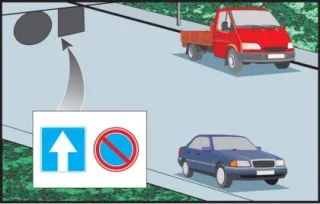
Question #15 Which vehicle drivers violated parking rules outside populated areas?
Topic: Stopping and parking
Answer help
15.3. In populated areas, stopping and parking of vehicles are allowed on the left side of a road that has one lane for movement in each direction (without tram tracks in the middle) and is not divided by marking 1.1, as well as on the left side of a road with one-way traffic.
If the road has a boulevard or a dividing strip, stopping and parking of vehicles near them is prohibited.
3.35. "Parking prohibited." Parking of all vehicles is prohibited. -
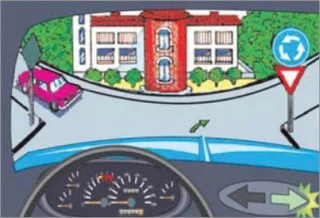
Question #16 The red car:
Topic: Passing intersections
Answer help
16.11. At an intersection of unequal roads, the driver of a vehicle moving along a secondary road must yield to vehicles approaching this intersection of roadways along the main road, regardless of the direction of their further movement. -
Question #17 How does fatigue affect the driver's attention and reaction?
Topic: Organization and safety of traffic
-
Question #18 Is it allowed to continue driving a car that has a brake system malfunction but allows the driver to stop it?
Topic: Technical condition of vehicles and their equipment
Answer help
31.5. In the event of malfunctions specified in point 31.4 of these Rules occurring on the road, the driver must take measures to eliminate them, and if this is impossible — move as short a route as possible to the place of parking or repair, observing precautions and fulfilling the requirements of points 9.9 and 9.11 of these Rules.
In the event of malfunctions specified in point 31.4.7 ("ї"; "д" — as part of a road train) occurring on the road, further movement is prohibited until they are eliminated. The driver of the faulty vehicle must take measures to remove it beyond the roadway.
31.6. Further movement of vehicles is prohibited if:
a) the service brake system or steering does not allow the driver to stop the vehicle or perform a maneuver during movement with minimal -
Question #19 In which of the listed cases should the high beam be switched to low beam?
Topic: Use of external lighting devices
Answer help
19.2. High beam should be switched to low beam at least 250 m before an oncoming vehicle, as well as when it can blind other drivers, in particular those moving in the same direction.
The light must also be switched at a greater distance if the driver of the oncoming vehicle indicates the need for this by periodically switching the headlights. -
Question #20 A driver leaving an unpaved road onto an asphalt road:
Topic: Passing intersections
Answer help
16.11. At an intersection of unequal roads, the driver of a vehicle moving along a secondary road must yield to vehicles approaching this intersection of roadways along the main road, regardless of the direction of their further movement.
main road — a road with a surface relative to an unpaved road or marked with signs 1.22, 1.23.1—1.23.4 and 2.3. The presence of a surface on a secondary road directly before the intersection does not equate it in importance to the intersecting road;