
Practice: ticket #33
Answers are checked instantly. The hint — a rules excerpt — is under the question.
-
Question #1 From what moment is a driver considered deprived of the right to drive a vehicle?
Topic: Fundamentals of law
-
Question #2 Where can pedestrians move in populated areas if there are no sidewalks, pedestrian and bicycle paths?
Topic: Duties and rights of pedestrians
Answer help
4.1. Pedestrians must move along sidewalks and pedestrian paths, keeping to the right side.
If there are no sidewalks, pedestrian paths or it is impossible to move along them, pedestrians can move along bicycle paths, keeping to the right side and not hindering the movement of bicycles and mopeds, or in one row along the roadside, keeping as far to the right as possible, and in its absence or impossibility to move along it — along the edge of the roadway towards the movement of vehicles. At the same time, you need to be careful and not interfere with other road users. -
Question #3 What does this road sign mean?
Topic: Road signs (Appendix 1)

Answer help
5.28.1. and 5.28.2. "Direction of movement for trucks." Shows the recommended direction of movement for trucks and self-propelled machines. -
Question #4 Which road sign allows bypassing an obstacle only on the right?
Topic: Road signs (Appendix 1)
Answer help
4.7. "Bypass an obstacle on the right side." -
Question #5 In which directions indicated by arrows is movement allowed?
Topic: Road signs (Appendix 1)
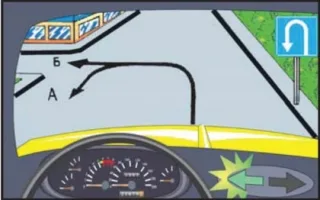
Answer help
5.26. "Place for a U-turn." Indicates a place for turning around vehicles. Turning left is prohibited. -
Question #6 With which road sign is this marking used?
Topic: Road markings (Appendix 2)

Answer help
1.13. — indicates the place where the driver must, if necessary, stop and give way to vehicles moving on the road being crossed; -
Question #7 Which of the listed vehicles is allowed to move on this road sign?
Topic: Road signs (Appendix 1)
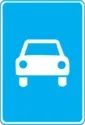
Answer help
5.3. "Road Narrowing". Sign 1.5.1 — road narrowing on both sides, 1.5.2 — on the right, 1.5.3 — on the left side. -
Question #8 Do the traffic rules always require compliance with the requirements of horizontal road marking?
Topic: Traffic regulation
Answer help
8.1. Traffic regulation is carried out with the help of road signs, road markings, road equipment, traffic lights, as well as traffic controllers.
8.5. Road markings (Annex 2) are divided into horizontal and vertical and are used separately or together with road signs, the requirements of which they emphasize or clarify. -
Question #9 When, according to the traffic rules, should the warning signal by hand be finished?
Topic: Warning signals
Answer help
9.4. It is necessary to give a signal with turn indicators or by hand in advance before the start of the maneuver (taking into account the speed of movement), but not less than 50-100 m in populated areas and 150-200 m outside them, and stop immediately after its completion (the hand signal should be finished immediately before the start of the maneuver). It is forbidden to give a signal if it may be unclear to other road users.
Giving a warning signal does not give the driver an advantage and does not relieve him of taking precautions. -
Question #10 Is it allowed for the bus driver to enter the intersection in this situation?
Topic: Passing intersections
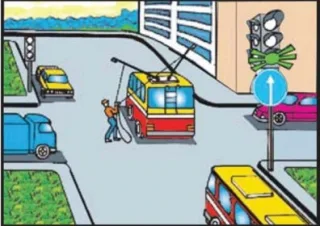
Answer help
16.4. It is forbidden to enter any intersection, including when the traffic light signal permits movement, if a traffic jam has formed that will force the driver to stop at the intersection, which will create an obstacle for the movement of other vehicles and pedestrians. -
Question #11 In a residential area it is prohibited:
Topic: Movement in residential and pedestrian zones
Answer help
26.2. In a residential area it is forbidden:
a) transit movement of vehicles;
b) parking of vehicles outside specially designated places and such their location that impedes the movement of pedestrians and the passage of operational or special vehicles;
c) parking with the engine running;
d) driving instruction;
e) movement of trucks, tractors, self-propelled machines and mechanisms (except those serving objects and citizens performing technological work or belonging to citizens who live in this area). -
Question #12 Is reversing allowed on road sections marked with this road sign?
Topic: Movement on highways and roads for cars
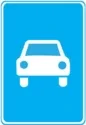
Answer help
27.2. On motorways and roads for cars it is forbidden:
e) reversing; -
Question #13 Which of the listed answers most fully indicates the errors when applying a tourniquet (twist)?
Topic: Fundamentals of providing medical assistance in case of a traffic accident
-
Question #14 This identification sign indicates a vehicle:
Topic: Number plates, identification signs, inscriptions and markings
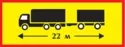
Answer help
30.3. The following identification signs are installed on the corresponding vehicles (Annex 4):
d) "Long vehicle" — two yellow rectangles measuring 500 x 200 mm with a red border 40 mm wide made of reflective material. The sign -
Question #15 Are stopping and parking allowed on the left side on a road with two-way traffic?
Topic: Stopping and parking
Answer help
15.3. In populated areas, stopping and parking of vehicles are allowed on the left side of the road that has one lane for traffic in each direction (without tram tracks in the middle) and is not divided by marking 1.1, as well as on the left side of a one-way road.
If the road has a boulevard or a dividing strip, stopping and parking of vehicles near them is prohibited. -
Question #16 Priority in movement has:
Topic: Passing intersections
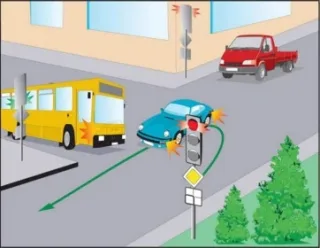
Answer help
16.5. When a traffic controller gives a signal or a traffic light signal permitting movement is turned on, the driver is obliged to give way to vehicles completing movement through the intersection, as well as to pedestrians finishing crossing. -
Question #17 What does reduced air pressure in the front tires of a car lead to?
Topic: Organization and safety of traffic
-
Question #18 Operation of vehicles is prohibited according to legislation in the presence of the following technical faults and conditions:
Topic: Technical condition of vehicles and their equipment
Answer help
31.4.3. External lighting devices:
c) the lamp of the left headlight in low beam mode does not burn;
31.4.4. Windshield wipers and washers:
a) windshield wipers do not work;
31.4.7. Other structural elements:
g) there are no seat belts and head restraints in vehicles where their installation is provided for by the design; -
Question #19 The driver of which vehicle must give way?
Topic: Passing intersections
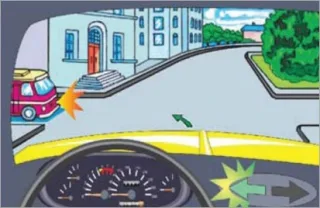
Answer help
16.12. At an intersection of equivalent roads, the driver of a non-rail vehicle is obliged to give way to vehicles approaching from the right.
Tram drivers must also be guided by this rule among themselves.
At any uncontrolled intersection, a tram, regardless of the direction of its further movement, has priority over non-rail vehicles approaching it on an equivalent road. -
Question #20 What must the driver do immediately in case of a forced stop of the vehicle at a railway crossing?
Topic: Movement through railway crossings
Answer help
20.8. In the event of a forced stop of a vehicle at a crossing, the driver is obliged to immediately disembark people and take measures to free the crossing, and if this cannot be done, he must:
a) if possible, send two people along the tracks in both directions from the crossing for at least 1000 m (if one, then in the direction of the likely appearance of the train, and at single-track crossings — in the direction of worse visibility of the railway track), explaining to them the rules for giving a stop signal to the driver of an approaching train (locomotive, railcar);
b) stay near the vehicle and, giving general alarm signals, take all measures to free the crossing;
c) in the event of a train appearing, run towards it, giving a stop signal.