
Practice: ticket #30
Answers are checked instantly. The hint — a rules excerpt — is under the question.
-
Question #1 Do officials have the right to seize things and documents during detention, personal search, or inspection?
Topic: Fundamentals of law
-
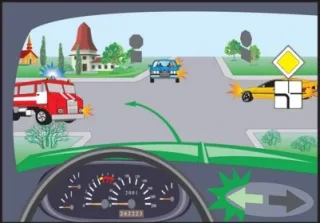
Question #2 The yellow car will cross the intersection:
Topic: Movement of vehicles with special signals
Answer help
3.2. When a vehicle with a blue flashing beacon and/or special sound signal is approaching, drivers of other vehicles that may obstruct its movement must yield the right of way and ensure unobstructed passage of the specified vehicle (and vehicles accompanied by it).
Vehicles moving in an accompanied convoy must have their low-beam headlights on.
If such a vehicle has blue and red or only red flashing beacons on, drivers of other vehicles must stop at the right edge of the roadway (on the right shoulder). On a road with a dividing strip, this requirement must be fulfilled by drivers of vehicles moving in the same direction.
16.11. At an intersection of unequal roads, the driver of a vehicle moving on a secondary road must yield the right of way to vehicles approaching this intersection of roadways on the main road, regardless of the direction of their further movement. -
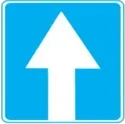
Question #3 What information is contained in this road sign?
Topic: Road signs (Appendix 1)
Answer help
5.5. "Road with one-way traffic". A road or separated roadway on which vehicle traffic across the entire width is carried out in only one direction. -
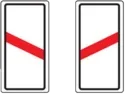
Question #4 How many meters before a railway crossing are these road signs installed?
Topic: Road signs (Appendix 1)
Answer help
1.31.1—1.31.6. "Approaching a railway crossing". Additional warning of approaching a railway crossing outside populated areas.
Warning signs, except for signs 1.4.1—1.4.3, 1.29—1.31.6, are installed outside populated areas at a distance of 150—300 m, in populated areas — at a distance of 50—100
m before the beginning of the dangerous section. If necessary, signs are also installed at a different distance, which is indicated on plate 7.1.1 -
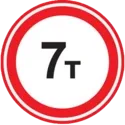
Question #5 What does this road sign mean?
Topic: Road signs (Appendix 1)
Answer help
3.15. "Movement of vehicles whose mass exceeds ...t is prohibited". The movement of vehicles, including their combinations, whose total actual mass exceeds that indicated on the sign is prohibited. -
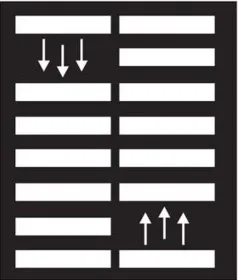
Question #6 What information is contained in this road marking?
Topic: Road markings (Appendix 2)
Answer help
1.14.1., 1.14.2. ("zebra") — marks an uncontrolled pedestrian crossing; arrows of marking 1.14.2 indicate the direction of movement for pedestrians; -
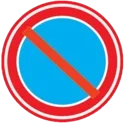
Question #7 Which vehicles are not affected by this road sign?
Topic: Road signs (Appendix 1)
Answer help
3.35. "No parking". Parking of all vehicles is prohibited.
The effect of the signs does not apply:
3.1, 3.2, 3.21—3.24, 3.34 — to vehicles moving on established routes;
3.1, 3.2, 3.35—3.38, as well as sign 3.34 with plate 7.18 underneath — to disabled drivers driving a motorized wheelchair or a car marked with the identification sign
"Disabled person";
3.1—3.8, 3.11 — to vehicles serving citizens or belonging to citizens who live or work in this zone, as well as to vehicles
serving enterprises located in the marked zone. In such cases, vehicles must enter the marked zone and leave it at the nearest intersection to the destination;
3.3 — to trucks that have an inclined white stripe on the outer side surface or carry groups of people;
3.35—3.38 — to taxis with the taximeter turned on.
2.8. A disabled driver driving a motorized wheelchair or a car marked with the identification sign "Disabled person" may deviate from the requirements of road signs 3.1, 3.2 and 3.35—3.38,
as well as sign 3.34 with plate 7.18 underneath -
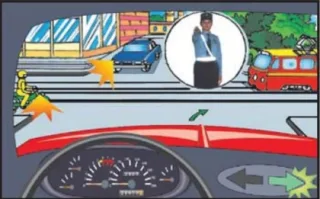
Question #8 Is tram movement allowed?
Topic: Traffic regulation
Answer help
8.8. Traffic controller signals. The signals of the traffic controller are the positions of his body, as well as hand gestures, including with a baton or a disk with a red reflector, having the following meanings:
b) right arm extended forward: from the left side — tram movement to the left is allowed, non-rail vehicles — in all directions; pedestrians are allowed to cross -
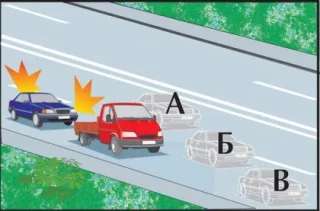
Question #9 In what position should the warning signal of the left turn indicator be turned off according to the requirements of the Road Traffic Rules?
Topic: Warning signals
Answer help
9.4. It is necessary to give a signal with turn indicators or by hand in advance before starting the maneuver (taking into account the speed of movement), but not less than 50—100 m in populated areas and
150—200 m outside them, and stop immediately after its completion (the hand signal should be finished immediately before starting the maneuver). The signal is prohibited if it may be unclear to other road users. Giving a warning signal does not give the driver an advantage and does not relieve him of taking precautions. -
Question #10 Moving straight ahead is allowed:
Topic: Starting movement and changing its direction
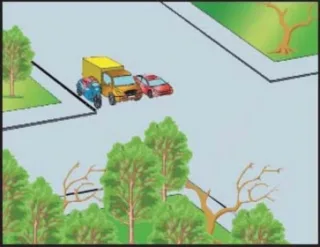
Answer help
10.4. Before turning right, left, or making a U-turn, the driver must take the appropriate extreme position on the roadway intended for movement in that direction in advance, except when making a turn when entering an intersection where circular traffic is organized, the direction of movement is determined by road signs or road markings, or movement is possible only in one direction established by the configuration of the roadway, road signs, or markings.
A driver making a left turn or U-turn outside an intersection from the corresponding extreme position on the roadway of this direction must yield to oncoming vehicles, and when performing these maneuvers not from the extreme left position on the roadway — also to vehicles moving in the same direction.
If there is a tram track in the middle of the roadway, the driver of a non-rail vehicle making a left turn or U-turn outside an intersection must yield to the tram. -
Question #11 In which of the listed cases must vehicles move as close as possible to the right edge of the roadway?
Topic: Position of vehicles on the road
Answer help
11.7. Vehicles whose speed must not exceed 40 km/h or which for technical reasons cannot develop such speed must move as close as possible to the right edge of the roadway, except when overtaking, bypassing, or changing lanes before turning left or making a U-turn. -
Question #12 The driver of which vehicle is allowed to move at the speed indicated on the road sign?
Topic: Speed of movement
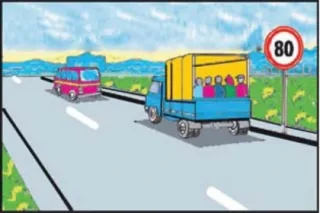
Answer help
12.6. Outside populated areas on all roads and on roads passing through populated areas marked with sign 5.47, movement is allowed at a speed of:
c) for trucks carrying people in the body — no more than 60 km/h; -
Question #13 Give a full answer on how to stop bleeding.
Topic: Fundamentals of providing medical assistance in case of a traffic accident
-
Question #14 At what minimum distance before a railway crossing is overtaking prohibited?
Topic: Overtaking
Answer help
14.6. Overtaking is prohibited:
b) at railway crossings and closer than 100 m before them; -
Question #15 At what distance from the sidewalk is it allowed to stop a vehicle?
Topic: Stopping and parking
Answer help
15.2. In the absence of specially designated places or a shoulder, or if stopping or parking there is impossible, they are allowed at the right edge of the roadway (as far to the right as possible so as not to obstruct other road users). -
Question #16 In which answer is the order of crossing the intersection correctly indicated?
Topic: Passing intersections
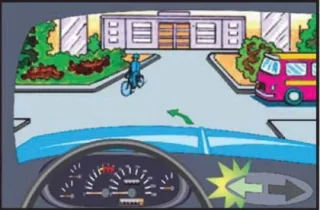
Answer help
16.12. At an intersection of equivalent roads, the driver of a non-rail vehicle must yield to vehicles approaching from the right.
Tram drivers must also be guided by this rule among themselves.
At any uncontrolled intersection, a tram, regardless of the direction of its further movement, has priority over non-rail vehicles approaching it on an equivalent road. -
Question #17 In which of the listed cases can the driver remove one hand from the steering wheel while driving?
Topic: Organization and safety of traffic
-
Question #18 If during braking the vehicle occupies a lane larger than provided by the standard, the driver must:
Topic: Technical condition of vehicles and their equipment
Answer help
31.4.1. Brake systems:
b) during road tests of the service brake system, the following values are exceeded:
31.5. In the event of malfunctions specified in point 31.4 of these Rules occurring on the road, the driver must take measures to eliminate them, and if this is impossible — move as short a route as possible to the place of parking or repair, observing precautionary measures with compliance with the requirements of points 9.9 and 9.11 of these Rules.
In the event of malfunctions specified in point 31.4.7 («ї»; «д» — as part of a road train) occurring on the road, further movement is prohibited until they are eliminated. The driver of the faulty vehicle must take measures to remove it beyond the roadway.
1. GENERAL PROVISIONS
1.1. These Rules, in accordance with the Law of Ukraine «On Road Traffic», establish a uniform procedure for road traffic throughout the territory of Ukraine. Other normative acts concerning the specifics of road traffic (transportation of special cargo, operation of certain types of vehicles, movement on a closed territory, etc.) must be based on the requirements of these Rules. # -
Question #19 During a stop on the road at night, the vehicle must have turned on:
Topic: Use of external lighting devices
Answer help
19.4. During a stop on the road at night and in conditions of insufficient visibility, the vehicle must have its parking lights or standing lights on, and during a forced stop additionally — the hazard warning lights.
In conditions of insufficient visibility, it is allowed to additionally turn on the low beam or fog lights and rear fog lights.
If the parking lights are faulty, the vehicle should be removed beyond the road, and if this is impossible, it must be marked in accordance with the requirements of points 9.10 and 9.11 of these Rules. -
Question #20 Vehicles will cross the intersection in the following order:
Topic: Passing intersections
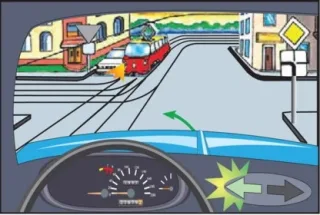
Answer help
16.11. At an intersection of unequal roads, the driver of a vehicle moving on a secondary road must yield to vehicles approaching this intersection of roadways on the main road, regardless of the direction of their further movement.
16.14. If the main road at an intersection changes direction, drivers of vehicles moving on it must be guided among themselves by the rules for passing through intersections of equivalent roads.
Drivers moving on secondary roads must also be guided by this rule among themselves.