
Practice: ticket #3
Answers are checked instantly. The hint — a rules excerpt — is under the question.
-
Question #1 Does the police have the right to use vehicles not belonging to it to pursue offenders in order to perform the duties assigned to it?
Topic: Fundamentals of law
-
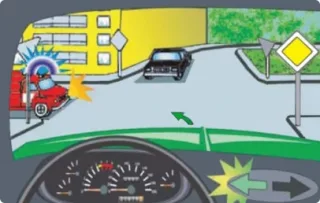
Question #2 The black car will pass the intersection:
Topic: Passing intersections
Answer help
3.2. In the event of approach of a vehicle with a blue flashing beacon and (or) a special sound signal, drivers of other vehicles that may create an obstacle to its movement must give way to it and ensure unhindered passage of the specified vehicle (and vehicles accompanied by it).
Vehicles moving in an accompanied column must have their low-beam headlights on.
If such a vehicle has blue and red or only red flashing beacons turned on, drivers of other vehicles must stop at the right edge of the carriageway (on the right shoulder). On a road with a dividing strip, this requirement must be fulfilled by drivers of vehicles moving in the same direction.
16.13. Before turning left and making a U-turn, the driver of a non-rail vehicle must give way to a tram in the same direction, as well as to vehicles moving on an equal road in the opposite direction straight or to the right.
Tram drivers must also be guided by this rule among themselves. -
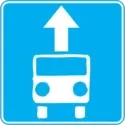
Question #3 Is it allowed for drivers of ordinary vehicles to stop for boarding or alighting passengers on the lane marked with this road sign?
Topic: Road signs (Appendix 1)
Answer help
5.11. "Lane for route vehicles". The lane is intended only for vehicles moving along established routes in the same direction as the general flow of vehicles.
The effect of the sign extends to the lane above which it is installed. The effect of the sign installed to the right of the road extends to the right lane.
17.2. A driver who turns right on a road with a lane for route vehicles separated by a broken line of road marking may make the turn from this lane. In such places, it is also allowed to enter it when leaving the road and for boarding or alighting passengers at the right edge of the carriageway. -
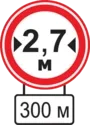
Question #4 What does the plate under the road sign indicate?
Topic: Road signs (Appendix 1)
Answer help
3.17. "Movement of vehicles whose width exceeds ... m is prohibited". The movement of vehicles whose overall width (with or without cargo) is greater than indicated on the sign is prohibited.
7.1.1.—7.1.4. "Distance to the object". They indicate: 7.1.1 — the distance from the sign to the beginning of the dangerous section, the place of introduction of the corresponding restriction or a certain object (place) located ahead in the direction of travel; 7.1.2 — the distance from sign 2.1 to the intersection in the case when sign 2.2 is installed directly before the intersection; 7.1.3 and 7.1.4 — the distance to the object located to the side of the road. -
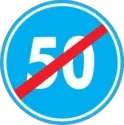
Question #5 At what speed does this road sign allow to move?
Topic: Road signs (Appendix 1)
Answer help
4.17. "End of minimum speed limit". -
Question #6 A solid yellow line of horizontal marking in combination with the road sign 'Stopping prohibited' allows stopping:
Topic: Road markings (Appendix 2)
Answer help
1.4. — denotes places where stopping and parking of vehicles are prohibited. It is used independently or in combination with sign 3.34 and is applied at the edge of the carriageway or on top of the curb;
3.34. "Stopping prohibited". Stopping and parking of vehicles are prohibited, except for a taxi carrying out boarding or alighting of passengers (unloading or loading of cargo). -
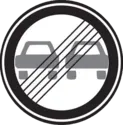
Question #7 This road sign:
Topic: Road signs (Appendix 1)
Answer help
3.26. "End of overtaking prohibition". -
Question #8 Is it allowed for a police officer to stop a vehicle using only a loudspeaker device?
Topic: Traffic regulation
Answer help
8.9. The requirement to stop a vehicle is given by a police officer:
a) with a baton or hand pointing to this vehicle;
b) using a flashing beacon of blue and red or only red color and (or) a special sound signal;
c) using a loudspeaker device;
d) using a special display on which the requirement to stop the vehicle is indicated. The driver must stop the vehicle at the place indicated to him, observing the stopping rules. -
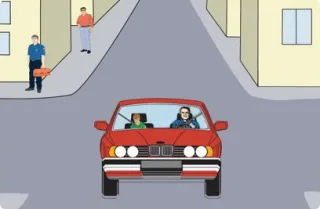
Question #9 From what age is it allowed to transport children on the front seat of a passenger car not equipped with a special device that allows fastening a child with seat belts?
Topic: Transportation of passengers
Answer help
21.11. It is prohibited to transport:
b) children whose height is less than 145 cm or who have not reached 12 years of age — in vehicles equipped with seat belts, without the use of special devices, -
Question #10 Is it allowed to teach driving a car (motorcycle) without the corresponding identification sign?
Topic: Training driving
Answer help
24.8. Mechanical vehicles on which training is conducted must have identification marks "Training vehicle" in accordance with the requirements of subparagraph "k" of paragraph 30.3 of these Rules. In addition, vehicles of educational institutions that are systematically used for driving instruction must be equipped with additional clutch and brake pedals, and a rear-view mirror for the driving instructor. -
Question #11 What is the maximum distance between vehicles that a rigid coupling must ensure when towing a mechanical vehicle?
Topic: Towing and operation of vehicle combinations
Answer help
23.3. A rigid coupling must ensure a distance between vehicles of no more than 4 m, a flexible one — within 4–6 m. A flexible coupling is marked every meter with signal boards or flags in accordance with the requirements of paragraph 30.5 of these Rules. -
Question #12 Is towing allowed on a motorway?
Topic: Speed of movement
Answer help
12.7. During towing, the speed must not exceed 50 km/h.
27.3. On motorways, except for specially equipped places, the movement of mechanical vehicles whose speed, according to their technical characteristics or their condition, is less than 40 km/h is prohibited, as well as driving and grazing animals in the road right-of-way. -
Question #13 The vehicle's medical first-aid kit contains 'Validol'. It is used for:
Topic: Fundamentals of providing medical assistance in case of a traffic accident
-
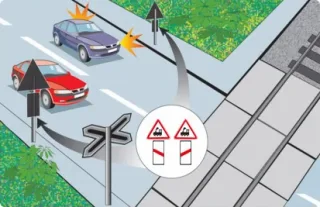
Question #14 Is overtaking allowed in this place outside a built-up area?
Topic: Overtaking
Answer help
14.6. Overtaking is prohibited:
b) at railway crossings and closer than 100 m before them; -
Question #15 At what distance from intersections are stopping and parking of vehicles prohibited?
Topic: Stopping and parking
Answer help
15.9. Stopping is prohibited:
d) at intersections and closer than 10 m from the edge of the crossed carriageway in the absence of a pedestrian crossing on them, except for stopping to give priority in traffic -
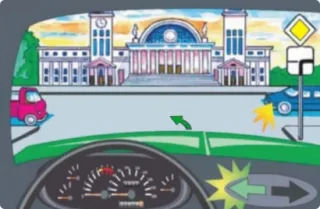
Question #16 Which car will pass the intersection last?
Topic: Passing intersections
Answer help
16.11. At an intersection of unequal roads, the driver of a vehicle moving on a secondary road must give way to vehicles approaching this intersection of carriageways on the main road, regardless of the direction of their further movement.
16.14. If the main road changes direction at an intersection, drivers of vehicles moving on it must be guided among themselves by the rules for passing through intersections of equal roads.
Drivers moving on secondary roads must also be guided by this rule among themselves. -
Question #17 What is meant by reaction time?
Topic: General provisions
-
Question #18 Under which of the listed conditions is the operation of vehicles prohibited? Give a complete answer.
Topic: Technical condition of vehicles and their equipment
Answer help
31.4.3. External lighting devices:
a) the number, type, color, placement and mode of operation of external lighting devices do not meet the requirements of the vehicle design; -
Question #19 Under which of the listed conditions is the operation of vehicles prohibited? Give a complete answer.
Topic: Technical condition of vehicles and their equipment
Answer help
31.4.7. Other structural elements:
e) missing: a warning triangle (flashing red lantern) that meets the requirements of the standard — on a motorcycle with a sidecar, passenger car, truck, wheeled tractor, bus; -
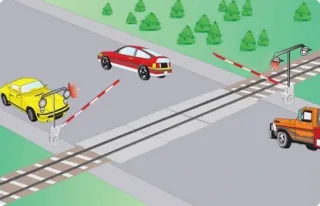
Question #20 If the barrier at a railway crossing begins to lower, the driver of a non-rail vehicle must:
Topic: Movement through railway crossings
Answer help
20.5. Movement through the crossing is prohibited if:
b) the barrier is lowered or has begun to lower;