
Practice: ticket #29
Answers are checked instantly. The hint — a rules excerpt — is under the question.
-
Question #1 To forcibly stop a vehicle if the driver's actions pose a threat to the health of citizens, police officers have the right to:
Topic: Fundamentals of law
-
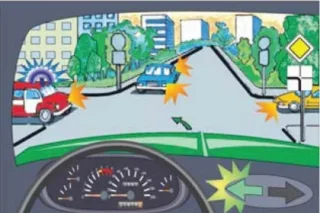
Question #2 The blue car will pass the intersection:
Topic: Movement of vehicles with special signals
Answer help
3.2. When a vehicle with a blue flashing beacon and/or special sound signal is approaching, drivers of other vehicles that may obstruct its movement must yield the right of way and ensure unobstructed passage of the specified vehicle (and vehicles accompanied by it).
Vehicles moving in an accompanied convoy must have their low-beam headlights on.
If such a vehicle has blue and red or only red flashing beacons on, drivers of other vehicles must stop at the right edge of the roadway (on the right shoulder). On a road with a dividing strip, this requirement must be fulfilled by drivers of vehicles moving in the same direction.
16.11. At an intersection of unequal roads, the driver of a vehicle moving on a secondary road must yield the right of way to vehicles approaching this intersection of roadways on the main road, regardless of the direction of their further movement.
16.14. If the main road changes direction at an intersection, drivers of vehicles moving on it must be guided among themselves by the rules for passing through intersections of equal roads.
Drivers moving on secondary roads must also be guided by this rule among themselves. -
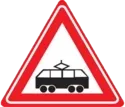
Question #3 What information is contained in this road sign?
Topic: Road signs (Appendix 1)
Answer help
1.20. "Intersection with a tram line". The place where the road crosses a tram track at an intersection with limited visibility or outside it. -
Question #4 The effect of which road sign does not apply to route vehicles?
Topic: Road signs (Appendix 1)
Answer help
3.34. "No stopping". Stopping and parking of vehicles is prohibited, except for taxis picking up or dropping off passengers (loading or unloading cargo).
The effect of the signs does not apply:
3.1, 3.2, 3.21—3.24, 3.34 — to vehicles moving on established routes;
3.1, 3.2, 3.35—3.38, as well as sign 3.34 with plate 7.18 underneath — to disabled drivers driving a motorized wheelchair or a car marked with the identification sign
"Disabled person";
3.1—3.8, 3.11 — to vehicles serving citizens or belonging to citizens who live or work in this zone, as well as to vehicles
serving enterprises located in the marked zone. In such cases, vehicles must enter the marked zone and leave it at the nearest intersection to the destination;
3.3 — to trucks that have an inclined white stripe on the outer side surface or carry groups of people;
3.35—3.38 — to taxis with the taximeter turned on. -
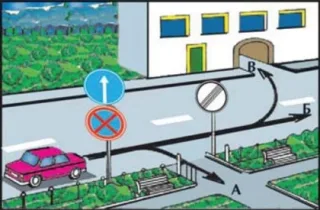
Question #5 Indicate the permitted directions of travel (Directions A and B are entrances to courtyards).
Topic: Road signs (Appendix 1)
Answer help
4.1. "Go straight".
Signs 4.3, 4.5 and 4.6 also allow U-turns of vehicles. The effect of signs 4.1—4.6 does not apply to vehicles moving on established routes.
The effect of signs 4.1—4.6 applies to the intersection of roadways in front of which they are installed. The effect of sign 4.1, installed at the beginning of the road or after an intersection,
applies to the section of road up to the nearest intersection. The sign does not prohibit turning right into courtyards and other territories adjacent to the road.
3.42. "End of all prohibitions and restrictions". Simultaneously determines the end of all prohibitions and restrictions introduced by prohibitory road signs 3.20, 3.25, 3.27, 3.29,
3.33—3.37 -
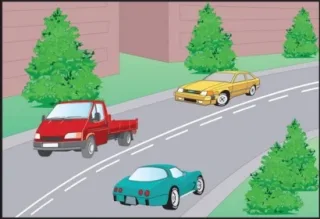
Question #6 In which of the listed cases is it allowed to cross the solid line of road marking that separates traffic flows of opposite directions?
Topic: Road markings (Appendix 2)
Answer help
1.11. — separates traffic flows of opposite or same directions on road sections where lane changing is allowed only from one lane; marks places intended for U-turns, entry and exit from parking areas, etc., where traffic is allowed only in one direction;
Line 1.11 is allowed to be crossed only from the side of its broken part, and from the side of the solid part — only after completing overtaking or avoiding an obstacle. -
Question #7 What does this road sign inform about?
Topic: Road signs (Appendix 1)

Answer help
5.5. "Road with one-way traffic". A road or separated roadway on which vehicle traffic across the entire width is carried out in only one direction. -
Question #8 Which vehicles are allowed to move at this traffic light signal?
Topic: Traffic regulation
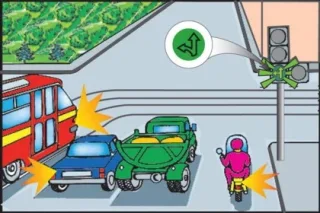
Answer help
8.7.3. Traffic light signals have the following meanings:
b) green in the form of an arrow (arrows) on a black background allows movement in the indicated direction (directions). The same meaning is given by a signal in the form of a green arrow (arrows) in -
Question #9 How should a towed vehicle be marked during towing?
Topic: Warning signals
Answer help
9.9. Hazard warning lights must be turned on:
d) on a towed motor vehicle; -
Question #10 Drivers of which vehicles violate the rules for entering the road when there is an acceleration lane?
Topic: Starting movement and changing its direction
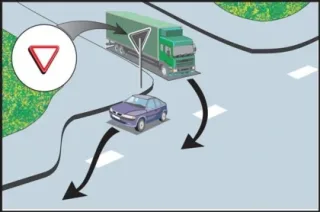
Answer help
10.8. If there is a deceleration lane at the place of leaving the road, the driver who intends to turn onto another road must change lanes to this lane in a timely manner and reduce speed only on it. If there is an acceleration lane at the place of entering the road, the driver must move along it and merge into the traffic flow, yielding the right of way to vehicles moving on this road. -
Question #11 With which car is it allowed to operate a trailer?
Topic: Towing and operation of vehicle combinations
Answer help
23.11. Operation of vehicle combinations consisting of a car, tractor or other towing vehicle and a trailer is allowed only if the trailer matches the towing vehicle and the requirements for their operation are met. -
Question #12 In the event of a forced stop on the carriageway of a motorway, the driver must:
Topic: Movement on highways and roads for cars
Answer help
27.5. In the event of a forced stop on the roadway of a motorway or a road for cars, the driver must mark the vehicle in accordance with the requirements of paragraphs 9.9—9.11 of these Rules and take measures to remove it beyond the edge of the roadway to the right. -
Question #13 Under the hemostatic tourniquet, it is necessary to place a note indicating:
Topic: Fundamentals of providing medical assistance in case of a traffic accident
-
Question #14 This identification sign marks a vehicle:
Topic: Number plates, identification signs, inscriptions and markings
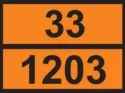
Answer help
30.3. The following identification signs are installed on the corresponding vehicles (Appendix 4):
d) "Information table of dangerous cargo" — an orange rectangle measuring 400 x 300 mm (300 x 120 mm) with a black border (width — 15 mm (10 mm), in the upper part -
Question #15 Closer than what distance from railway crossings is parking of vehicles prohibited?
Topic: Stopping and parking
Answer help
15.10. Parking is prohibited:
d) closer than 50 m from railway crossings; -
Question #16 The last to cross the intersection will be:
Topic: Passing intersections
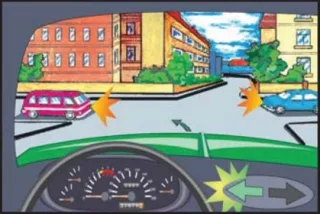
Answer help
16.12. At an intersection of equal roads, the driver of a non-rail vehicle must yield the right of way to vehicles approaching from the right.
Tram drivers must also be guided by this rule among themselves.
At any uncontrolled intersection, a tram, regardless of the direction of its further movement, has priority over non-rail vehicles
approaching it on an equal road. -
Question #17 To prevent dangerous consequences of a vehicle skid, the driver must:
Topic: Organization and safety of traffic
-
Question #18 Under what malfunction is further movement of vehicles prohibited?
Topic: Technical condition of vehicles and their equipment
Answer help
31.6. Further movement of vehicles is prohibited if:
a) the service brake system or steering does not allow the driver to stop the vehicle or perform a maneuver while driving at minimum speed;
b) at night or in conditions of insufficient visibility, the headlights or rear position lights are not on;
c) during rain or snowfall, the windshield wiper on the side of the steering wheel does not work;
d) the towing coupling device of the road train is damaged. -
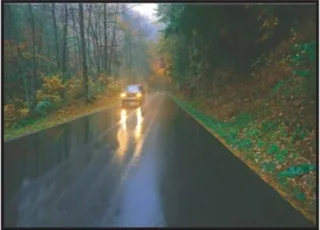
Question #19 What external lighting devices must be turned on on a moving vehicle regardless of the degree of road illumination at night?
Topic: Use of external lighting devices
Answer help
19.1. At night and in conditions of insufficient visibility, regardless of the degree of road lighting, as well as in tunnels, the following lighting devices must be turned on on a moving vehicle:
a) on all motor vehicles — low-beam (high-beam) headlights;
b) on mopeds (bicycles) and horse-drawn carts (sledges) — headlights or lanterns;
c) on trailers and towed vehicles — position lights.
Note.
In conditions of insufficient visibility, on motor vehicles it is allowed to turn on fog lights instead of low-beam (high-beam) headlights. -
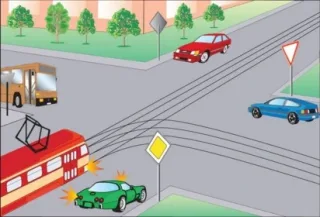
Question #20 When turning left or making a U-turn at an uncontrolled intersection, the driver of a non-rail vehicle must yield to:
Topic: Passing intersections
Answer help
16.13. Before turning left and making a U-turn, the driver of a non-rail vehicle must yield the right of way to a tram of the same direction, as well as to vehicles
moving on an equal road in the opposite direction straight or to the right.
Tram drivers must also be guided by this rule among themselves.