
Practice: ticket #28
Answers are checked instantly. The hint — a rules excerpt — is under the question.
-
Question #1 If the driver of a vehicle moving ahead has turned on the left turn indicator, then his:
Topic: General provisions
Answer help
overtaking in the sense of moving ahead — movement of a vehicle at a speed exceeding the speed of a vehicle moving alongside on an adjacent lane;
overtaking — moving ahead of one or more vehicles, associated with entering the oncoming traffic lane; -
Question #2 Which answer most fully indicates the places where pedestrians should wait for a vehicle in the absence of a landing area?
Topic: Duties and rights of pedestrians
Answer help
4.11. Pedestrians must wait for a vehicle on sidewalks, boarding areas, and if they are absent, on the roadside, without creating obstacles for road traffic. -
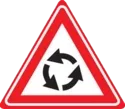
Question #3 What information is contained in this road sign?
Topic: Road signs (Appendix 1)
Answer help
1.19. "Roundabout intersection". -
Question #4 Which road sign warns of approaching a railway crossing with a barrier?
Topic: Road signs (Appendix 1)
Answer help
1.27. "Railway crossing with a barrier". -
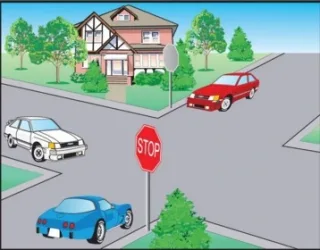
Question #5 How should the driver of a non-rail vehicle act if this road sign is installed before the intersection he is approaching?
Topic: Road signs (Appendix 1)
Answer help
2.2. "Moving without stopping is prohibited". It is prohibited to move without stopping before marking 1.12 (stop line), and if it is absent, before the sign. -
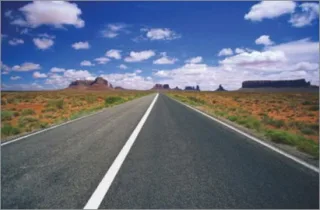
Question #6 A solid line of road marking separating traffic flows of opposite directions:
Topic: Road markings (Appendix 2)
Answer help
1.1. (narrow solid line) — separates traffic flows of opposite directions and marks the boundaries of traffic lanes on roads; marks the boundaries of the roadway, which entry is prohibited; marks the boundaries of parking places for vehicles and the edge of the roadway of roads not classified by traffic conditions as motorways;
Lines 1.1 and 1.3 are prohibited to cross. If line 1.1 marks a parking place or the edge of the roadway adjacent to the roadside, it is allowed to cross this line.
As an exception, provided road safety is ensured, it is allowed to cross line 1.1 to bypass a stationary obstacle whose dimensions do not allow safe bypass without crossing this line, as well as to overtake single vehicles moving at a speed of less than 30 km/h. -
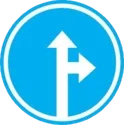
Question #7 What information is contained in this road sign?
Topic: Road signs (Appendix 1)
Answer help
4.4. "Move straight or right".
Signs 4.3, 4.5, and 4.6 also allow U-turns of vehicles. The effect of signs 4.1–4.6 does not apply to vehicles moving on established routes.
The effect of signs 4.1–4.6 applies to the intersection of roadways before which they are installed. The effect of sign 4.1, installed at the beginning of a road or after an intersection, applies to the road section up to the nearest intersection. The sign does not prohibit turning right into courtyards and other territories adjacent to the road. -
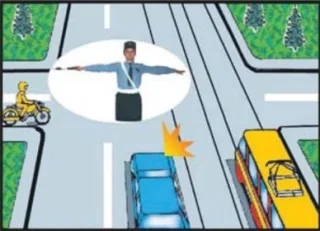
Question #8 Movement is prohibited
Topic: Traffic regulation
Answer help
8.8. Traffic controller signals. Traffic controller signals are the positions of his body, as well as hand gestures, including with a baton or a disc with a red reflector, having the following meanings:
a) arms extended to the sides, lowered, or the right arm bent in front of the chest: from the left and right sides — tram movement straight is allowed, non-rail vehicles — straight and -
Question #9 How many passengers are allowed to be transported next to the driver?
Topic: Transportation of passengers
Answer help
21.1. It is allowed to carry passengers in a vehicle equipped with seating places in the quantity provided by the technical characteristics, so that they do not interfere with the driver's control of the vehicle and do not restrict visibility, in accordance with the rules of transportation. -
Question #10 Persons learning to drive individually must have with them:
Topic: Training driving
Answer help
24.1. It is allowed to teach driving a vehicle only to persons who do not have medical contraindications for this, and in the case of individual training by a person in accordance with the requirements of point 24.7 — if there is an appropriate medical certificate. -
Question #11 Do pedestrians have the right of way over vehicles in residential and pedestrian zones?
Topic: Movement in residential and pedestrian zones
Answer help
26.1. Pedestrians are allowed to move in a residential and pedestrian zone both on sidewalks and on the roadway. Pedestrians have priority over vehicles, but they must not create unreasonable obstacles for their movement. -
Question #12 When installing which of these road signs is reversing prohibited on the marked section of the road?
Topic: Movement on highways and roads for cars
Answer help
27.2. On motorways and roads for cars, it is prohibited:
e) reversing; -
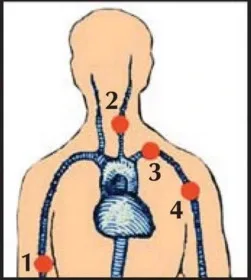
Question #13 Indicate the most typical place for compressing an artery to stop bleeding from a wound on the head and neck:
Topic: Fundamentals of providing medical assistance in case of a traffic accident
-
Question #14 On mechanical vehicles and trailers, except for trams and trolleybuses, according to the Traffic Rules, the following is installed:
Topic: Number plates, identification signs, inscriptions and markings
Answer help
30.2. On mechanical vehicles (except trams and trolleybuses) and trailers, license plates of the appropriate type are installed in the places provided for this, and in the lower right corner of the front windshield of the vehicle, a technical inspection coupon is attached.
On trams and trolleybuses, registration numbers assigned by the relevant authorized bodies are applied.
By decision of the Council of Ministers of the Autonomous Republic of Crimea, local executive authorities, or local self-government bodies, registration of mopeds, bicycles, and horse-drawn transport may be carried out.
It is prohibited to change the dimensions, shape, designations, color, and placement of license plates, to apply additional designations to them or to cover them; they must be clean and sufficiently illuminated. -
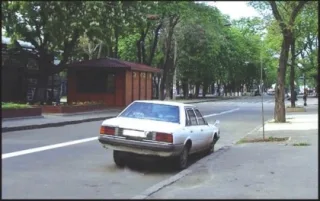
Question #15 Stopping of vehicles is prohibited in places where the minimum distance between the solid line of longitudinal road marking and the stopped vehicle is less than:
Topic: Stopping and parking
Answer help
15.9. Stopping is prohibited:
d) in places where the distance between a solid marking line, dividing strip, or the opposite edge of the roadway and the stopped vehicle is less than 3 m; -
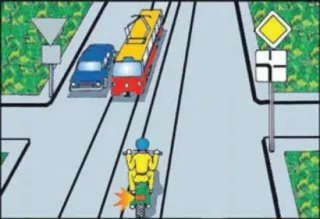
Question #16 Vehicles will pass the intersection in the following order:
Topic: Passing intersections
Answer help
16.11. At an intersection of unequal roads, the driver of a vehicle moving on a secondary road must give way to vehicles approaching this intersection of roadways on the main road, regardless of the direction of their further movement.
16.14. If the main road at an intersection changes direction, drivers of vehicles moving on it must be guided among themselves by the rules for passing intersections of equivalent roads.
Drivers moving on secondary roads must also be guided by this rule among themselves. -
Question #17 When driving in foggy conditions, the distance to objects appears:
Topic: Organization and safety of traffic
-
Question #18 Further movement of vehicles is prohibited if:
Topic: Technical condition of vehicles and their equipment
Answer help
31.6. Further movement of vehicles is prohibited if:
a) the service brake system or steering does not allow the driver to stop the vehicle or perform a maneuver during movement at minimum speed;
b) in the dark or in conditions of insufficient visibility, the lamps of headlights or rear side lights do not light;
c) during rain or snowfall, the windshield wiper on the side of the steering wheel does not work;
d) the coupling device of the road train is damaged. -
Question #19 How should a towed mechanical vehicle be marked if the hazard warning lights are malfunctioning?
Topic: Use of external lighting devices
Answer help
19.4. During a stop on the road in the dark and in conditions of insufficient visibility, the vehicle must have side or parking lights on, and in case of a forced stop, additionally, the hazard warning lights.
In conditions of insufficient visibility, it is allowed to additionally turn on low beam or fog lights and rear fog lights.
If the side lights are faulty, the vehicle should be removed outside the road, and if this is impossible, it must be marked in accordance with the requirements of points 9.10 and 9.11 of these Rules.
9.11. If the vehicle is not equipped with hazard warning lights or they are faulty, it is necessary to install a warning triangle or a flashing red light:
a) at the rear of the vehicle specified in point 9.9 ("c", "d", "e") of these Rules; -
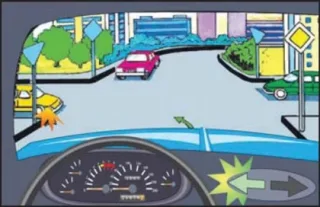
Question #20 The second to pass the intersection will be:
Topic: Passing intersections
Answer help
16.11. At an intersection of unequal roads, the driver of a vehicle moving on a secondary road must give way to vehicles approaching this intersection of roadways on the main road, regardless of the direction of their further movement.
16.13. Before turning left and making a U-turn, the driver of a non-rail vehicle must give way to a tram of the same direction, as well as to vehicles moving on an equivalent road in the opposite direction straight or to the right.
Tram drivers must also be guided by this rule among themselves.