
Practice: ticket #23
Answers are checked instantly. The hint — a rules excerpt — is under the question.
-
Question #1 What should the driver consider when determining the maximum width of the lane of a road train?
Topic: Position of vehicles on the road
Answer help
11.1. The number of lanes on the carriageway for the movement of trackless vehicles is determined by road markings or road signs 5.16, 5.17.1, 5.17.2, and in their absence — by the drivers themselves, taking into account the width of the carriageway of the corresponding direction of movement, the dimensions of vehicles and safe intervals between them.
traffic lane — a longitudinal strip on the carriageway at least 2.75 m wide, marked or not marked with road markings and intended for the movement of trackless vehicles; -
Question #2 Drivers of which vehicles always have priority in traffic?
Topic: Movement of vehicles with special signals
Answer help
3.1. Drivers of operational vehicles, performing an urgent official task, may deviate from the requirements of sections 8 (except for traffic controller signals), 10—18, 26, 27 and point 28.1 of these Rules, provided that a blue or red flashing beacon and a special sound signal are turned on and road safety is ensured. If there is no need to additionally attract the attention of road users, the special sound signal may be turned off.
3.2. In the event of an approaching vehicle with a blue flashing beacon and (or) a special sound signal turned on, drivers of other vehicles that may create an obstacle to its movement must give way to it and ensure unhindered passage of the specified vehicle (and vehicles accompanied by it).
On vehicles moving in an accompanied column, the low beam headlights must be turned on.
If on such a vehicle flashing beacons of blue and red or only red are turned on, drivers of other vehicles must stop at the right edge of the carriageway (on the right shoulder). On a road with a dividing strip, this requirement must be fulfilled by drivers of vehicles moving in the same direction.
3.3. If during the escort of a column of vehicles on a vehicle moving ahead of the column, flashing beacons of blue and red or only red are turned on, the column must be closed by a vehicle with a green or blue and green flashing beacon turned on, after the passage of which restrictions on the movement of other vehicles are canceled.
3.4. It is prohibited to overtake and pass vehicles with flashing beacons of blue and red or only red and green or blue and green and vehicles accompanied by them (column), as well as to move along adjacent lanes at the speed of the column or to take a place in the column.
3.5. Approaching a stationary vehicle with a blue or blue and red flashing beacon and a special sound signal (or without a special sound signal turned on), standing on the carriageway, the driver must stop. You can continue moving only with the permission of the traffic controller, and in his absence — another person regulating traffic.
3.6. Turning on an orange flashing beacon on mechanical vehicles of the road maintenance service during work on the road, on large and heavy vehicles does not give them an advantage in movement, but serves to attract attention and warn of danger. At the same time, drivers of road maintenance service vehicles during work on the road are allowed to deviate from the requirements of road signs (except for priority signs and signs 3.21—3.23), road markings, as well as points 11.2, 11.5—11.10, 11.12, 11.13, subparagraphs "b", "c", "g" of point 26.2 of these Rules, provided that road safety is ensured.
Drivers of other vehicles must not interfere with their work. -
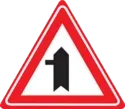
Question #3 This road sign is installed on the road. Which vehicle's driver has priority in traffic?
Topic: Road signs (Appendix 1)
Answer help
1.23.1—1.23.4. "Adjoining of a secondary road." Sign 1.23.1 — adjoining on the right side, 1.23.2 — on the left, 1.23.3 — on the right and left, 1.23.4 — on the left and right side. -
Question #4 Which of these road signs warns of an upcoming road narrowing?
Topic: Road signs (Appendix 1)
Answer help
1.5.1—1.5.3. "Road narrowing." Sign 1.5.1 — narrowing of the road on both sides, 1.5.2 — on the right, 1.5.3 — on the left side. -
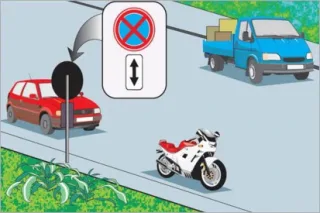
Question #5 In which answer are all drivers who violated the stopping rules on a one-way road outside a populated area indicated?
Topic: Road signs (Appendix 1)
Answer help
3.34. "Stopping prohibited." Stopping and parking of vehicles are prohibited, except for taxis carrying out boarding or disembarking of passengers (unloading or loading of cargo).
7.2.1.—7.2.6. "Zone of action." Indicate: 7.2.1 — the length of the dangerous section marked with warning signs, or the zone of action of prohibiting and information-indicating signs;
7.2.2 — the zone of action of prohibiting signs 3.34—3.37, as well as the length of one or more stopping areas located one after another; 7.2.3 — the end of the zone of action of signs 3.34—3.37;
7.2.4 — that the vehicle is in the zone of action of signs 3.34—3.37; 7.2.5, 7.2.6 — the direction and zone of action of signs 3.34—3.37 in case of prohibition of stopping or parking along one side of a square, building facade, etc. When used together with prohibiting signs, the plates reduce the zone of action of the signs.
11.6. On roads having three or more lanes for movement in one direction, trucks with a permissible maximum mass exceeding 3.5 t, tractors, self-propelled machines and mechanisms are allowed to enter the far left lane only for turning left and making a U-turn, and in populated areas on roads with one-way traffic, in addition, for stopping on the left, in permitted cases, for loading or unloading.
15.3. In populated areas, stopping and parking of vehicles are allowed on the left side of a road having one lane for movement in each direction (without tram tracks in the middle) and not separated by marking 1.1, as well as on the left side of a road with one-way traffic.
If the road has a boulevard or a dividing strip, stopping and parking of vehicles near them is prohibited. -
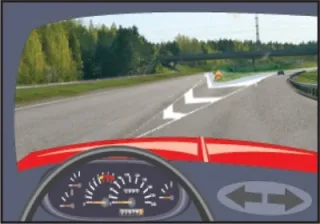
Question #6 What does this road marking mean?
Topic: Road markings (Appendix 2)
Answer help
1.16.1.—1.16.3. — indicates guide islands in places of separation, branching or merging of traffic flows; -
Question #7 Closer than what distance is stopping prohibited from boarding platforms, and in their absence, from the road sign for stopping route vehicles?
Topic: Stopping and parking
Answer help
15.9. Stopping is prohibited:
e) closer than 30 m from boarding areas for stopping route vehicles, and if there are none — closer than 30 m from the road sign of such a stop on both sides; -
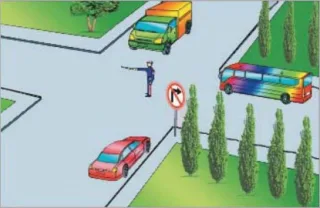
Question #8 On this traffic controller's signal, the driver of a passenger car is allowed to move:
Topic: Traffic regulation
Answer help
8.8. Traffic controller signals. Traffic controller signals are the positions of his body, as well as hand gestures, including with a baton or a disk with a red reflector, having the following meanings:
b) right arm extended forward: from the left side — tram movement to the left is allowed, trackless vehicles — in all directions; pedestrians are allowed to cross
3.22. "Right turn prohibited." -
Question #9 Which external light devices must be turned on on vehicles when towing?
Topic: Warning signals
Answer help
9.8. During daylight hours, while mechanical vehicles are moving, in order to indicate the moving vehicle, the low beam headlights must be turned on:
ґ) on the towing vehicle;
9.9. Hazard warning lights must be turned on:
г) on the towed mechanical vehicle; -
Question #10 In which of the listed cases is a U-turn prohibited?
Topic: Starting movement and changing its direction
Answer help
10.7. U-turn is prohibited:
в) in tunnels; -
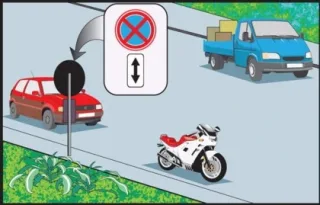
Question #11 Which answer lists all drivers who violated the stopping rules on a one-way road outside a populated area?
Topic: Position of vehicles on the road
Answer help
11.6. On roads with three or more lanes for traffic in one direction, trucks with a permissible maximum mass exceeding 3.5 t, tractors, self-propelled machines and mechanisms are allowed to enter the far left lane only for turning left and making a U-turn, and in populated areas on roads with one-way traffic, in addition, for stopping on the left, in permitted cases, for loading or unloading.
15.3. In populated areas, stopping and parking of vehicles are allowed on the left side of the road that has one lane for traffic in each direction (without tram tracks in the middle) and is not divided by marking 1.1, as well as on the left side of a road with one-way traffic.
If the road has a boulevard or a dividing strip, stopping and parking of vehicles near them is prohibited.
3.34. "Stopping prohibited". Stopping and parking of vehicles are prohibited, except for taxis carrying out boarding or disembarkation of passengers (unloading or loading of cargo).
7.2.1.—7.2.6. "Area of operation". They indicate: 7.2.1 — the length of the dangerous section marked with warning signs, or the area of operation of prohibition and information-indication signs;
7.2.2 — the area of operation of prohibition signs 3.34—3.37, as well as the length of one or several stopping areas located one after another; 7.2.3 — the end of the area of operation of signs 3.34—3.37;
7.2.4 — that the vehicle is in the area of operation of signs 3.34—3.37; 7.2.5, 7.2.6 — the direction and area of operation of signs 3.34—3.37 in case of prohibition of stopping or parking along one side of a square, building facade, etc. When used together with prohibition signs, the plates reduce the area of operation of the signs. -
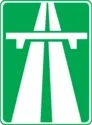
Question #12 What is the maximum speed allowed for motorcycles on road sections marked with this road sign?
Topic: Speed of movement
Answer help
12.6. Outside populated areas on all roads and on roads passing through populated areas, marked with sign 5.47, movement is allowed at a speed:
а) buses (minibuses) carrying organized groups of children, passenger cars with a trailer and motorcycles — no more than 80 km/h; -
Question #13 What should be done in case of a rib fracture in the victim?
Topic: Fundamentals of providing medical assistance in case of a traffic accident
-
Question #14 In which of the given cases must the transported cargo be marked with signal shields or flags, and at night or in poor visibility conditions with reflectors or lanterns?
Topic: Transportation of cargo
Answer help
22.4. Cargo protruding beyond the dimensions of the vehicle in front or behind by more than 1 m, and in width exceeding 0.4 m from the outer edge of the front or rear side marker light, must be marked in accordance with the requirements of subparagraph "з" of paragraph 30.3 of these Rules. -
Question #15 Placing vehicles at an angle to the edge of the roadway:
Topic: Stopping and parking
Answer help
15.5. Placing vehicles at an angle to the edge of the roadway is allowed in places where this will not impede the movement of other vehicles.
Near sidewalks or other places with pedestrian traffic, placing vehicles at an angle is allowed only with the front part, and on inclines — only with the rear part. -
Question #16 In which of the listed cases, when approaching an uncontrolled intersection, does the driver have the right of way?
Topic: Passing intersections
Answer help
16.12. At an intersection of equivalent roads, the driver of a non-rail vehicle must give way to vehicles approaching from the right.
Tram drivers must also be guided by this rule among themselves.
At any uncontrolled intersection, a tram, regardless of the direction of its further movement, has priority over non-rail vehicles approaching it on an equivalent road.
2.1. "Give way". The driver must give way to vehicles approaching an uncontrolled intersection on the main road, and in the presence of plate 7.8 — to vehicles moving on the main road. -
Question #17 When driving on slopes, the driver must:
Topic: Organization and safety of traffic
-
Question #18 In which cases is the operation of vehicles not prohibited?
Topic: Technical condition of vehicles and their equipment
Answer help
31.4.3. External lighting devices:
а) the quantity, type, color, placement and mode of operation of external lighting devices do not meet the requirements of the vehicle design;
б) the adjustment of the headlights is violated;
в) the lamp of the left headlight in low beam mode does not light;
г) there are no diffusers on the lighting devices or diffusers and lamps are used that do not correspond to the type of this lighting device;
ґ) tinting or coating is applied to the diffusers of lighting devices, which reduces their transparency or light transmission.
Notes:
1. Motorcycles (mopeds) may be additionally equipped with one fog lamp, other mechanical vehicles — with two. Fog lamps must be placed at a height of at least 250 mm from the road surface (but not higher than the low beam headlights) symmetrically relative to the longitudinal axis of the vehicle and no further than 400 mm from the outer dimension in width.
1. GENERAL PROVISIONS
1.1. These Rules, in accordance with the Law of Ukraine "On Road Traffic", establish a uniform procedure for road traffic throughout the territory of Ukraine. Other regulatory acts relating to the specifics of road traffic (transportation of special cargo, operation of certain types of vehicles, movement on a closed territory, etc.) must be based on the requirements of these Rules. #
31.4.7. Other structural elements:
г) the door locks of the body or cab, the locks of the sides of the cargo platform, the locks of the necks of tanks and fuel tanks, the adjustment mechanism provided by the design do not work; е) the bumper or rear protective device, mud flaps and splash guards provided by the design are missing; -
Question #19 Which lights must be turned on on a motor vehicle when driving in a tunnel regardless of the degree of road lighting?
Topic: Use of external lighting devices
Answer help
19.1. In the dark and in conditions of insufficient visibility, regardless of the degree of road lighting, as well as in tunnels, the following lighting devices must be turned on on a moving vehicle:
а) on all mechanical vehicles — low beam (high beam) headlights;
б) on mopeds (bicycles) and horse-drawn carts (sledges) — headlights or lanterns;
в) on trailers and towed vehicles — side marker lights.
Note.
In conditions of insufficient visibility, on mechanical vehicles it is allowed to turn on fog lamps instead of low beam (high beam) headlights. -
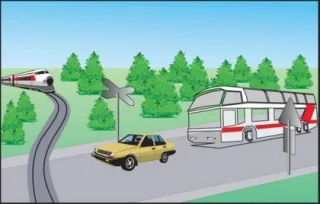
Question #20 At what place at a railway crossing must the driver stop his vehicle if he sees an approaching train?
Topic: Movement through railway crossings
Answer help
20.3. To allow an approaching train to pass and in other cases when movement through a railway crossing is prohibited, the driver must stop before road marking 1.12 (stop line), road sign 2.2, barrier or traffic light so as to see the signals, and if there are no traffic management devices — no closer than 10 m to the nearest rail.