
Practice: ticket #22
Answers are checked instantly. The hint — a rules excerpt — is under the question.
-
Question #1 Is it allowed to drive or park vehicles on the dividing strip?
Topic: Road markings (Appendix 2)
-
Question #2 To ensure road safety, which of the listed actions must the driver perform?
Topic: Duties and rights of drivers of mechanical vehicles
Answer help
2.3. To ensure road safety, the driver is obliged to:
a) before departure, check and ensure the technically sound condition and completeness of the vehicle, the correct placement and securing of the cargo; -
Question #3 Which trucks are affected by this plate?
Topic: Road signs (Appendix 1)
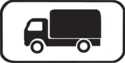
Answer help
7.5.1.—7.5.8. "Type of vehicle." Indicate the type of vehicle to which the sign applies. Plate 7.5.1 extends the sign's effect to trucks (including those with a trailer) with a permissible maximum mass exceeding 3.5 t; 7.5.3 — to passenger cars, as well as trucks with a permissible maximum mass up to 3.5 t. -
Question #4 What does this road sign with a plate mean?
Topic: Road signs (Appendix 1)
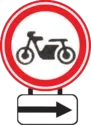
Answer help
3.6. "Motorcycle movement prohibited."
7.3.1.—7.3.3. "Direction of action." Show the directions of action of signs placed before an intersection, or the directions of movement to designated objects located directly near the road. -
Question #5 In which of the listed cases is overtaking prohibited on an uphill grade?
Topic: Road signs (Appendix 1)
Answer help
3.25. "Overtaking prohibited." Overtaking of all vehicles is prohibited (except single vehicles * moving at a speed of less than 30 km/h).* Single vehicles are considered to be individual vehicles, road trains, as well as a towing vehicle coupled with a towed vehicle.
14.6. Overtaking is prohibited:
g) at the end of an ascent, on bridges, overpasses, viaducts, sharp curves, and other road sections with limited visibility or in conditions of insufficient visibility; -
Question #6 A white broken line separates traffic flows in opposite directions. On this section of the road, overtaking:
Topic: Road markings (Appendix 2)
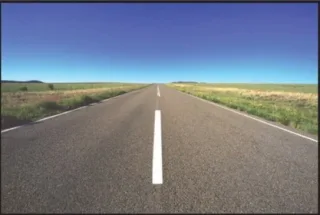
Answer help
1.5. — separates traffic flows of opposite directions on roads having two or three lanes; marks the boundaries of traffic lanes when there are two or more lanes intended for movement in one direction;
14.6. Overtaking is prohibited:
e) on roads having two or more lanes for movement in one direction; -
Question #7 Before the intersection, the green traffic light is on and a 'Stop' sign is installed. The driver must:
Topic: Road signs (Appendix 1)
Answer help
5.62. "Stopping place." The place where vehicles stop during the action of a prohibiting traffic light signal (or traffic controller) or before railway crossings, the movement through which is regulated by traffic lights. -
Question #8 What do the black contour arrows on the red and yellow traffic light signals inform about?
Topic: Traffic regulation
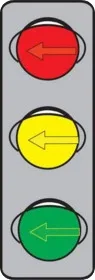
Answer help
8.7.3. Traffic light signals have the following meanings:
g) black contour arrows on red and yellow signals do not change the meaning of these signals and inform about permitted directions of movement when the green signal is on; -
Question #9 In which cases is low beam headlights turned on on a bus (minibus) during daylight hours?
Topic: Warning signals
Answer help
9.8. During the movement of mechanical vehicles in daylight hours, in order to indicate the moving vehicle, the low beam headlights must be turned on:
b) on route vehicles moving along a lane marked by road sign 5.8, against the general flow of vehicles;
c) on buses (minibuses) carrying out pe -
Question #10 In which of the listed cases is a U-turn allowed? Give a full answer.
Topic: Starting movement and changing its direction
Answer help
10.7. Turning around is prohibited:
a) at railway crossings; -
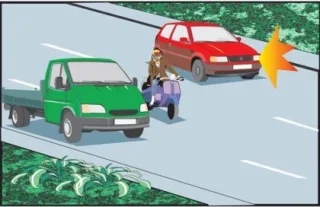
Question #11 Is the driver of a passenger car allowed to enter the far left lane on a one-way road? A motorcyclist is moving in the second lane.
Topic: Position of vehicles on the road
Answer help
11.5. On roads having two or more lanes for movement in one direction, entering the far left lane for movement in the same direction is permitted if the right lanes are occupied, as well as for turning left, making a U-turn, or for stopping or parking on the left side of a road with one-way traffic in populated areas, if this does not contradict the stopping (parking) rules. -
Question #12 What measures, according to the Traffic Rules, must a driver take when an obstacle or danger to traffic arises that he can objectively detect?
Topic: Speed of movement
Answer help
12.3. In the event of a danger to movement or an obstacle that the driver is objectively able to detect, he must immediately take measures to reduce speed up to stopping the vehicle or safely bypassing the obstacle for other road users. -
Question #13 The obligatory participants in gas exchange in the human body are:
Topic: Fundamentals of providing medical assistance in case of a traffic accident
-
Question #14 Is it allowed to overtake a vehicle that has begun to slow down before an intersection?
Topic: Overtaking
Answer help
14.6. Overtaking is prohibited:
a) at an intersection;
18.4. If before an uncontrolled pedestrian crossing a vehicle slows down or stops, drivers of other vehicles moving along adjacent lanes must reduce speed, and if necessary stop, and may continue (resume) movement only after making sure that there are no pedestrians on the pedestrian crossing for whom an obstacle or danger may be created. -
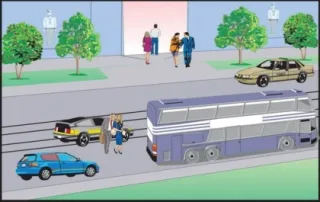
Question #15 The only lane for non-rail vehicles is occupied by a standing vehicle. Is the driver of a car allowed to stop nearby on the tram tracks of the same direction to disembark passengers?
Topic: Stopping and parking
Answer help
15.9. Stopping is prohibited:
b) on tram tracks (except for cases specified in point 15.8 of these Rules); -
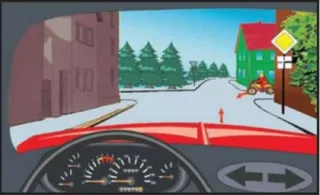
Question #16 Which vehicle's driver will pass the intersection second?
Topic: Passing intersections
Answer help
16.11. At an intersection of unequal roads, the driver of a vehicle moving along a secondary road must give way to vehicles approaching this intersection of carriageways along the main road, regardless of the direction of their further movement.
16.14. If the main road changes direction at an intersection, drivers of vehicles moving along it must be guided among themselves by the rules for passing through intersections of equal roads. Drivers moving along secondary roads must also be guided by this rule among themselves. -
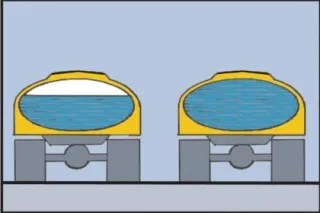
Question #17 Which of the shown tank trucks is more stable against overturning when turning?
Topic: Organization and safety of traffic
-
Question #18 Under which of the listed conditions is the operation of vehicles prohibited? Give a full answer.
Topic: Technical condition of vehicles and their equipment
Answer help
31.4.1. Brake systems:
e) the lever (handle) of the parking brake system does not lock in the working position;
31.4.5. Wheels and tires:
e) — diagonal; -
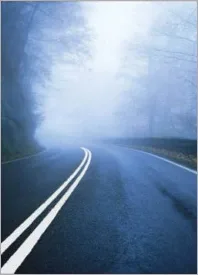
Question #19 Which external light devices must be turned on on a moving mechanical vehicle in fog or heavy rain?
Topic: Use of external lighting devices
Answer help
19.1. In the dark and in conditions of insufficient visibility, regardless of the degree of road lighting, as well as in tunnels, the following lighting devices must be turned on on a moving vehicle:
a) on all mechanical vehicles — low beam (high beam) headlights;
b) on mopeds (bicycles) and horse-drawn carts (sledges) — headlights or lanterns;
c) on trailers and towed vehicles — clearance lights.
Note.
In conditions of insufficient visibility, on mechanical vehicles it is allowed to turn on fog lights instead of low beam (high beam) headlights. -
Question #20 Which of the listed actions must the driver of a vehicle perform when approaching a railway crossing?
Topic: Movement through railway crossings
Answer help
20.2. Approaching the crossing, as well as starting to move after stopping before it, the driver must be guided by the instructions and signals of the crossing attendant, the position of the barrier, light and sound signaling, road signs and road markings, and also make sure that no train (locomotive, draisine) is approaching.