
Practice: ticket #21
Answers are checked instantly. The hint — a rules excerpt — is under the question.
-
Question #1 Which road, according to the definition of the Traffic Rules, should be considered the main road?
Topic: General provisions
Answer help
main road — a road with a surface relative to an unpaved road or marked with signs 1.22, 1.23.1—1.23.4 and 2.3 The presence of a surface on a secondary road immediately before the intersection does not equate it in importance to the road being crossed; -
Question #2 If as a result of a traffic accident there are no injured and no material damage is caused to third parties, and the vehicles can move safely, can the drivers themselves leave the scene and arrive at the nearest traffic police post or
Topic: Duties and rights of drivers of mechanical vehicles
Answer help
2.11. If as a result of a traffic accident there are no casualties and no material damage is caused to third parties, and the vehicles can move safely,
drivers (if there is mutual agreement in assessing the circumstances of what happened) may arrive at the nearest State Automobile Inspection post or to the body or unit of the police for registration of relevant materials, having previously drawn up a diagram of the accident and signed it.
Third parties are considered to be other road users who, due to circumstances, turned out to be involved in the traffic accident.
If during a traffic accident only insured vehicles are damaged and there are no dead and injured, it is allowed to register the relevant materials by a representative of the insurance organization without the participation of an employee of the State Automobile Inspection unit with the consent of the accident participants. -
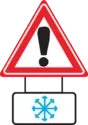
Question #3 What information is contained in this plate with a road sign?
Topic: Road signs (Appendix 1)
Answer help
1.39. "Other danger (accident-prone section)". A dangerous section of the road in places where the width of the roadway, radii of curves, etc. do not meet the requirements of building codes, as well as a place or section of concentration of traffic accidents.
7.12. "Icy road". Means that the effect of the sign extends to the winter period when the roadway may be slippery. -
Question #4 Which of the indicated road signs means that the driver is moving on a road where he has the right of way?
Topic: Road signs (Appendix 1)
Answer help
1.22. "Intersection with a secondary road". -
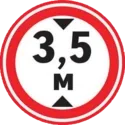
Question #5 What information is contained in this road sign?
Topic: Road signs (Appendix 1)
Answer help
3.18. "Movement of vehicles whose height exceeds ...m is prohibited". The movement of vehicles whose overall height (with or without cargo) is greater than indicated on the sign is prohibited. -
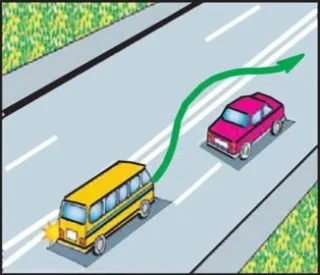
Question #6 Is overtaking allowed in this situation?
Topic: Road markings (Appendix 2)
Answer help
1.3. — separates traffic flows of opposite directions on roads with four or more lanes;
14.6. Overtaking is prohibited:
e) on roads with two or more lanes for traffic in one direction; -
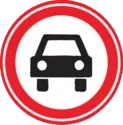
Question #7 Which of the listed vehicles are not affected by this road sign?
Topic: Road signs (Appendix 1)
Answer help
3.2. "Several turns". A section of road with two or more dangerous turns located one after another: 1.3.1 — with the first turn to the right, 1.3.2 — with the first turn to the left.
The effect of the signs does not apply:
3.1, 3.2, 3.21—3.24, 3.34 — to vehicles moving on established routes;
3.1, 3.2, 3.35—3.38, as well as sign 3.34 if there is plate 7.18 under it — to disabled drivers driving a motorized wheelchair or a car marked with the identification sign
"Disabled";
3.1—3.8, 3.11 — to vehicles serving citizens or belonging to citizens who live or work in this zone, as well as to vehicles
servicing enterprises located in the designated zone. In such cases, vehicles must enter the designated zone and leave it at the nearest intersection to the destination;
3.3 — to trucks that have an inclined white stripe on the outer side surface or carry groups of people;
3.35—3.38 — to taxis with the taximeter turned on. -
Question #8 In which directions is the movement of vehicles allowed?
Topic: Traffic regulation
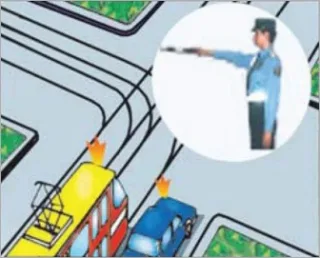
Answer help
8.8. Traffic controller signals. Traffic controller signals are the positions of his body, as well as hand gestures, including with a baton or a disc with a red reflector,
having the following meanings:
b) right arm extended forward: from the left side — tram movement to the left is allowed, non-rail vehicles — in all directions; pedestrians are allowed to cross -
Question #9 In which cases is it allowed to give a warning signal by hand?
Topic: Warning signals
Answer help
9.3. In the absence or malfunction of turn indicators, signals for starting movement from the right edge of the roadway, stopping on the left, turning left, making a U-turn or changing to the left lane are given by the left arm extended to the side, or the right arm extended to the side and bent at the elbow at a right angle upward.
Signals for starting movement from the left edge of the roadway, stopping on the right, turning right, changing to the right lane are given by the right arm extended to the side, or the left arm extended to the side and bent at the elbow at a right angle upward.
In the absence or malfunction of brake signals, such a signal is given by the left or right arm raised upward. -
Question #10 The driver of the green car when changing lanes:
Topic: Starting movement and changing its direction
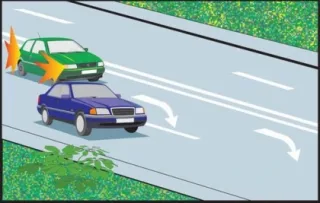
Answer help
10.3. When changing lanes, the driver must give way to vehicles moving in the same direction on the lane he intends to change into.
When vehicles moving in the same direction change lanes simultaneously, the driver who is on the left must give way to the vehicle
on the right. -
Question #11 Which driver violates the stopping rules, if the driver of the truck stopped for loading cargo, and the driver of the bus stopped for rest?
Topic: Position of vehicles on the road
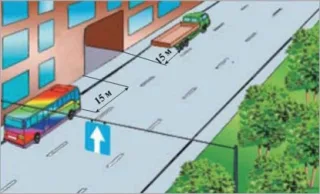
Answer help
11.6. On roads with three or more lanes for traffic in one direction, trucks with a permissible maximum mass over 3.5 t, tractors, self-propelled machines and mechanisms are allowed to enter the far left lane only for turning left and making a U-turn, and in populated areas on roads with one-way traffic, in addition, for stopping on the left, in permitted cases, for loading or unloading.
15.9. Stopping is prohibited:
i) closer than 10 m from exits from adjacent territories and directly at the exit point. -
Question #12 At what maximum speed is it allowed to drive motorcycles on the road section indicated by this road sign?
Topic: Speed of movement
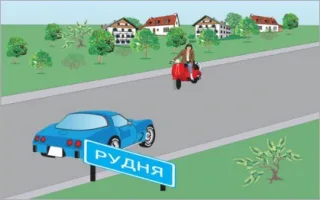
Answer help
12.6. Outside populated areas on all roads and on roads passing through populated areas, marked with sign 5.47, movement is allowed at a speed:
a) buses (minibuses) carrying organized groups of children, passenger cars with a trailer and motorcycles – no more than 80 km/h; -
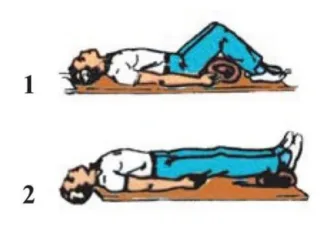
Question #13 In which figure is the position of the victim shown, in which it is recommended to transport him in case of a fracture of the pelvic bones?
Topic: Fundamentals of providing medical assistance in case of a traffic accident
-
Question #14 In which of the listed cases is overtaking prohibited on an uphill grade?
Topic: Overtaking
Answer help
14.6. Overtaking is prohibited:
d) at the end of an incline, on bridges, overpasses, viaducts, sharp turns and other sections of roads with limited visibility or in conditions of insufficient visibility;
3.25. "Overtaking prohibited". Overtaking of all vehicles is prohibited (except for single *, moving at a speed of less than 30 km/h).* Single vehicles are considered to be single vehicles, road trains, as well as a towing vehicle coupled with a towed one. -
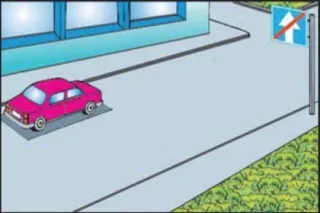
Question #15 Is parking allowed in this place?
Topic: Stopping and parking
Answer help
15.3. In populated areas, stopping and parking of vehicles are allowed on the left side of a road with one lane for traffic in each direction (without tram tracks in the middle) and not separated by marking 1.1, as well as on the left side of a road with one-way traffic. If the road has a boulevard or a dividing strip, stopping and parking of vehicles near them is prohibited. -
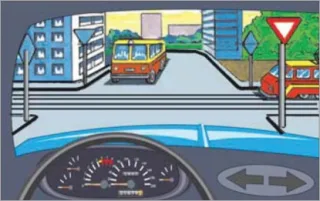
Question #16 Vehicles will pass the intersection in the following order:
Topic: Passing intersections
Answer help
16.11. At an intersection of unequal roads, the driver of a vehicle moving on a secondary road must give way to vehicles approaching this intersection of roadways on the main road, regardless of the direction of their further movement. -
Question #17 A car is moving along the road, the driver of which has turned on the left turn signal and does not turn it off for a long time. How should the driver moving behind him act?
Topic: Organization and safety of traffic
-
Question #18 How should the driver of a vehicle approaching pedestrians who are forced to be on the roadway act?
Topic: Passing pedestrian crossings and stops of vehicles
Answer help
18.3. Passing by pedestrians who have not managed to finish crossing the roadway and are forced to be on a safety island or a line separating traffic flows of opposite directions, drivers must maintain a safe interval. -
Question #19 Under which of the listed conditions is the operation of vehicles prohibited? Give a complete answer.
Topic: Technical condition of vehicles and their equipment
Answer help
31.4.5. Wheels and tires:
c) tires do not correspond to the vehicle model in size or permissible load; -
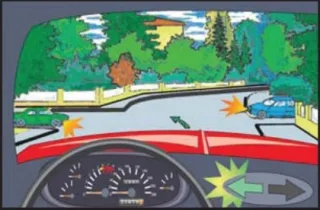
Question #20 Vehicles will pass the intersection in the following order:
Topic: Passing intersections
Answer help
16.12. At an intersection of equal roads, the driver of a non-rail vehicle must give way to vehicles approaching from the right.
Tram drivers must also be guided by this rule among themselves.
At any uncontrolled intersection, a tram, regardless of the direction of its further movement, has priority over non-rail vehicles
approaching it on an equal road.