
Practice: ticket #2
Answers are checked instantly. The hint — a rules excerpt — is under the question.
-
Question #1 Which body has the right to consider an appeal against administrative detention, inspection, seizure of things and documents?
Topic: Fundamentals of law
-
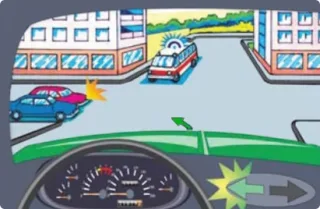
Question #2 The blue car will pass the intersection:
Topic: Passing intersections
Answer help
3.2. In the case of approach of a vehicle with a blue flashing beacon and (or) a special sound signal turned on, drivers of other vehicles that may create an obstacle to its movement are obliged to give way to it and ensure unhindered passage of the specified vehicle (and the vehicles accompanied by it).
On vehicles moving in the accompanied column, the low beam headlights must be turned on.
If on such a vehicle blue and red or only red flashing beacons are turned on, drivers of other vehicles are obliged to stop at the right edge of the carriageway (on the right shoulder). On a road with a dividing strip, this requirement must be fulfilled by drivers of vehicles moving in the same direction.
16.12. At an intersection of equal roads, the driver of a non-rail vehicle is obliged to give way to vehicles approaching from the right.
Tram drivers must also be guided by this rule among themselves.
At any uncontrolled intersection, a tram, regardless of the direction of its further movement, has an advantage over non-rail vehicles approaching it on an equal road.
16.13. Before turning left and making a U-turn, the driver of a non-rail vehicle is obliged to give way to a tram of the same direction, as well as to vehicles moving on an equal road in the opposite direction straight or to the right.
Tram drivers must also be guided by this rule among themselves. -
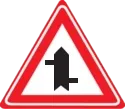
Question #3 What information is contained in this road sign installed on a road outside a populated area?
Topic: Road signs (Appendix 1)
Answer help
1.23.1—1.23.4. "Adjoining of a secondary road." Sign 1.23.1 — adjoining from the right side, 1.23.2 — from the left, 1.23.3 — from the right and left, 1.23.4 — from the left and right side.
On signs 1.23.1—1.23.4, the image of the adjoining corresponds to the real configuration of the intersection.
Signs 1.23.3 and 1.23.4 are installed when the distance between the adjoining of secondary roads is less than 50 m in populated areas and 100 m — outside them. -
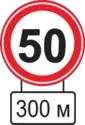
Question #4 Directly on which section of the road does the effect of this road sign with a plate begin?
Topic: Road signs (Appendix 1)
Answer help
3.29. "Maximum speed limit." It is prohibited to move at a speed exceeding that indicated on the sign.
7.1.1.—7.1.4. "Distance to the object." They indicate: 7.1.1 — the distance from the sign to the beginning of the dangerous section, the place of introduction of the corresponding restriction or a certain object (place) located ahead in the direction of movement; 7.1.2 — the distance from sign 2.1 to the intersection in the case when sign 2.2 is installed directly before the intersection; 7.1.3 and 7.1.4 — the distance to the object located to the side of the road. -
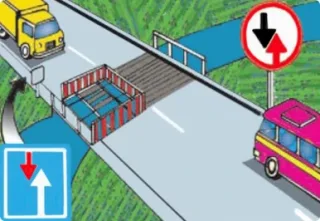
Question #5 The driver of which vehicle has the right of way in traffic?
Topic: Road signs (Appendix 1)
Answer help
2.5. "Advantage of oncoming traffic." Entry into a narrow section of the road is prohibited if this may impede oncoming traffic. The driver must give way to oncoming vehicles located on the narrow section.
2.6. "Advantage over oncoming traffic." A narrow section of road, during the movement along which the driver has an advantage over oncoming vehicles. -
Question #6 Is it allowed to drive onto an island marked with wide white lines?
Topic: Road markings (Appendix 2)
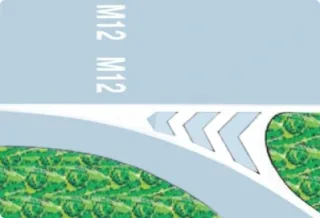
Answer help
1.1. (narrow solid line) — separates traffic flows of opposite directions and marks the boundaries of traffic lanes on roads; marks the boundaries of the carriageway, entry into which is prohibited; marks the boundaries of parking places for vehicles and the edge of the carriageway of roads not classified by traffic conditions as highways;
Lines 1.1 and 1.3 are prohibited to cross. If line 1.1 marks a parking place or the edge of the carriageway adjacent to the shoulder, crossing this line is allowed.
As an exception, provided that road safety is ensured, it is allowed to cross line 1.1 to bypass a stationary obstacle whose dimensions do not allow its safe bypass without crossing this line, as well as to overtake single vehicles moving at a speed of less than 30 km/h. -
Question #7 What information is contained in this road sign?
Topic: Road signs (Appendix 1)
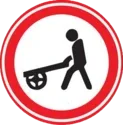
Answer help
3.10. "Movement with hand carts is prohibited." -
Question #8 Movement is allowed:
Topic: Traffic regulation
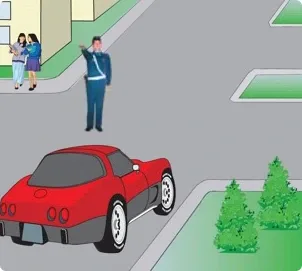
Answer help
8.8. Traffic controller signals. The signals of the traffic controller are the positions of his body, as well as gestures with his hands, including with a baton or a disk with a red reflector, having the following meanings:
b) the right arm is extended forward: from the left side — the movement of a tram to the left is allowed, non-rail vehicles — in all directions; pedestrians are allowed to cross -
Question #9 What determines the permissible number of passengers that can be carried in the body of a truck?
Topic: Transportation of passengers
Answer help
21.7. The number of passengers transported in the body of a truck must not exceed the number of seats equipped for sitting. -
Question #10 How are mechanical vehicles of educational institutions equipped when teaching driving?
Topic: Training driving
Answer help
24.8. Mechanical vehicles on which training is conducted must have identification marks "Training vehicle" in accordance with the requirements of subparagraph "k" of paragraph 30.3 of these Rules. In addition, vehicles of educational institutions that are systematically used for driving instruction must be equipped with additional clutch and brake pedals, and a rear-view mirror for the driving instructor. -
Question #11 What minimum distance between vehicles must a flexible coupling ensure when towing?
Topic: Towing and operation of vehicle combinations
Answer help
23.3. A rigid coupling must ensure a distance between vehicles of no more than 4 m, a flexible one — within 4–6 m. A flexible coupling is marked every meter with signal boards or flags in accordance with the requirements of paragraph 30.5 of these Rules. -
Question #12 On which roads in populated areas is a speed of more than 60 km/h allowed?
Topic: Speed of movement
Answer help
12.8. On road sections where road conditions have been created that allow driving at a higher speed, with the consent of the State Automobile Inspection, by decision of the road owners or bodies to which the right to maintain such roads has been transferred, the permitted speed may be increased by installing appropriate road signs. -
Question #13 At the scene of an accident, a victim lies without signs of life. How to determine whether he is alive or dead? Give a complete answer.
Topic: Fundamentals of providing medical assistance in case of a traffic accident
-
Question #14 Is the driver of the green car allowed to overtake? The red car is performing a detour.
Topic: Overtaking
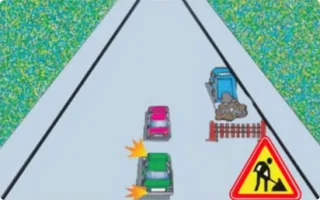
Answer help
14.6. Overtaking is prohibited:
g) of a vehicle that is overtaking or avoiding an obstacle; -
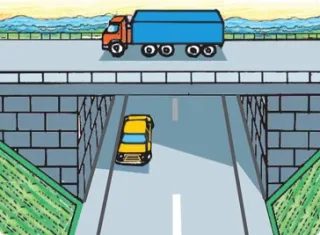
Question #15 The driver of which car is allowed to stop?
Topic: Stopping and parking
Answer help
15.9. Stopping is prohibited:
c) on overpasses, bridges, viaducts and under them, as well as in tunnels; -
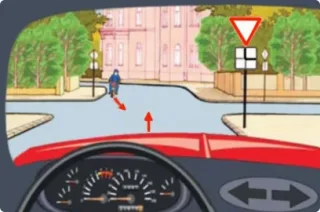
Question #16 The driver of which vehicle must yield?
Topic: Passing intersections
Answer help
16.11. At an intersection of unequal roads, the driver of a vehicle moving on a secondary road must give way to vehicles approaching this intersection of carriageways on the main road, regardless of the direction of their further movement.
16.14. If the main road changes direction at an intersection, drivers of vehicles moving on it must be guided among themselves by the rules for passing through intersections of equal roads.
Drivers moving on secondary roads must also be guided by this rule among themselves. -
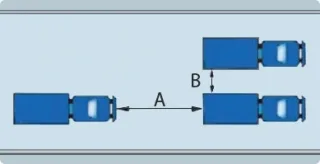
Question #17 What is called the distance?
Topic: General provisions
-
Question #18 Is it allowed to proceed to the place of parking or repair at night on roads without artificial lighting or in conditions of insufficient visibility with non-burning rear side lights?
Topic: Technical condition of vehicles and their equipment
Answer help
31.6. Further movement of vehicles is prohibited if:
a) the service brake system or steering does not allow the driver to stop the vehicle or perform a maneuver while driving at minimum speed;
b) in the dark or in conditions of insufficient visibility, the headlamps or rear position lamps are not lit;
c) during rain or snowfall, the windshield wiper on the side of the steering wheel does not work;
d) the towing coupling device of a road train is damaged. -
Question #19 If the tightness of the hydraulic brake drive is broken, the driver must:
Topic: Technical condition of vehicles and their equipment
Answer help
31.5. In the event of malfunctions specified in paragraph 31.4 of these Rules occurring on the road, the driver must take measures to eliminate them, and if this is impossible, drive as short a route as possible to the place of parking or repair, observing precautionary measures and fulfilling the requirements of paragraphs 9.9 and 9.11 of these Rules.
In the event of malfunctions specified in paragraph 31.4.7 ("i"; "d" — as part of a road train) occurring on the road, further movement is prohibited until they are eliminated. The driver of the faulty vehicle must take measures to remove it beyond the edge of the carriageway. -
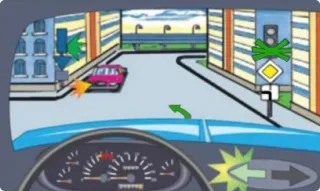
Question #20 The red car will pass the intersection:
Topic: Passing intersections
Answer help
16.6. When turning left or making a U-turn at a green signal of the main traffic light, the driver of a non-rail vehicle must give way to a tram in the same direction, as well as to vehicles moving in the opposite direction straight or turning right.
Tram drivers must also be guided by this rule among themselves.
8.3. Traffic controller signals have priority over traffic light signals and the requirements of priority road signs and are mandatory for execution.
Traffic light signals, except for the yellow flashing one, have priority over priority road signs.
Drivers and pedestrians must comply with additional requirements of the traffic controller, even if they contradict traffic light signals, the requirements of road signs and markings.