
Practice: ticket #19
Answers are checked instantly. The hint — a rules excerpt — is under the question.
-
Question #1 According to the definition of the Traffic Rules, route vehicles include:
Topic: General provisions
Answer help
route vehicles (public transport vehicles) — buses, minibuses, trolleybuses, trams, and taxis moving along established routes and having certain places on the road for boarding (alighting) passengers; -
Question #2 The right to drive buses, trams, and trolleybuses is granted:
Topic: Duties and rights of drivers of mechanical vehicles
Answer help
2.13. The right to drive vehicles is granted:
a) motor vehicles and motorized wheelchairs — from the age of 16;
b) cars of all types and categories (except buses and trucks equipped for transporting more than eight passengers), trams and trolleybuses — from the age of 18;
c) buses and trucks equipped for transporting more than eight passengers — from the age of 19. -
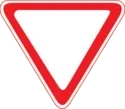
Question #3 In which case did the driver correctly comply with the requirement of this road sign?
Topic: Duties and rights of drivers of mechanical vehicles
Answer help
2.1. "Give way". The driver must give way to vehicles approaching an uncontrolled intersection on the main road, and if there is plate 7.8 —
to vehicles moving on the main road. -
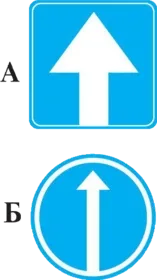
Question #4 How to determine a road with one-way traffic?
Topic: General provisions
Answer help
5.5. "Road with one-way traffic". A road or separated carriageway along which vehicle movement across the entire width is carried out in only one direction.
1.3. — separates traffic flows of opposite directions on roads having four or more traffic lanes; -
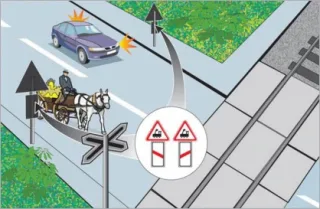
Question #5 Is overtaking allowed in the situation shown in the figure?
Topic: Road signs (Appendix 1)
Answer help
1.28. "Railway crossing without a barrier".
1.31.1—1.31.6. "Approaching a railway crossing". Additional warning about approaching a railway crossing outside built-up areas. -
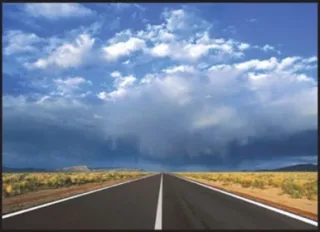
Question #6 Is it allowed to cross a narrow solid line of road marking?
Topic: Road markings (Appendix 2)
Answer help
1.1. (narrow solid line) — separates traffic flows of opposite directions and marks the boundaries of traffic lanes on roads; marks the boundaries of the carriageway, which are prohibited to enter; marks the boundaries of parking places for vehicles and the edge of the carriageway of roads not classified by traffic conditions as motorways;
Lines 1.1 and 1.3 are prohibited to cross. If line 1.1 marks a parking place or the edge of the carriageway adjacent to the shoulder, this line is allowed to be crossed.
As an exception, provided that road safety is ensured, it is allowed to cross line 1.1 to bypass a stationary obstacle whose dimensions do not allow its safe bypass without crossing this line, as well as to overtake single vehicles moving at a speed of less than 30 km/h. -
Question #7 In which of the listed cases should you give way to a vehicle approaching from the left?
Topic: Road signs (Appendix 1)
Answer help
2.1. "Give way". The driver must give way to vehicles approaching an uncontrolled intersection on the main road, and if there is a plate 7.8 — to vehicles moving on the main road.
2.2. "Passing without stopping is prohibited". It is prohibited to pass without stopping before marking 1.12 (stop line), and if it is absent — before the sign.
2.5. "Advantage of oncoming traffic". It is prohibited to enter a narrow section of the road if this may impede oncoming traffic. The driver must give way to oncoming vehicles located on the narrow section. -
Question #8 What does the flashing green signal of a traffic light mean?
Topic: Traffic regulation
Answer help
8.7.3. Traffic light signals have the following meanings:
c) green flashing allows movement, but informs that a signal prohibiting movement will soon be turned on. -
Question #9 Which answer indicates the correct option for turning on lights on a towed motor vehicle?
Topic: Warning signals
Answer help
9.9. Hazard warning lights must be turned on:
d) on a towed mechanical vehicle; -
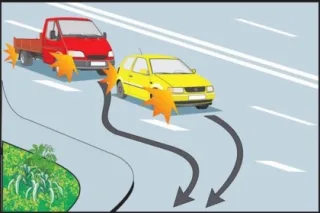
Question #10 The driver of which vehicle violates the rules of turning from a road with a deceleration lane?
Topic: Starting movement and changing its direction
Answer help
10.8. If there is a deceleration lane at the place of leaving the road, the driver who intends to turn onto another road must change lanes to this lane in a timely manner and reduce speed only on it. If there is an acceleration lane at the place of entering the road, the driver must move along it and merge into the traffic flow, giving way to vehicles moving on this road. -
Question #11 You are turning onto a road with reversible traffic. Which lane after the turn are you allowed to drive in?
Topic: Position of vehicles on the road
Answer help
11.12. A driver making a turn onto a road that has a lane for reversible traffic may change lanes onto it only after passing a reversible traffic light with a signal allowing movement, and if this does not contradict paragraphs 11.2, 11.5 and 11.6 of these Rules. -
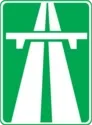
Question #12 What is the maximum speed allowed for trucks with a permissible maximum mass of no more than 3.5 tons on road sections marked with this road sign?
Topic: Speed of movement
Answer help
12.6. Outside built-up areas on all roads and on roads passing through built-up areas, marked with sign 5.47, movement is allowed at a speed:
e) for other vehicles: on a motor road marked with road sign 5.1 – no more than 130 km/h, on a motor road with separate carriageways, -
Question #13 How to position the victim if he lost consciousness due to a traumatic brain injury?
Topic: Fundamentals of providing medical assistance in case of a traffic accident
-
Question #14 What measures should the driver take if he is transporting cargo that raises dust?
Topic: Transportation of cargo
Answer help
22.3. Carriage of cargo is allowed provided that it:
e) does not create noise, does not raise dust and does not pollute the carriageway and the environment. -
Question #15 In the dark and in conditions of insufficient visibility, parking outside populated areas is allowed:
Topic: Stopping and parking
Answer help
15.11. In the dark and in conditions of insufficient visibility, parking outside built-up areas is allowed only on parking areas or outside the road. -
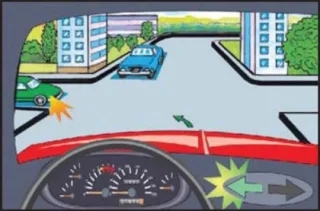
Question #16 The last vehicle to cross the intersection will be:
Topic: Passing intersections
Answer help
16.12. At an intersection of equivalent roads, the driver of a non-rail vehicle must give way to vehicles approaching from the right. This rule must also be followed by tram drivers among themselves. At any uncontrolled intersection, a tram, regardless of the direction of its further movement, has priority over non-rail vehicles approaching it on an equivalent road.
16.13. Before turning left and making a U-turn, the driver of a non-rail vehicle must give way to a tram of the same direction, as well as to vehicles moving on an equivalent road in the opposite direction straight or to the right. This rule must also be followed by tram drivers among themselves. -
Question #17 What gear is recommended to engage when parking on a downhill slope to prevent the vehicle from moving spontaneously?
Topic: Organization and safety of traffic
-
Question #18 Under which of the listed conditions is the operation of cars and road trains prohibited?
Topic: Technical condition of vehicles and their equipment
Answer help
31.4.1. Brake systems:
c) the tightness of the hydraulic brake drive is broken;
e) the parking brake system with the engine disconnected from the transmission does not ensure the stationary state: of vehicles with full load — on a slope of at least 16%; -
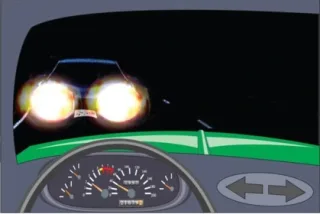
Question #19 When blinded, the driver must:
Topic: Use of external lighting devices
Answer help
19.3. In case of deterioration of visibility in the direction of movement caused by the light of headlights of oncoming vehicles, the driver must reduce speed to such that it does not exceed the safe speed according to the conditions of actual visibility of the road in the direction of movement, and in case of blinding — turn on the hazard warning lights and, without changing lane, stop. Resumption of movement is allowed only after the negative consequences of blinding have passed. -
Question #20 If a train is approaching a railway crossing within visibility, the driver of a non-rail vehicle must:
Topic: Movement through railway crossings
Answer help
20.5. Movement through the crossing is prohibited if:
e) a train (locomotive, draisine) is approaching the crossing within visibility.