
Practice: ticket #17
Answers are checked instantly. The hint — a rules excerpt — is under the question.
-
Question #1 Which road, according to the definition of the Road Traffic Rules, should be considered the 'main road'?
Topic: General provisions
Answer help
main road — a road with a surface relative to an unpaved road or marked by signs 1.22, 1.23.1—1.23.4 and 2.3. The presence of a surface on a secondary road immediately before the intersection does not equate it in importance to the road being crossed; -
Question #2 What should the driver involved in a traffic accident do first?
Topic: Duties and rights of drivers of mechanical vehicles
Answer help
2.10. In the event of involvement in a traffic accident, the driver is obliged to:
a) immediately stop the vehicle and remain at the scene of the accident;
b) turn on the hazard warning lights and set up an emergency stop sign in accordance with the requirements of paragraph 9.10 of these Rules;
9.10. Together with turning on the hazard warning lights, an emergency stop sign or a flashing red lantern should be set up at a distance ensuring road safety, but not closer than 20 m to the vehicle in populated areas and 40 m outside them, in the case of:
a) committing a traffic accident;
b) forced stop in places with limited visibility of the road in at least one direction less than 100 m. -
Question #3 At what maximum speed is the movement of vehicles allowed on road sections marked with this road sign?
Topic: Road signs (Appendix 1)
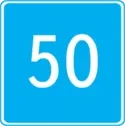
Answer help
5.30. "Recommended speed". The zone of action of the sign extends to the nearest intersection. -
Question #4 Which of these road signs give priority in traffic?
Topic: Road signs (Appendix 1)
Answer help
1.22. "Intersection with a secondary road".
1.23.1—1.23.4. "Junction of a secondary road". Sign 1.23.1 — junction on the right side, 1.23.2 — on the left, 1.23.3 — on the right and left, 1.23.4 — on the left and right side. -
Question #5 In which directions is the movement of a truck with a permissible maximum mass of less than 3.5 tons allowed?
Topic: Road signs (Appendix 1)
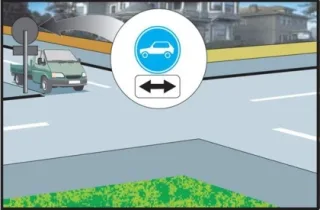
Answer help
4.11. "Movement of passenger cars". Only passenger cars, buses, motorcycles, route vehicles and trucks whose permitted maximum mass does not exceed 3.5 tons are allowed to move.
7.3.1.—7.3.3. "Direction of action". They show the directions of action of signs located before the intersection, or directions of movement to designated objects located directly near the road. -
Question #6 Which road sign can this road marking be used with?
Topic: Road markings (Appendix 2)

Answer help
1.10. — indicates places where parking is prohibited. It is used independently or in combination with sign 3.35 and is applied at the edge of the carriageway or along the top of the curb; -
Question #7 According to the State Standard of Ukraine, what does a round road sign with a white background, black border, and black diagonal stripes mean?
Topic: Road signs (Appendix 1)
Answer help
3.42. "End of all prohibitions and restrictions". Simultaneously determines the end of the effect of all prohibitions and restrictions introduced by prohibitory road signs 3.20, 3.25, 3.27, 3.29,
3.33—3.37 -
Question #8 The driver of the red car:
Topic: Traffic regulation
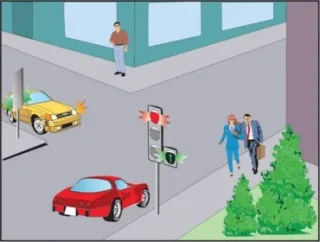
Answer help
8.7.3. Traffic light signals have the following meanings:
e) a red signal, including flashing, or two red flashing signals prohibit movement. A signal in the form of a green arrow (arrows) in an additional section (additional sections)
16.9. When moving in the direction of the arrow included in the additional section simultaneously with a yellow or red traffic light signal, the driver must give way to vehicles moving from other directions. When moving in the direction of a green arrow on a plate installed at the level of the red traffic light signal with vertical arrangement of signals, the driver must take the extreme right (left) lane and give way to vehicles and pedestrians moving from other directions. -
Question #9 If it is necessary to turn on the hazard warning lights in a populated area, but they are faulty, is it necessary to put out a warning triangle or a flashing red light?
Topic: Warning signals
Answer help
9.11. If the vehicle is not equipped with hazard warning lights or they are faulty, it is necessary to set up an emergency stop sign or a flashing red lantern:
a) at the rear of the vehicle specified in paragraph 9.9 ("c", "d", "e") of these Rules;
b) on the side of worse visibility for other road users in the case specified in subparagraph "b" of paragraph 9.10 of these Rules. -
Question #10 Which vehicle's driver is allowed to drive in reverse?
Topic: Starting movement and changing its direction
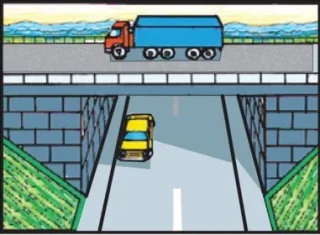
Answer help
10.10. It is prohibited to move vehicles in reverse on motorways, roads for cars, railway crossings, pedestrian crossings, intersections, bridges,
viaducts, overpasses, in tunnels, at entrances and exits from them, as well as on road sections with limited visibility or insufficient visibility.
It is allowed to move in reverse on roads with one-way traffic, provided that the requirements of paragraph 10.9 of these Rules are met and it is impossible to approach the object in another way. -
Question #11 Is it allowed to carry passengers when towing with a flexible or rigid coupling in the towed motor vehicle?
Topic: Towing and operation of vehicle combinations
Answer help
23.9. During towing on a rigid or flexible coupling, it is prohibited to carry passengers in the towed vehicle (except for a passenger car) and in the body of the towing truck, and in the case of towing by partial loading of this vehicle onto a platform or special support device — in all vehicles (except for the cab of the towing vehicle). -
Question #12 What is prohibited on highways for drivers of trucks whose permissible maximum mass is less than 3.5 tons?
Topic: Movement on highways and roads for cars
Answer help
27.2. On motorways and roads for cars, it is prohibited:
e) driving in reverse; -
Question #13 To prevent a collision with a vehicle moving ahead, the driver must:
Topic: Distance, interval, oncoming passing
Answer help
13.1. The driver, depending on the speed of movement, road conditions, characteristics of the transported cargo and the condition of the vehicle, must maintain a safe distance and a safe interval. -
Question #14 Give a complete answer: what must the driver make sure of before starting to overtake?
Topic: Overtaking
Answer help
14.2. Before starting to overtake, the driver must make sure that:
a) none of the drivers of vehicles moving behind him and who may be obstructed has started overtaking;
b) the driver of the vehicle moving ahead in the same lane has not given a signal of intention to turn (change lanes) to the left;
c) the lane of oncoming traffic, into which he will drive out, is free from vehicles at a sufficient distance for overtaking;
d) after overtaking, he will be able, without creating an obstacle to the vehicle being overtaken, to return to the occupied lane. -
Question #15 Stopping a vehicle is allowed from the sidewalk (edge of the roadway) at a distance of:
Topic: Stopping and parking
Answer help
15.2. In the absence of specially designated places or a roadside, or if stopping or parking there is impossible, they are allowed at the right edge of the carriageway (as far to the right as possible so as not to obstruct other road users). -
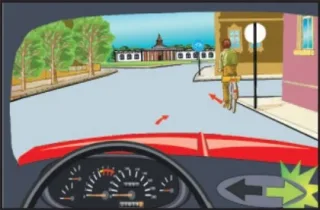
Question #16 Turning right, the driver of the car:
Topic: Passing intersections
Answer help
16.2. At controlled and uncontrolled intersections, the driver, turning right or left, must give way to pedestrians crossing the carriageway onto which he is turning, as well as to cyclists moving straight in the same direction. -
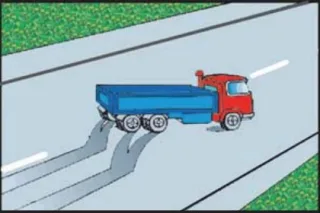
Question #17 What should the driver do to stop the beginning skid of the rear axle of a rear-wheel-drive car?
Topic: Organization and safety of traffic
-
Question #18 Under which of the listed conditions is the operation of vehicles prohibited? Give a complete answer.
Topic: Technical condition of vehicles and their equipment
Answer help
31.4.7. Other structural elements:
и) the motorcycle lacks the safety arcs provided for by the design; -
Question #19 When driving in tunnels, the traffic rules oblige the driver of a motor vehicle to:
Topic: Use of external lighting devices
Answer help
19.1. At night and in conditions of insufficient visibility, regardless of the degree of road lighting, as well as in tunnels, the following lighting devices must be switched on on a moving vehicle:
a) on all mechanical vehicles — low beam (high beam) headlights;
b) on mopeds (bicycles) and horse-drawn carts (sledges) — headlights or lanterns;
c) on trailers and towed vehicles — side marker lights.
Note.
In conditions of insufficient visibility, on mechanical vehicles it is permitted to switch on fog lights instead of low beam (high beam) headlights. -
Question #20 The driver of a wheeled tractor crosses an intersection, leaving a dirt road onto an asphalt one. He must:
Topic: Passing intersections
Answer help
16.11. At an intersection of unequal roads, the driver of a vehicle moving on a secondary road must give way to vehicles approaching this intersection of carriageways on the main road, regardless of the direction of their further movement.
main road — a road with a surface relative to an unpaved road or marked with signs 1.22, 1.23.1—1.23.4 and 2.3. The presence of a surface on a secondary road immediately before the intersection does not equate it in importance to the road being crossed;