
Practice: ticket #13
Answers are checked instantly. The hint — a rules excerpt — is under the question.
-
Question #1 Which of the listed issues, in accordance with the requirements of the Traffic Rules, are subject to coordination with the State Automobile Inspectorate?
Topic: Individual traffic rules issues requiring coordination with the State Automobile Inspection
Answer help
32.1. The following are coordinated with the State Automobile Inspection bodies:
e) technical requirements, design and installation on vehicles of special sound and light signaling devices (such as "Siren", flashing beacon, etc.), light -
Question #2 Organized groups of children are allowed to be led only along sidewalks and pedestrian paths, and if they are absent, along the side of the road:
Topic: Duties and rights of pedestrians
Answer help
4.6. Organized groups of children are allowed to be led only on sidewalks and pedestrian paths, and if they are absent — on the roadside of the road in the direction of movement of vehicles in a column, but only in daylight and only accompanied by adults. -
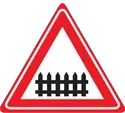
Question #3 What information is contained in this road sign?
Topic: Road signs (Appendix 1)
Answer help
1.27. "Railway crossing with a barrier." -
Question #4 Which of these road signs allows the movement of a truck with a total actual mass of 6 tons?
Topic: Road signs (Appendix 1)
Answer help
3.3. "Movement of trucks is prohibited." It is prohibited to move trucks and combinations of vehicles with a permissible maximum mass exceeding 3.5 t (if the mass is not indicated on the sign) or exceeding that indicated on the sign, as well as tractors, self-propelled machines and mechanisms.
3.15. "Movement of vehicles whose mass exceeds ...t, is prohibited." It is prohibited to move vehicles, including their combinations, whose total actual mass exceeds that indicated on the sign. -
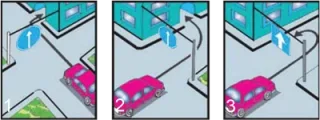
Question #5 In which figure did the driver perform the maneuver without violating the requirements of the Traffic Rules?
Topic: Road signs (Appendix 1)
Answer help
4.1. "Move straight ahead."
Signs 4.3, 4.5 and 4.6 also allow U-turn of vehicles. The effect of signs 4.1-4.6 does not apply to vehicles moving on established routes.
The effect of signs 4.1-4.6 applies to the intersection of carriageways in front of which they are installed. The effect of sign 4.1, installed at the beginning of the road or after an intersection, applies to the road section up to the nearest intersection. The sign does not prohibit turning right into courtyards and other territories adjacent to the road.
5.5. "Road with one-way traffic." A road or separated carriageway along which vehicle traffic across its entire width is carried out in only one direction. -
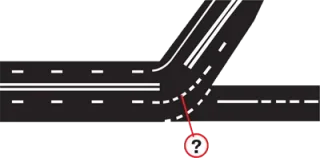
Question #6 What information is contained in this road marking?
Topic: Road markings (Appendix 2)
Answer help
1.7. (broken line with short strokes and equal intervals) — indicates traffic lanes, as well as the direction of the main road within the intersection; -
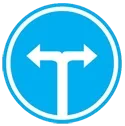
Question #7 What does this road sign mean?
Topic: Road signs (Appendix 1)
Answer help
4.6. "Move right or left." Movement only in the directions indicated by arrows on signs 4.1-4.6
Signs 4.3, 4.5 and 4.6 also allow U-turn of vehicles. The effect of signs 4.1-4.6 does not apply to vehicles moving on established routes.
The effect of signs 4.1-4.6 applies to the intersection of carriageways in front of which they are installed. The effect of sign 4.1, installed at the beginning of the road or after an intersection, applies to the road section up to the nearest intersection. The sign does not prohibit turning right into courtyards and other territories adjacent to the road. -
Question #8 Vehicles must move in a column:
Topic: Movement of vehicles in columns
Answer help
25.2. Vehicles must move in a column only in one row as close as possible to the right edge of the carriageway, except when they are accompanied by operational vehicles. -
Question #9 In the event of a forced stop in a place where stopping is prohibited, and if it is impossible to remove the vehicle from this place with limited visibility of the road in at least one direction less than 100 m, the driver must:
Topic: Warning signals
Answer help
9.9. Hazard warning lights must be turned on:
a) in the event of a forced stop on the road;
9.10. Together with turning on the hazard warning lights, a warning triangle or a flashing red lantern should be placed at a distance ensuring road safety, but not closer than 20 m to the vehicle in built-up areas and 40 m outside them, in the case of:
b) a forced stop in places with limited visibility of the road in at least one direction of less than 100 m.
15.14. In the event of a forced stop in a place where stopping is prohibited, the driver must take all measures to remove the vehicle, and if it is impossible to do so — act in accordance with the requirements of paragraphs 9.9-9.11 of these Rules. -
Question #10 U-turn is prohibited:
Topic: Starting movement and changing its direction
Answer help
10.7. U-turn is prohibited:
d) when visibility of the road is less than 100 m in at least one direction; -
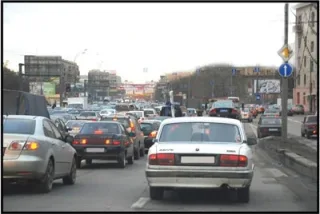
Question #11 In heavy traffic, is it allowed to change lanes in which you are moving?
Topic: Position of vehicles on the road
Answer help
11.11. In heavy traffic, changing lanes is allowed only to bypass an obstacle, turn, make a U-turn, or stop. -
Question #12 What is the maximum speed allowed for trucks with a permissible maximum mass of more than 3.5 tons on motorways?
Topic: Speed of movement
Answer help
12.6. Outside built-up areas on all roads and on roads passing through built-up areas marked with sign 5.47, movement is allowed at a speed:
d) for other vehicles: on a highway marked with road sign 5.1 — not more than 130 km/h, on a highway with separate carriageways, -
Question #13 What safe distance between moving vehicles should the driver choose?
Topic: Distance, interval, oncoming passing
Answer help
13.1. The driver, depending on the speed of movement, road conditions, characteristics of the cargo being transported and the condition of the vehicle, must maintain a safe distance and a safe interval. -
Question #14 Overtaking non-rail vehicles is allowed:
Topic: Overtaking
Answer help
14.1. Overtaking of non-rail vehicles is permitted only on the left. -
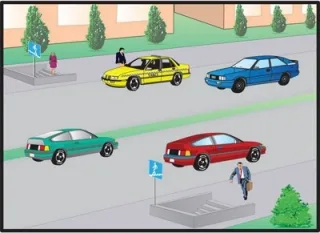
Question #15 If the road has a boulevard or a dividing strip, are stopping and parking of vehicles near them allowed?
Topic: Stopping and parking
Answer help
15.3. In populated areas, stopping and parking of vehicles are allowed on the left side of the road that has one lane for traffic in each direction (without tram tracks in the middle) and is not divided by marking 1.1, as well as on the left side of a one-way road. If the road has a boulevard or a dividing strip, stopping and parking of vehicles near them is prohibited. -
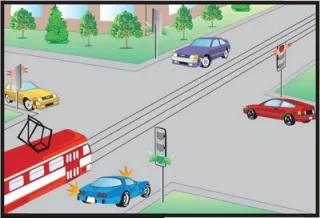
Question #16 When turning left or making a U-turn at a green signal of the main traffic light, the driver of a non-rail vehicle must give way to:
Topic: Passing intersections
Answer help
16.6. When turning left or making a U-turn at a green signal of the main traffic light, the driver of a non-rail vehicle must give way to a tram traveling in the same direction, as well as to vehicles moving in the opposite direction straight or turning right. Tram drivers must also be guided by this rule among themselves. -
Question #17 For an emergency stop on a dry road, it is necessary to:
Topic: Organization and safety of traffic
-
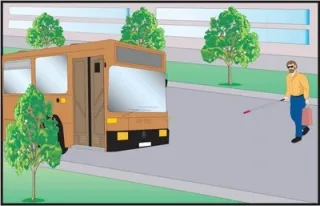
Question #18 Must drivers of route vehicles give way to blind pedestrians outside a pedestrian crossing who signal with a white cane pointed forward?
Topic: Passing pedestrian crossings and stops of vehicles
Answer help
18.5. In any place, the driver must let blind pedestrians pass who are signaling with a white cane pointed forward. -
Question #19 Which answer most accurately indicates the permitted method of towing on mountain roads?
Topic: Movement on mountain roads and steep descents
Answer help
28.3. On mountain roads, it is prohibited:
a) to move with the engine not running and with the clutch or gear disengaged;
b) to tow on a flexible coupling;
c) any towing during icy conditions. -
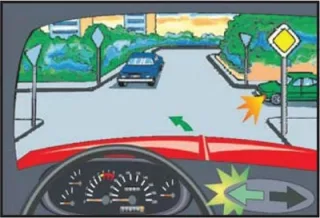
Question #20 The second will pass the intersection
Topic: Passing intersections
Answer help
16.11. At an intersection of unequal roads, the driver of a vehicle moving on a secondary road must give way to vehicles approaching this intersection of roadways on the main road, regardless of the direction of their further movement.
16.13. Before turning left and making a U-turn, the driver of a non-rail vehicle must give way to a tram traveling in the same direction, as well as to vehicles moving on an equal road in the opposite direction straight or to the right. Tram drivers must also be guided by this rule among themselves.