
Practice: ticket #12
Answers are checked instantly. The hint — a rules excerpt — is under the question.
-
Question #1 Transferring control of a vehicle to a person who does not have the right to drive entails:
Topic: Fundamentals of law
-
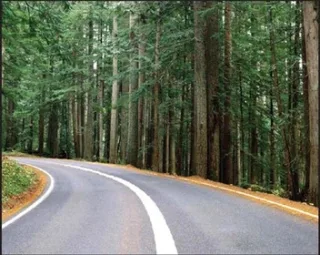
Question #2 Where should a pedestrian move outside a populated area?
Topic: Duties and rights of pedestrians
Answer help
4.1. Pedestrians must move along sidewalks and pedestrian paths, keeping to the right side. If there are no sidewalks, pedestrian paths, or it is impossible to move along them, pedestrians may move along bicycle paths, keeping to the right side and not obstructing bicycle and moped movement, or in one row along the shoulder, keeping as far to the right as possible, and in its absence or impossibility to move along it — along the edge of the roadway towards the movement of vehicles. In this case, one must be careful and not interfere with other road users.
4.3. Outside populated areas, pedestrians moving along the shoulder or edge of the roadway must walk towards the movement of vehicles. Persons moving along the shoulder or edge of the roadway in wheelchairs without an engine, leading a motorcycle, moped or bicycle, must move in the direction of vehicle movement. -
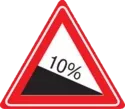
Question #3 A bus driver approaches a section of road in front of which this road sign is installed. What should the driver do to ensure road safety?
Topic: Movement on mountain roads and steep descents
Answer help
1.7. 'Steep descent'. Signs 1.6 and 1.7 warn of approaching an ascent or descent on which the requirements of section 28 of these Rules apply.
28.2. On mountain roads and steep descents, the driver of a truck whose permitted maximum mass exceeds 3.5 t, a tractor and a bus must:
b) during a stop or parking on ascents and descents, use anti-roll chocks. -
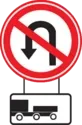
Question #4 This road sign with a plate:
Topic: Road signs (Appendix 1)
Answer help
7.5.1.—7.5.8. 'Type of vehicle'. Indicate the type of vehicle to which the sign applies. Plate 7.5.1 extends the effect of the sign to trucks (including with a trailer) with a permitted maximum mass exceeding 3.5 t; 7.5.3 — to passenger cars, as well as trucks with a permitted maximum mass up to 3.5 t. -
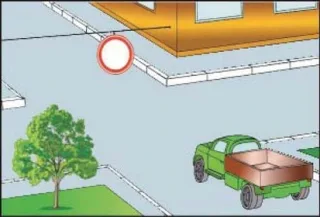
Question #5 The enterprise is located in the zone marked by the road sign. Does the effect of this road sign extend to the vehicle serving this enterprise?
Topic: Road signs (Appendix 1)
Answer help
3.1. 'Movement prohibited'. Movement of all vehicles is prohibited.
The effect of signs does not apply:
3.1, 3.2, 3.21—3.24, 3.34 — to vehicles moving on established routes;
3.1, 3.2, 3.35—3.38, as well as sign 3.34 with plate 7.18 under it — to drivers with disabilities driving a motorized wheelchair or a car marked with the identification sign 'Disabled';
3.1—3.8, 3.11 — to vehicles serving citizens or belonging to citizens who live or work in this zone, as well as to vehicles serving enterprises located in the designated zone. In such cases, vehicles must enter the designated zone and exit it at the nearest intersection to the destination;
3.3 — to trucks that have an inclined white stripe on the outer side surface or carry groups of people;
3.35—3.38 — to taxis with the taximeter turned on. -
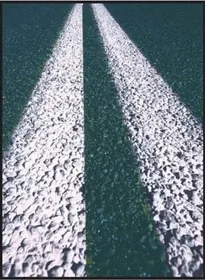
Question #6 How many lanes for traffic does a road have where traffic flows in opposite directions are separated by a double solid line?
Topic: Road markings (Appendix 2)
Answer help
1.3. — separates traffic flows of opposite directions on roads with four or more lanes; -
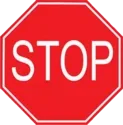
Question #7 What should a driver do when approaching an intersection where the traffic light is not working and this road sign is installed on the road before the intersection?
Topic: Road signs (Appendix 1)
Answer help
2.2. 'Proceeding without stopping prohibited'. Proceeding without stopping before marking 1.12 (stop line) is prohibited, and if it is absent — before the sign. -
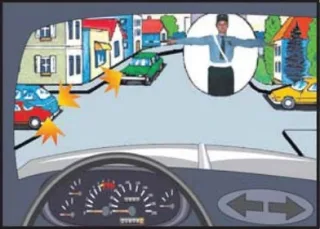
Question #8 Movement prohibited
Topic: Traffic regulation
Answer help
8.8. Traffic controller signals. The signals of the traffic controller are the positions of his body, as well as hand gestures, including with a baton or a disk with a red reflector, having the following meanings:
a) arms extended to the sides, lowered, or the right arm bent in front of the chest: from the left and right sides — tram movement straight is allowed, trackless vehicles — straight and -
Question #9 Give the most complete answer: must a driver always give a light signal with turn indicators?
Topic: Warning signals
Answer help
9.2. The driver must give signals with direction indicators of the corresponding direction:
a) before starting to move and stopping;
b) before changing lanes, turning, or making a U-turn.
9.4. It is necessary to give a signal with direction indicators or by hand in advance before the start of the maneuver (taking into account the speed of movement), but not less than 50-100 m in built-up areas and 150-200 m outside them, and stop immediately after its completion (the hand signal should be finished immediately before the start of the maneuver). It is prohibited to give a signal if it may be unclear to other road users.
Giving a warning signal does not give the driver an advantage and does not relieve him from taking precautionary measures. -
Question #10 When must a driver yield to pedestrians?
Topic: Starting movement and changing its direction
Answer help
10.2. When entering the road from a residential area, courtyards, parking areas, gas stations, and other adjacent territories, the driver must, before the carriageway or sidewalk, give way to pedestrians and vehicles moving along it, and when leaving the road — to cyclists and pedestrians whose direction of movement he is crossing. -
Question #11 On a road with two-way traffic having three lanes in each direction, which lane is allowed for driving straight for trucks with a permissible maximum mass up to 3.5 tons?
Topic: Position of vehicles on the road
Answer help
11.6. On roads with three or more lanes for traffic in one direction, trucks with a permissible maximum mass exceeding 3.5 t, tractors, self-propelled machines and mechanisms are allowed to enter the far left lane only for turning left and making a U-turn, and in built-up areas on roads with one-way traffic, in addition, for stopping on the left, in permitted cases, for loading or unloading. -
Question #12 At what maximum speed is it allowed to ride a bicycle or moped in a residential or pedestrian zone?
Topic: Speed of movement
Answer help
12.5. In residential and pedestrian zones, the speed of movement must not exceed 20 km/h. -
Question #13 If oncoming passage is difficult, the road must be yielded by:
Topic: Distance, interval, oncoming passing
Answer help
13.4. If oncoming passage is difficult, the driver on whose lane there is an obstacle or the dimensions of the vehicle he is driving interfere with oncoming traffic, must give way. On road sections marked with signs 1.6 "Steep ascent" and 1.7 "Steep descent", in the presence of an obstacle, the driver of the vehicle moving downhill must give way. -
Question #14 In which cases is overtaking allowed at an intersection?
Topic: Overtaking
Answer help
14.6. Overtaking is prohibited:
a) at an intersection; -
Question #15 Stopping and parking of vehicles are prohibited:
Topic: Stopping and parking
Answer help
15.9. Stopping is prohibited:
d) at intersections and closer than 10 m from the edge of the intersecting carriageway in the absence of a pedestrian crossing on them, except for stopping to give priority in traffic -
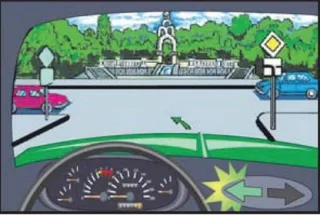
Question #16 Vehicles will pass the intersection in the following order:
Topic: Passing intersections
Answer help
16.11. At an intersection of unequal roads, the driver of a vehicle moving on a secondary road must give way to vehicles approaching this intersection of carriageways on the main road, regardless of the direction of their further movement. -
Question #17 Reducing the braking distance on a slippery road for a rear-wheel drive vehicle is achieved by:
Topic: Organization and safety of traffic
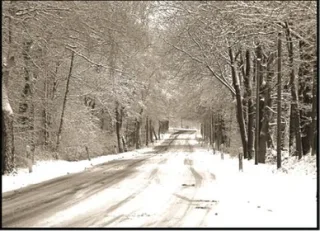
-
Question #18 Under which of the listed conditions is the operation of vehicles prohibited? Give a complete answer.
Topic: Technical condition of vehicles and their equipment
Answer help
31.4.3. External lighting devices:
d) tinting or coating is applied to the diffusers of lighting devices, which reduces their transparency or light transmission.
31.4.7. Other structural elements:
e) the bumper or rear protective device, mud flaps and splash guards provided by the design are missing; -
Question #19 Is it allowed to drive mechanical vehicles with high beam headlights on illuminated sections of the road at night?
Topic: Use of external lighting devices
Answer help
19.1. In the dark and in conditions of insufficient visibility, regardless of the degree of road lighting, as well as in tunnels, the following lighting devices must be turned on on a moving vehicle:
a) on all mechanical vehicles — low beam (high beam) headlights;
b) on mopeds (bicycles) and horse-drawn carts (sledges) — headlights or lanterns;
c) on trailers and towed vehicles — side lights.
Note.
In conditions of insufficient visibility, on mechanical vehicles it is allowed to turn on fog lights instead of low beam (high beam) headlights. -
Question #20 This road sign:
Topic: Road signs (Appendix 1)
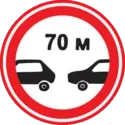
Answer help
3.20. "Movement of vehicles without maintaining a distance ...m, is prohibited." It is prohibited to move vehicles with a distance between them less than that indicated on the sign.