
Practice: ticket #11
Answers are checked instantly. The hint — a rules excerpt — is under the question.
-
Question #1 Entering a railway crossing by drivers on a prohibiting traffic light signal with a closed barrier entails:
Topic: Fundamentals of law
-
Question #2 Does an activated flashing beacon of orange color give an advantage in traffic?
Topic: Movement of vehicles with special signals
Answer help
3.6. Turning on an orange flashing beacon on mechanical vehicles of the road maintenance service while performing work on the road, on large and heavy vehicles does not give them an advantage in movement, but serves to attract attention and warn of danger. In this case, drivers of road maintenance service vehicles while performing work on the road are allowed to deviate from the requirements of road signs (except priority signs and signs 3.21—3.23), road markings, as well as points 11.2, 11.5—11.10, 11.12, 11.13, subparagraphs 'b', 'v', 'g' of point 26.2 of these Rules, provided that road safety is ensured.
Drivers of other vehicles must not obstruct their work. -
Question #3 What information is contained in this road sign?
Topic: Road signs (Appendix 1)
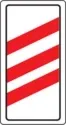
Answer help
1.31.1—1.31.6. 'Approach to a railway crossing'. Additional warning of approaching a railway crossing outside populated areas.
Warning signs, except signs 1.4.1—1.4.3, 1.29—1.31.6, are installed outside populated areas at a distance of 150—300 m, in populated areas — at a distance of 50—100 m before the beginning of the dangerous section. If necessary, signs are installed at a different distance, which is indicated on plate 7.1.1 -
Question #4 Do the requirements of these road signs differ from each other?
Topic: Road signs (Appendix 1)
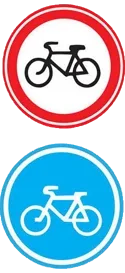
Answer help
3.8. 'Bicycle movement prohibited'.
4.12. 'Bicycle path'. Movement only on bicycles and mopeds. If there is no sidewalk or pedestrian path, pedestrian movement is also allowed. -
Question #5 On which path is movement allowed?
Topic: Road signs (Appendix 1)
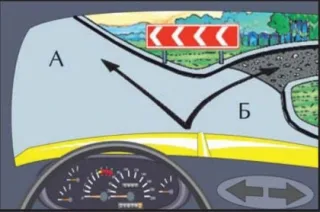
Answer help
1.4.1-1.4.3. 'Direction of turn'. Signs (1.4.1 — movement to the right, 1.4.2 — movement to the left) show the direction of the turn of the road indicated by signs 1.1 and 1.2, the direction of bypassing an obstacle on the road, and sign 1.4.1, in addition, — the direction of bypassing the center of an intersection with circular traffic; sign 1.4.3 (movement to the right or left) shows the direction of movement at T-shaped intersections, road forks, or bypassing a repaired road section. -
Question #6 In which of the listed cases is it allowed to cross a solid line of road marking separating traffic flows of opposite directions?
Topic: Road markings (Appendix 2)
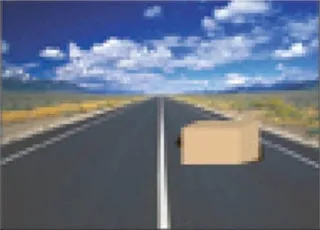
Answer help
1.1. (narrow solid line) — separates traffic flows of opposite directions and marks the boundaries of traffic lanes on roads; marks the boundaries of the roadway, entry onto which is prohibited; marks the boundaries of parking places for vehicles and the edge of the roadway of roads not classified by traffic conditions as motorways;
Lines 1.1 and 1.3 are prohibited to cross. If line 1.1 marks a parking place or the edge of the roadway adjacent to the shoulder, crossing this line is allowed.
As an exception, provided that road safety is ensured, it is allowed to cross line 1.1 to bypass a stationary obstacle whose dimensions do not allow its safe bypass without crossing this line, as well as to overtake single vehicles moving at a speed of less than 30 km/h. -
Question #7 What information is contained in this road sign?
Topic: Road signs (Appendix 1)
Answer help
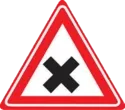
1.21. 'Intersection of equivalent roads'. -
Question #8 Which vehicles are allowed to turn right?
Topic: Traffic regulation
Answer help
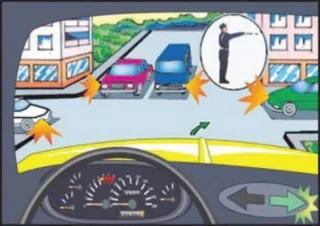
8.8. Traffic controller signals. Traffic controller signals are the positions of his body, as well as hand gestures, including with a baton or a disk with a red reflector, having the following meanings:
b) right arm extended forward: from the left side — tram movement to the left is allowed, non-rail vehicles — in all directions; pedestrians are allowed to cross -
Question #9 Is it allowed to use high beam headlights as a warning signal when overtaking?
Topic: Warning signals
Answer help
9.6. To attract the attention of the driver of the vehicle being overtaken, headlight switching can be used, and outside populated areas, also a sound signal.
9.7. It is prohibited to use high beam headlights as a warning signal in conditions where this could lead to blinding other drivers, including through the rearview mirror. -
Question #10 In which of the listed cases is a U-turn from the right edge of the roadway allowed?
Topic: Starting movement and changing its direction
Answer help
10.6. If a vehicle, due to its dimensions or for other reasons, cannot perform a turn or U-turn from the corresponding extreme position, it is allowed to deviate from the requirements of point 10.4 of these Rules, if this does not contradict the requirements of prohibitory or mandatory road signs, road markings, and does not create danger or obstacles to other road users. If necessary, to ensure road safety, one should seek help from other persons. -
Question #11 In which directions is movement of cars allowed?
Topic: Position of vehicles on the road
Answer help
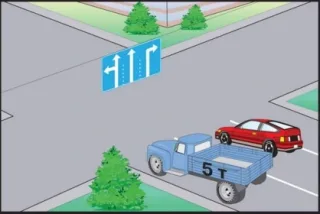
11.6. On roads with three or more lanes for movement in one direction, trucks with a permitted maximum mass exceeding 3.5 t, tractors, self-propelled machines and mechanisms are allowed to enter the extreme left lane only for turning left and making a U-turn, and in populated areas on roads with one-way traffic, in addition, for stopping on the left, in permitted cases, for loading or unloading. -
Question #12 What is prohibited in the residential zone of a populated area?
Topic: Speed of movement
Answer help
12.5. In residential and pedestrian zones, the speed of movement must not exceed 20 km/h. -
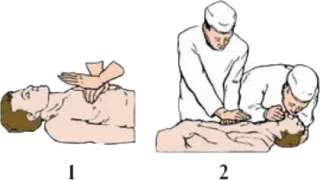
Question #13 In which figure is the method of restoring breathing and blood circulation in a victim correctly shown?
Topic: Fundamentals of providing medical assistance in case of a traffic accident
-
Question #14 The coupon about passing technical inspection:
Topic: Number plates, identification signs, inscriptions and markings
Answer help
30.2. On mechanical vehicles (except trams and trolleybuses) and trailers, license plates of the appropriate type are installed in the places provided for this, and a technical inspection coupon is attached in the lower right corner of the front windshield of the vehicle. On trams and trolleybuses, registration numbers assigned by the relevant authorized bodies are applied. By decision of the Council of Ministers of the Autonomous Republic of Crimea, local executive authorities or local self-government bodies, registration of mopeds, bicycles and horse-drawn transport may be carried out. It is prohibited to change the dimensions, shape, markings, color and placement of license plates, apply additional markings to them or cover them; they must be clean and sufficiently illuminated. -
Question #15 Are stopping or parking of vehicles at the right edge of the roadway allowed if there is a roadside on the road?
Topic: Stopping and parking
Answer help
15.2. In the absence of specially designated places or a shoulder, or if stopping or parking there is impossible, they are allowed at the right edge of the roadway (as far to the right as possible so as not to obstruct other road users). -
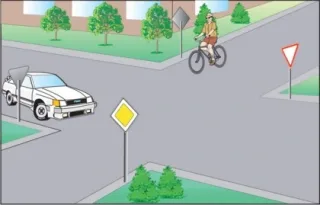
Question #16 A driver of a car, in front of which a road sign 'Give way' is installed, and a cyclist are approaching an uncontrolled intersection. Who has the advantage in movement?
Topic: Passing intersections
Answer help
16.11. At an intersection of unequal roads, the driver of a vehicle moving on a secondary road must give way to vehicles approaching this intersection of roadways on the main road, regardless of the direction of their further movement. -
Question #17 Shifting the center of gravity upward when loading a truck:
Topic: Organization and safety of traffic
-
Question #18 Is it allowed to proceed to the place of parking or repair in the dark, as well as in conditions of insufficient visibility with non-burning rear side lights?
Topic: Technical condition of vehicles and their equipment
Answer help
31.6. Further movement of vehicles is prohibited if:
b) in the dark or in conditions -
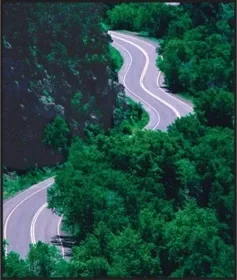
Question #19 Must drivers of a bus and a tractor use wheel chocks when stopping or parking on ascents and descents?
Topic: Movement on mountain roads and steep descents
Answer help
28.2. On mountain roads and steep descents, the driver of a truck whose permitted maximum mass exceeds 3.5 t, a tractor and a bus must:
b) during a stop or parking on ascents and descents, use anti-roll chocks. -
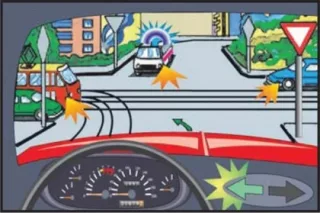
Question #20 The blue car will pass the intersection:
Topic: Passing intersections
Answer help
16.11. At an intersection of unequal roads, the driver of a vehicle moving on a secondary road must give way to vehicles approaching this intersection of roadways on the main road, regardless of the direction of their further movement.
16.13. Before turning left and making a U-turn, the driver of a non-rail vehicle must give way to a tram in the same direction, as well as to vehicles moving on an equivalent road in the opposite direction straight or to the right. Tram drivers must also be guided by this rule among themselves.