Road markings of Ukraine
ROAD MARKINGS (Annex 2)
1. Horizontal markings
Horizontal marking lines are white. Yellow lines are 1.4, 1.10, 1.17, as well as 1.2 if they mark the boundaries of the lane for route vehicles.
Horizontal markings have the following meaning:
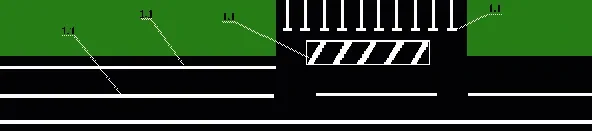
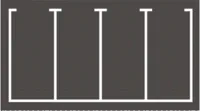

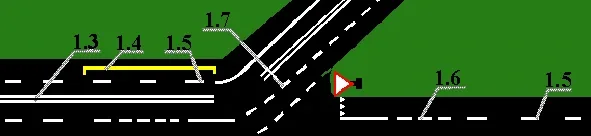
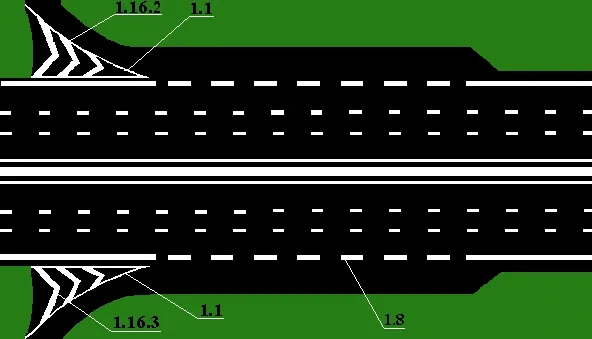
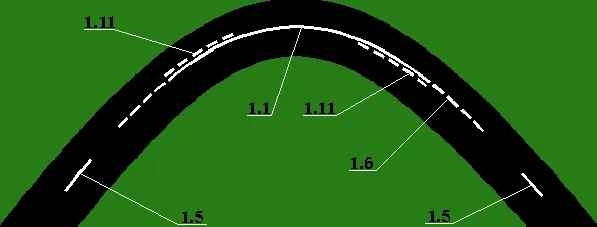
1.1 narrow solid line - separates traffic flows of opposite directions and marks the boundaries of traffic lanes on roads; marks the boundaries of the carriageway, onto which entry is prohibited; marks the boundaries of vehicle parking areas and near the carriageway of roads not classified as motorways by traffic conditions;
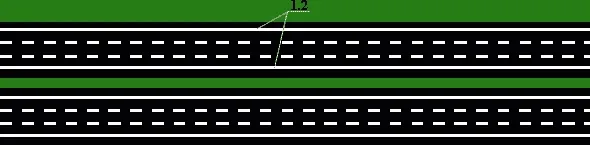

1.2 wide solid line - marks the boundary of the carriageway on motorways or the boundary of the lane for route vehicles. In places where entry into the lane for route vehicles is allowed for other vehicles, this line may be broken;

1.3 - separates traffic flows of opposite directions on roads that have four or more lanes;

1.4 - marks places where stopping and parking of vehicles is prohibited. Used independently or in combination with the sign
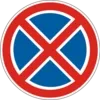
3.34
(see Road signs)
and is applied near the edge of the carriageway or along the top of the curb;

1.5 - separates traffic flows of opposite directions on roads that have two or three lanes; marks the boundaries of traffic lanes when there are two or more lanes intended for traffic in one direction;

1.6 (approach line - a broken line in which the length of the strokes is three times the gaps between them) - warns of approaching marking 1.1 or 1.11, which separates traffic flows of opposite or same directions;

1.7 (broken line with short strokes and equal gaps) - marks traffic lanes, as well as the direction of the main road within the intersection;

1.8 (wide broken line) - marks the boundary between the acceleration or deceleration lane and the main lane of the carriageway (at intersections, road crossings at different levels, in the area of bus stops, etc.);
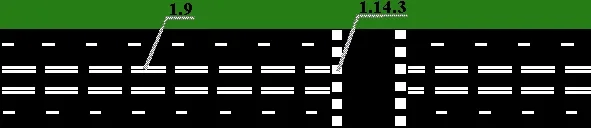
1.9 - marks the boundaries of traffic lanes on which reversible regulation is carried out; separates traffic flows of opposite directions (when reversible traffic lights are off) on roads where reversible regulation is carried out;

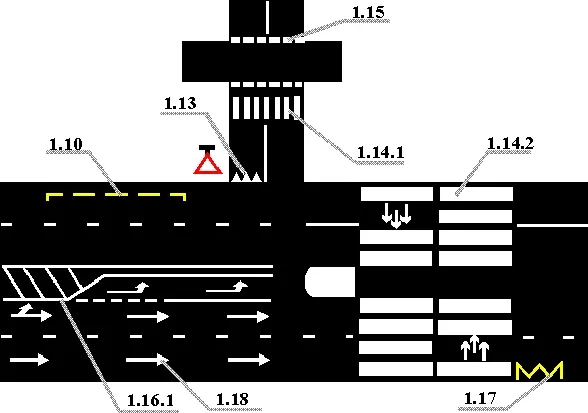
1.10 - marks places where parking is prohibited. Used independently or in combination with the sign
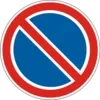
3.35(see Road signs)
and is applied near the edge of the carriageway or along the top of the curb;

1.11 - separates traffic flows of opposite or same directions on road sections where lane changing is allowed only from one lane; marks places intended for turning around, entering and exiting parking areas, etc., where traffic is allowed only in one direction;

1.12 (stop line) - indicates the place where the driver must stop when there is a sign
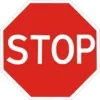
2.2(see Road signs)
or by a traffic light or traffic controller signal that prohibits movement;

1.13 - indicates the place where the driver must, if necessary, stop and give way to vehicles moving on the intersecting road;
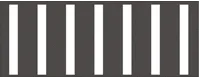
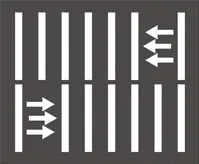
1.14.1, 1.14.2 ("zebra") - marks an uncontrolled pedestrian crossing; arrows of marking 1.14.2 indicate the direction of movement for pedestrians;

1.14.3 - marks a pedestrian crossing where traffic is regulated by a traffic light;
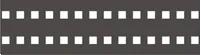
1.15 - marks the place where a bicycle path crosses the carriageway;



1.16.1-1.16.3 - marks guide islands in places of division, branching or merging of traffic flows;

1.17 - marks stops of route vehicles and taxis;

1.18 - indicates the permitted directions of movement along lanes at an intersection. Used independently or in combination with signs
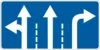
5.16
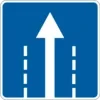
5.18(see Road signs)
marking with a dead end image is applied to indicate that turning onto the nearest carriageway is prohibited; marking that allows turning left from the far left lane also allows a U-turn;
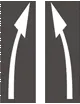
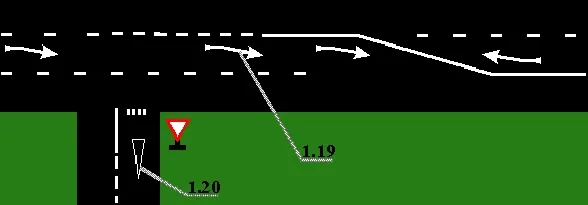
1.19 - warns of approaching a narrowing of the carriageway (a section where the number of traffic lanes in this direction decreases) or to a marking line 1.1 or 1.11, which separates traffic flows of opposite directions. In the first case, it may be used in combination with signs
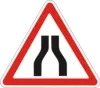
1.5.1
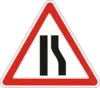
1.5.2
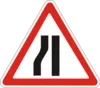
1.5.3(see Road signs);

1.20 - warns of approaching marking 1.13;

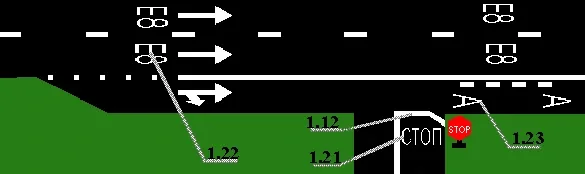
1.21 (inscription "STOP") - warns of approaching marking 1.12, if it is used in combination with the sign
2.2(see Road signs)

1.22 - indicates the road number (route);

1.23 - marks the lane intended for movement of route vehicles only.
Lines 1.1 and 1.3 are prohibited to cross. If line 1.1 marks a parking place or near
the roadway, adjacent to the shoulder, this line is allowed to cross.
As an exception, provided traffic safety is ensured, it is allowed to cross line 1.1 to bypass a stationary obstacle, whose dimensions do not allow safe bypass without crossing this line, as well as overtaking single vehicles moving at a speed of less than 30 km/h.
Line 1.2 is allowed to cross in case of forced stop, if this line marks near the roadway, adjacent to the shoulder.
Lines 1.5-1.8 are allowed to cross from any side.
On the road section between reversible traffic lights, line 1.9 is allowed to cross if it is located on the right side of the driver.
When green signals are on in reversible traffic lights, line 1.9 is allowed to cross from any side, if it separates lanes along which traffic is allowed in one direction. In case of switching off reversible traffic lights, the driver must immediately move to the right side behind the marking line 1.9.
Line 1.9, located on the left side, is prohibited to cross when reversible traffic lights are off. Line 1.11 is allowed to cross only from its broken side, and from the solid side - only upon completion of overtaking or bypassing an obstacle.
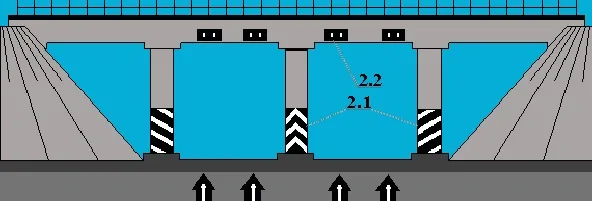
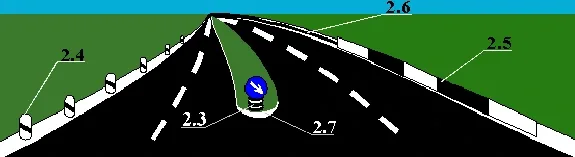
2. Vertical marking
Vertical marking indicates:
2.1 - elements of road structures (bridge supports, overpasses, end parts of parapets, etc.);
2.2 - lower part near the span structure of tunnels, bridges and overpasses;
2.3 - round bollards installed on dividing strips or safety islands;
2.4 - guide posts, bollards, guardrail resistances, etc.;
2.5 - side surfaces of road barriers on small radius curves, steep descents, other dangerous sections;
2.6 - side surfaces of barriers on other sections;
2.7 - curbs on dangerous sections and raised safety islands.